
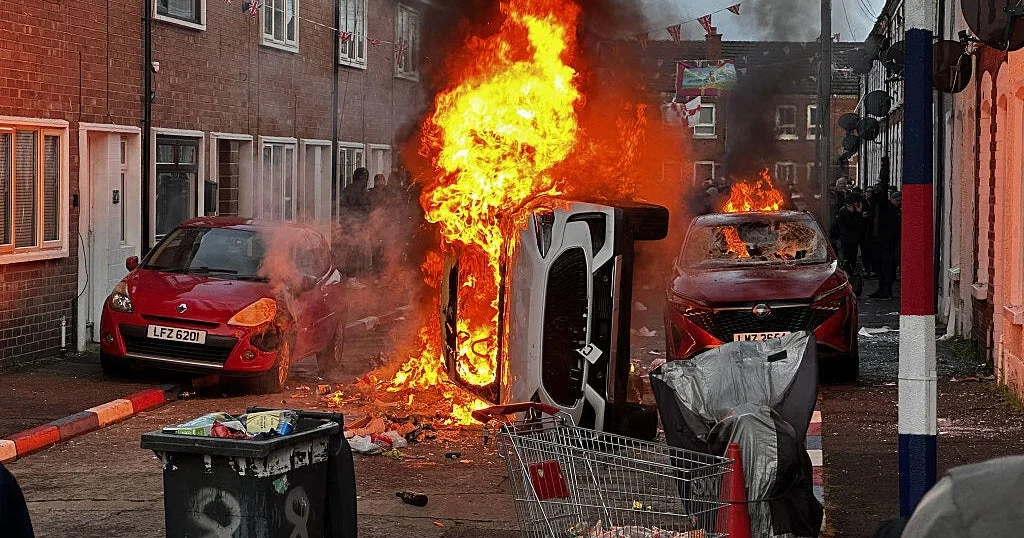
Violent anti-immigration protests broke out across several areas of Belfast on the evening of June 9, 2026, after a brutal stabbing attack the previous night sparked outrage. Masked demonstrators set fire to vehicles, homes, and trash bins amid calls on social media for mass street protests, despite police and political leaders urging calm.
What Happened
A graphic video circulated online showing a man being stabbed multiple times in the head and neck during a violent assault. Northern Ireland police detained and charged a Sudanese man in his 30s, who had entered the UK on an asylum application and was granted a five-year visa in 2023. He faces charges of attempted murder, possession of a knife in a public place, and making threats to kill. The victim sustained serious injuries and was hospitalized.
Following the stabbing, far-right activists and some political figures shared the video, inciting protests targeting immigrant communities. Dozens of masked individuals marched through parts of Belfast, setting fires, smashing windows, and shouting anti-immigrant slogans. Firefighters responded to numerous incidents as families fled burning homes.
Key Facts
- The accused is a Sudanese asylum seeker with a valid UK visa granted in 2023.
- The stabbing victim suffered severe injuries and was taken to hospital.
- Numerous fires were set by protesters, including to a bus and residential properties.
- Social media was used by far-right figures to organize and incite protests.
- Police and political leaders condemned the violence and urged calm.
- The stabbing is not confirmed to be terror-related; an investigation into motives continues.
Why It Matters
The unrest highlights deep societal tensions in Northern Ireland related to immigration, community relations, and security concerns. The violent response to an individual crime risks exacerbating ethnic divisions in a region with a complex history of sectarian conflict. The involvement of high-profile far-right individuals in amplifying unrest online raises concerns about the role of digital platforms in fueling real-world violence.
Background
Northern Ireland remains a semi-autonomous UK region with a history of sectarian conflict and political complexity. Recent years have seen rising immigration tensions, especially in working-class neighborhoods facing housing shortages and public service pressures. Far-right groups have increasingly used social media to stir anti-immigrant sentiment amid broader debates over policing and community safety.
Analysis
The rapid mobilization following the stabbing reveals how social media can amplify isolated crimes into wider social conflicts. The cordoning of community identities around immigration is reinforcing divisions in Belfast’s mixed neighborhoods. Calls for a “sensible immigration policy” by some protest participants indicate frustrations beyond the immediate incident, tied to economic pressures and political representation. The response from civic leaders underscores the challenge of balancing security, justice, and community cohesion.
Who Is Affected
Immigrant communities, particularly in northern Belfast, have faced direct violence and intimidation during the protests. Local residents fearful of escalation and displacement are also impacted. The broader public and authorities confront a renewed challenge to peace and safety in a region still sensitive to political and ethnic unrest.
Reactions / Official Statements
Northern Ireland First Minister Michelle O’Neill condemned the scenes as “outright thuggery,” denouncing the burning of homes. Local lawmaker Claire Hanna described the protests as “a race-based pogrom” fueled by online agitation from figures including Nigel Farage and Tommy Robinson. British Prime Minister Keir Starmer called the attack “horrific” and expressed zero tolerance for street violence. Police confirmed the ongoing investigation but found no current evidence suggesting terror-related motives.
What Remains Unclear
The exact motive behind the stabbing remains under investigation. This information was not confirmed in the reviewed sources. It is also unclear how widespread the coordination of protests was beyond calls on social media.
What Comes Next
The accused is scheduled for a court appearance on June 10 to face charges. Authorities are expected to maintain a heightened security presence to prevent further unrest. Political and community leaders face pressure to address underlying social grievances and to foster dialogue aimed at restoring peace and trust. Ongoing investigations will also seek to clarify motive and prevent similar incidents.
Sources
This article is based on reporting and publicly available information from the following source:
Read more World News stories on Goka World News.