
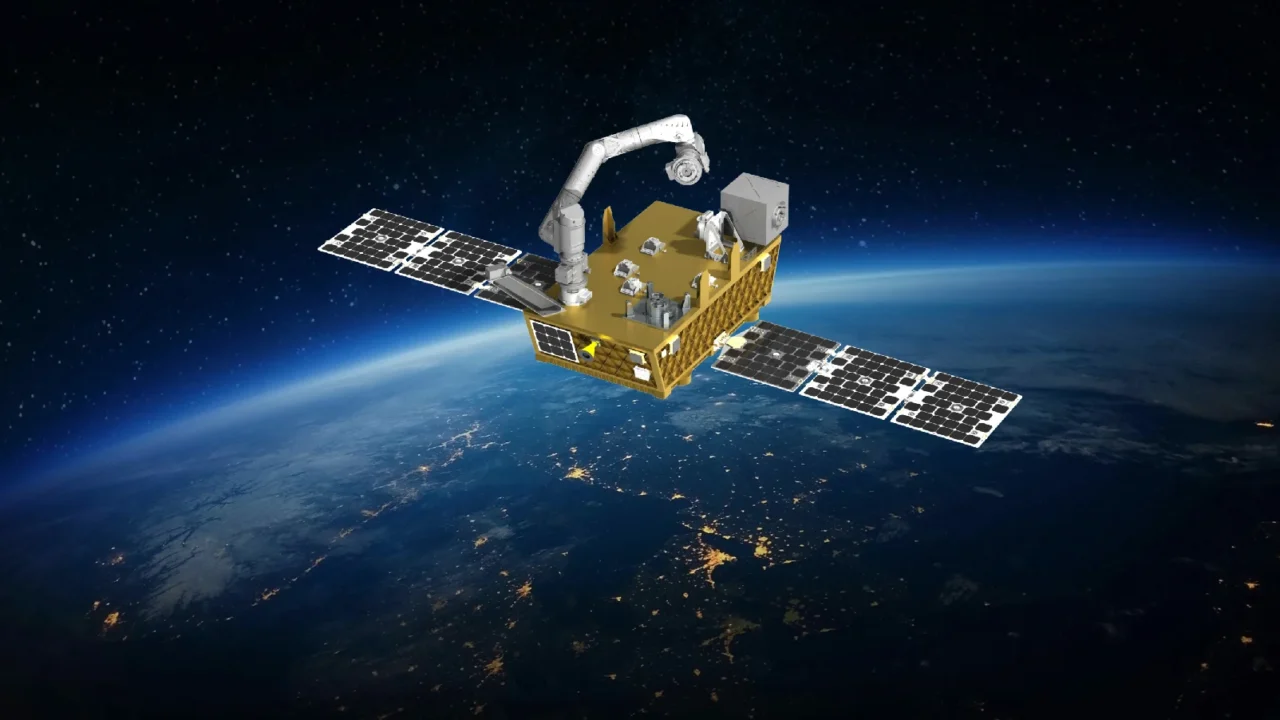
NASA’s innovative AstroPix gamma-ray sensor technology is set to be demonstrated aboard the upcoming Fly Foundational Robots mission, scheduled for launch in late 2027. This mission will showcase AstroPix’s ability to measure gamma rays using advanced detectors operated via a robotic arm system.
What Happened
The Fly Foundational Robots mission will carry the AstroPix Satellite Technology dEmonstration Payload (A-STEP) in its Orbital Replacement Unit, a movable module outfitted with silicon pixel gamma-ray detectors. The spacecraft, provided by Astro Digital, will operate alongside a robotic arm supplied by Rocket Lab Robotics to reposition the payload in orbit. The mission will demonstrate robotic servicing techniques while collecting gamma-ray data through the AstroPix sensors.
Key Facts
- Launch expected in late 2027.
- AstroPix detectors measure gamma rays between 20,000 and 700,000 electron volts (eV).
- Each AstroPix chip contains four silicon pixel detectors, each with 1,225 pixels, functioning similarly to cell phone camera sensors.
- The payload fits inside an 11.8-inch (30-centimeter) cube within the Orbital Replacement Unit.
- Robotic arm system provided by Rocket Lab Robotics, integrated under a NASA Small Business Innovation Research Phase III award.
- Spacecraft hosted by Astro Digital, with data collection and transmission managed through the module’s power and data interfaces.
- Funding from NASA’s Space Technology Mission Directorate’s In-space Servicing, Assembly, and Manufacturing (ISAM) portfolio and support from NASA’s Astrophysics Division and Astrophysics Research and Analysis Program.
Why It Matters
The AstroPix technology targets an energy range (20,000 to 700,000 eV) where current gamma-ray detectors have reduced sensitivity, particularly between 500,000 and 1 million eV. This range is critical for observing phenomena such as gamma-ray bursts and emissions from massive active galaxies powered by black holes. Demonstrating AstroPix’s performance in orbit could bridge the sensitivity gap and enhance gamma-ray astronomy, revealing new insights into high-energy cosmic processes.
Background
Gamma rays represent the highest-energy form of light and originate from phenomena including Earth’s atmospheric lightning, solar flares, and distant cosmic collisions. Existing NASA gamma-ray observatories like the Fermi Gamma-ray Space Telescope and Neil Gehrels Swift Observatory cover broader energy ranges but are less sensitive in the mid-energy region targeted by AstroPix. Previous flight tests of similar technology were conducted on scientific balloon missions and sounding rockets, but orbital demonstrations like this are rare.
Analysis
Dan Violette, an AstroPix team member and postdoctoral fellow at NASA’s Goddard Space Flight Center, noted the complementarity of the AstroPix payload with the Fly Foundational Robots mission’s objective to test robotic servicing in orbit. Bo Naasz, senior technical lead at NASA Headquarters for In-space Servicing, Assembly, and Manufacturing, emphasized that integrating AstroPix enhances mission value by combining robotic technology demonstrations with advanced gamma-ray sensing.
Who Is Affected
The mission benefits the astrophysics research community by advancing gamma-ray detection capabilities and informs NASA’s broader efforts in in-space robotic servicing technology. It also involves multiple NASA centers, commercial partners including Rocket Lab Robotics and Astro Digital, and scientific researchers focused on high-energy astrophysics.
What Remains Unclear
- Precise performance outcomes of the AstroPix sensors in orbit remain to be determined.
- Final integration status and in-flight operational results of the robotic arm and payload after launch.
What Comes Next
The AstroPix team will deliver the hardware by September ahead of integration into the Fly Foundational Robots payload. The mission’s launch window remains set for late 2027, after which data collection and robotic servicing demonstrations will begin.
Sources
This article is based on reporting and publicly available information from the following source:
Read more Space & NASA stories on Goka World News.