
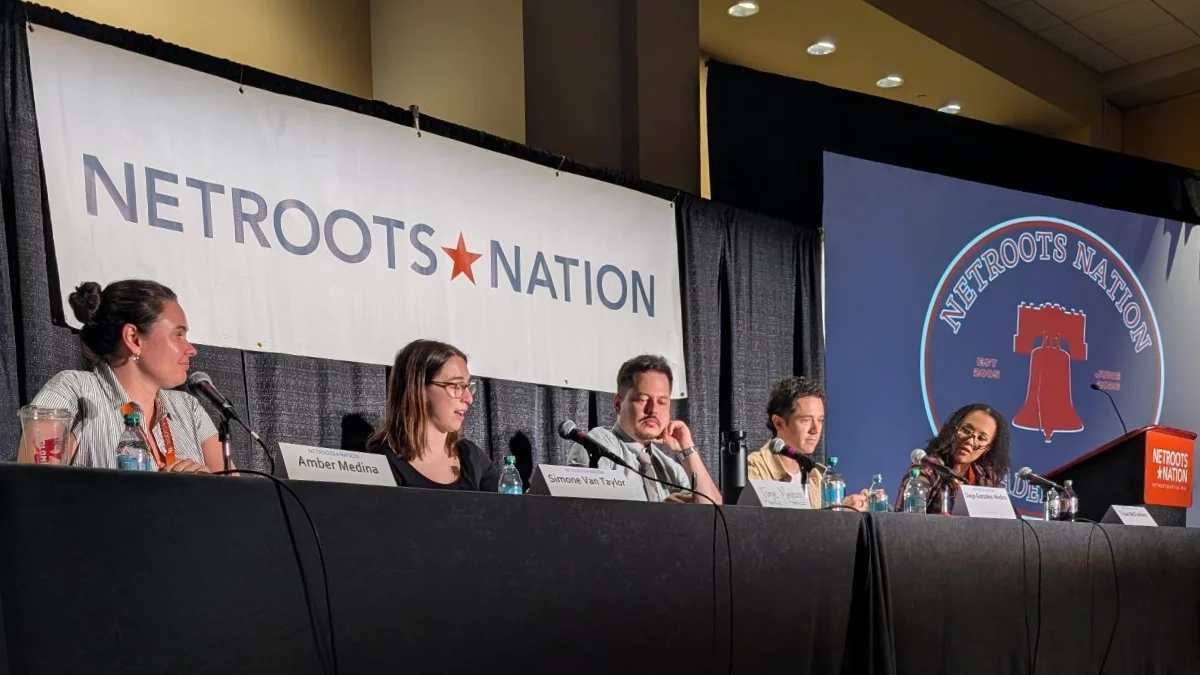
Artificial intelligence is stirring a notable divide among progressives, political operatives, and activists at the 2026 Netroots Nation conference in Philadelphia. As AI tools become more prevalent in political campaigns and organizing, questions about their risks, benefits, and governance continue to spur intense debate within the progressive movement.
What Happened
At Netroots Nation, the largest annual progressive conference, attendees engaged in discussions about the role of AI in political change. Panels and workshops highlighted divergent views: some see AI as a technology that can drive prosperity and improve campaign efficiency, while others regard AI as inherently extractive and harmful, raising ethical and political concerns. Party operatives revealed that Republicans currently outpace Democrats in AI adoption for campaigning. Vendors presented a range of AI applications, mostly focusing on internal campaign tools like data management, social media monitoring, and memo writing, rather than full public-facing content creation. Debate unfolded over whether progressives should adopt AI widely, reject it on principle, or pursue a middle ground with more ethical and localized AI models.
Key Facts
- AI use is growing in political campaigns, with Republican campaigns reportedly leading Democratic efforts in adoption and enthusiasm.
- Few vendors offer fully customized large language models (LLMs) for campaigns; most provide specific features such as customer support bots or fundraising audience segmentation powered by machine learning.
- About half of workshop participants regularly use AI, and roughly the same portion work for organizations with formal AI policies.
- Concerns raised at the conference include AI’s environmental impact, intellectual property rights, labor issues, potential loss of human skills, and the influence of Silicon Valley.
- Some progressives advocate for smaller, open-source AI models that could run locally with renewable energy, providing more ethical control.
Why It Matters
This debate matters because AI is becoming an intrinsic part of political campaigns and organizing, shaping how elections are waged and how political movements mobilize. The divisions within the progressive camp reflect broader questions about the ethical use of AI and the influence of Big Tech in society. Their outcomes could impact how Democrats compete in upcoming elections and how the party’s platform and policies address tech governance and social justice.
Background
Founded in 2006, Netroots Nation is a major conference gathering progressive activists and thinkers. It serves as a forum for discussing emerging digital tools for political action. The infusion of AI into political technology represents an evolution from earlier digital organizing practices focused on email, social media, and data analytics. Recent years have seen AI tools shift toward operational uses rather than just content generation, reflecting changes in how campaigns manage information and outreach.
Analysis
The progressive split on AI illustrates tension between embracing innovation for competitive advantage and adhering to underlying political values that question large technology companies’ motives and societal impact. While some see AI as a governance and distribution challenge, others see its fundamental design as exploitative. The call for smaller, localized AI models using renewable energy highlights a desire to reclaim technological control away from Silicon Valley giants. However, reconciling these positions within the Democratic coalition remains complex, with policy stances on Big Tech, data centers, and AI ethics yet to converge fully.
Who Is Affected
The primary groups affected include progressive political operatives, campaign strategists, and activists who must decide how to incorporate AI tools. Democratic candidates and their campaigns face pressure to adapt or risk losing ground to Republicans who currently lead in AI use. AI vendors and technology providers are also impacted as they navigate demand for ethical and sustainable AI solutions tailored to progressive values.
Reactions / Official Statements
This information was not confirmed in the reviewed sources.
What Remains Unclear
It remains unclear how and if the Democratic Party will develop unified policies or official guidelines governing AI use in campaigns. The long-term impacts of AI adoption on political competition and progressive organizing strategies are also uncertain. Additionally, the degree to which concerns about AI’s environmental and social costs will influence actual technology procurement decisions within campaigns is yet to be seen.
What Comes Next
As the 2026 midterm elections approach, the debate over AI’s role in progressive campaigns is expected to intensify. Efforts to develop smaller, bespoke AI models may gain traction, and organizational AI policies will likely become more common. Continued dialogue about aligning AI practices with progressive values and mitigating risks may influence both technology adoption and policy proposals within the Democratic Party.
Sources
This article is based on reporting and publicly available information from the following source:
Read more AI Regulation stories on Goka World News.