
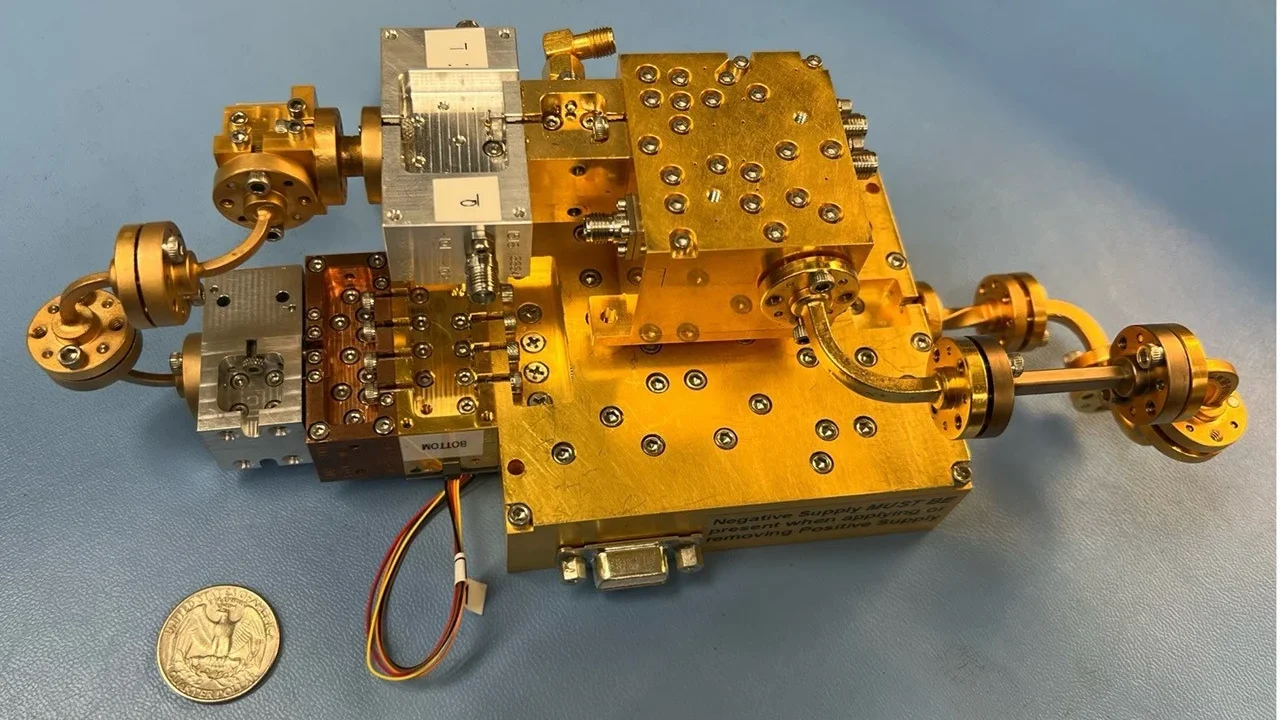
NASA’s Jet Propulsion Laboratory has developed an innovative compact radar instrument called CloudCube, designed to enhance the observation of cloud systems and precipitation with unprecedented detail. CloudCube’s multifrequency radar simultaneously emits three distinct radio frequency bands to analyze various cloud constituents, advancing atmospheric science and climate research.
What Happened
CloudCube, a miniature radar funded by NASA’s Earth Science Technology Office Instrument Incubator Program, transmits Ka-, W-, and G-band signals ranging from 36 to 240 GHz. This allows it to measure a wide range of water droplet and ice particle sizes within clouds. It is the first compact radar capable of simultaneously observing meteorological targets across such a broad millimeter-wave frequency spectrum. The instrument has undergone successful ground and airborne testing, including snowfall observations from a NASA aircraft, improving the understanding of cloud microphysics and precipitation processes.
Key Facts
- CloudCube uses three radar bands: Ka-band for precipitation profiles, W-band for cloud particle measurements, and G-band for detecting ice and liquid water in light clouds.
- The instrument generates high transmit power at 240 GHz through multiple frequency multipliers, unique for a low-power, small-scale radar.
- A ground prototype operated over 11 months during the DOE’s Cloud and Precipitation Experiment at Kennaook (CAPE-K).
- It recently performed airborne observations of snowfall during NASA’s North American Upstream Feature-Resolving and Tropopause Uncertainty Reconnaissance Experiment.
- CloudCube’s compact design minimizes mass and power consumption, making it suitable for future cost-effective Earth-observing missions.
Why It Matters
CloudCube’s simultaneous use of three radar frequencies enables comprehensive, highly sensitive measurements of cloud dynamics, precipitation initiation, and evolution. These detailed observations can improve weather forecasting accuracy and significantly enhance climate modeling by providing better data on cloud microphysics and radiative properties. Most notably, the inclusion of G-band radar data from space for the first time allows scientists to weigh clouds more precisely than ever.
Background
Radar instruments have long been used to study clouds and precipitation, but previous systems typically operated at a single frequency band or required larger, heavier equipment. The development of millimeter-wave hardware facilitates the miniaturization of radar systems like CloudCube, which can achieve a broad frequency range critical for detecting different hydrometeor sizes under varying atmospheric conditions. CloudCube builds on existing radar science with innovations in transmit power and component efficiency.
Analysis
By integrating three frequency bands into a compact, low-power platform, CloudCube represents a technological leap in atmospheric remote sensing. The combination of Ka-, W-, and G-bands allows simultaneous capture of diverse cloud attributes, yielding richer datasets from a single instrument. This approach is expected to reduce mission complexity and costs while enhancing spatial resolution and sensitivity. The successful airborne and ground-based testing validates its readiness for future orbital deployment.
Who Is Affected
CloudCube’s capabilities benefit meteorologists, climatologists, and atmospheric researchers who rely on precise cloud and precipitation data to model Earth’s weather systems and climate. The instrument’s compact design also enables integration into new satellite missions, potentially expanding global observation capabilities for governments and scientific organizations worldwide.
Reactions / Official Statements
Raquel Rodriguez Monje, CloudCube’s principal investigator at JPL, emphasized the instrument’s novel multi-frequency radar capabilities and its low mass and power consumption as key advances for future atmospheric missions. JPL researcher Matt Lebsock highlighted the unique advantage of including the G-band radar, which allows researchers to measure cloud water content with unprecedented accuracy.
What Remains Unclear
This information was not confirmed in the reviewed sources.
What Comes Next
The CloudCube team is currently calibrating and processing data collected during recent airborne campaigns. The next phase involves making this data publicly available, paving the way for potential inclusion of CloudCube technology in cost-effective satellite missions to enhance continuous global atmospheric monitoring.
Sources
This article is based on reporting and publicly available information from the following source:
Read more Space & NASA stories on Goka World News.