
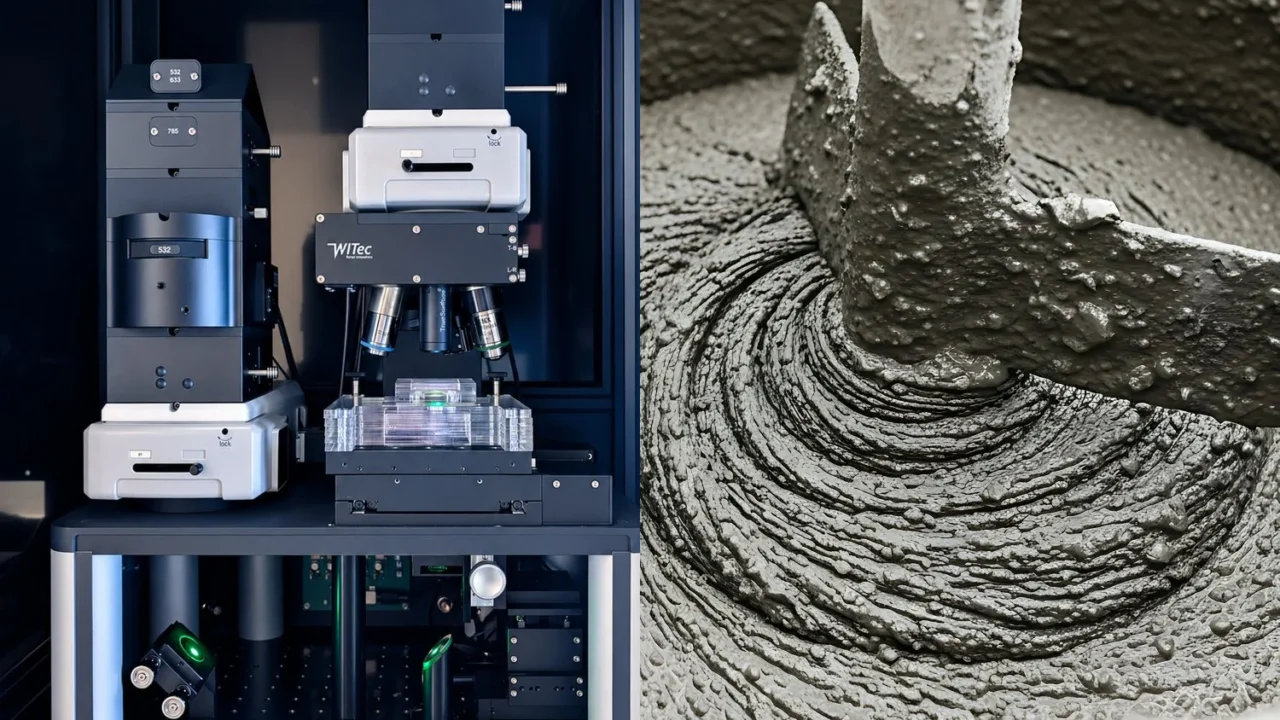
Scientists at MIT have directly observed how carbon dioxide (CO2) changes the chemical setting process of cement, a discovery detailed in the Journal of the American Ceramic Society. Led by Associate Professor Admir Masic and graduate student Marcin Hajduczek from MIT’s Concrete Sustainability Hub, the team used advanced laser spectroscopy techniques to visualize rapid chemical reactions occurring during the first 24 hours after CO2 injection into fresh cement paste.
What Happened
The research team depressurized liquid CO2 to produce solid flakes, which they added to freshly mixed cement paste. Using Raman confocal microscopy, they illuminated the sample with lasers to detect chemical changes in real time. This allowed them to capture transient reactions too fast for conventional methods. Their observations showed a three-stage chemical transformation within the first 24 hours, beginning with calcium carbonate formation, followed by the emergence and rapid consumption of a silica gel phase, concluding with the formation of a more homogenous cement binder matrix that significantly boosts early strength.
Key Facts
- The findings were published in the open-access Journal of the American Ceramic Society in 2024.
- Research was conducted by MIT’s Concrete Sustainability Hub and Department of Civil and Environmental Engineering, with collaborators from IIT Jodhpur and CarbonCure Technologies.
- Samples were sealed cement paste discs about the size of a dime, injected with CO2 at 1 percent of cement weight.
- Raman confocal microscopy enabled continuous chemical monitoring over 24 hours.
- CO2 injection led to a 13 percent average increase in 24-hour compressive strength compared to control samples.
Why It Matters
This direct visualization of CO2’s chemical influence clarifies the mechanism behind increased early strength in CO2-treated cement, a crucial factor for reducing carbon emissions in concrete production. The rewiring of cement’s setting chemistry offers a foundation to optimize CO2 injection, enabling more sustainable construction materials with lower environmental footprints while maintaining performance.
Background
Previous studies had hypothesized the chemical effects of CO2 injection based on indirect evidence, but rapid, transient reactions prevented direct observation. Raman spectroscopy has recently been applied successfully to study other historical materials, such as ancient Roman concrete, but this is the first time it captured these fleeting chemical phases in cement paste.
Analysis
According to lead author Marcin Hajduczek, the discovery of a transient silica gel phase that later reacts with calcium hydroxide challenges prior assumptions that calcium carbonate played a direct role in forming the cement binder. Masic emphasized that understanding these underlying mechanisms opens the way to control and advance CO2-injected cement formulations.
Who Is Affected
The findings directly impact researchers and industries involved in cement and concrete production, particularly companies exploring carbon capture and storage technologies to reduce the carbon footprint of construction materials globally.
What Remains Unclear
- The mechanical properties of the newly identified silica gel phase have yet to be experimentally determined.
- The optimal CO2 dosage to maximize carbon offset without inhibiting critical hydration reactions remains undetermined.
- The practical carbon emissions offset achievable in real-world cement and concrete production requires further quantification.
What Comes Next
The research team plans to measure the mechanical behavior of the silica gel phase and refine CO2 injection protocols to enhance concrete strength and sustainability. Understanding the chemical pathway now provides specific targets for future experimental and applied research.
Sources
This article is based on reporting and publicly available information from the following source:
Read more Science Discoveries stories on Goka World News.