
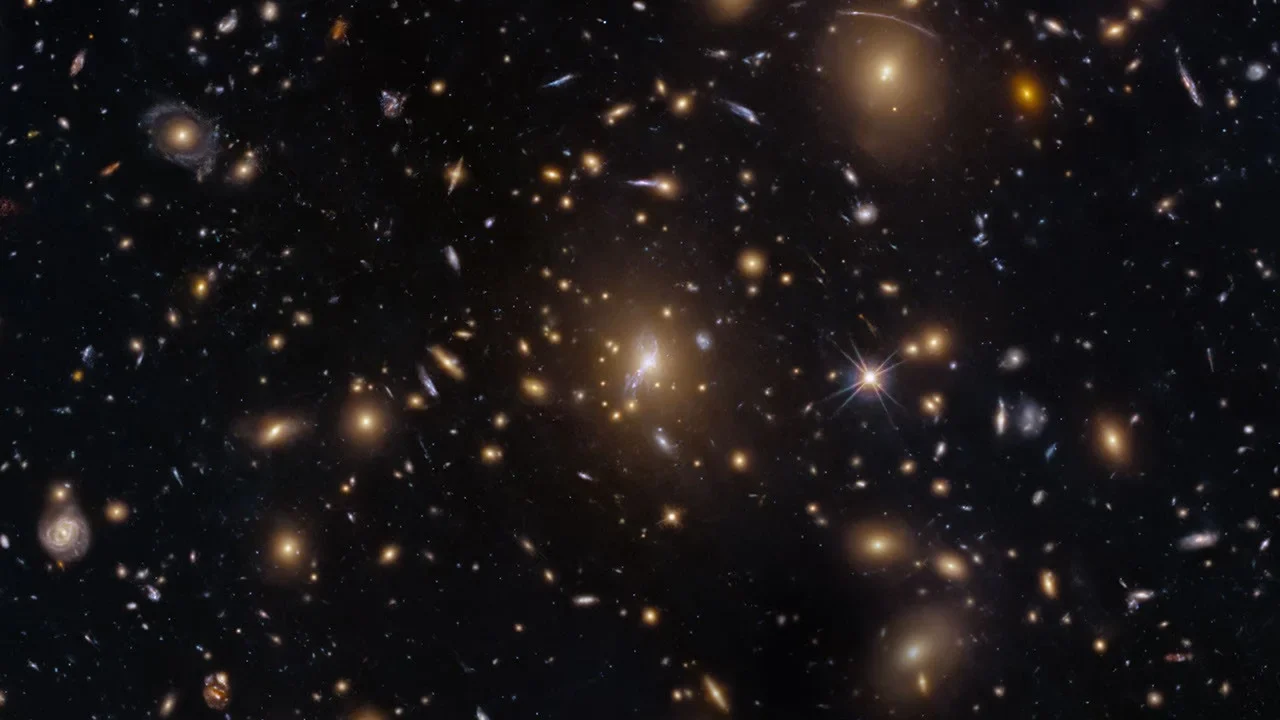
The NASA Hubble Space Telescope captured a detailed image of the galaxy cluster MACS0329-0211, located deep in space. The observation, conducted by the Hubble mission team at Goddard Space Flight Center, unveiled a diverse mix of elliptical, spiral, and lenticular galaxies as well as gravitational lensing effects caused by the cluster’s massive gravity.
What Happened
Hubble imaged MACS0329-0211 as part of an observing program focused on X-ray bright galaxy clusters. Using its Advanced Camera for Surveys and Wide Field Camera 3, the telescope recorded visible and infrared light to reveal the cluster’s structure and the phenomena surrounding it. The images show both the large, oval-shaped elliptical galaxies and thin spiral and lenticular galaxies, some viewed edge-on, located within this galaxy swarm.
Key Facts
- Galaxy cluster featured: MACS0329-0211
- Imaging instruments: Hubble’s Advanced Camera for Surveys and Wide Field Camera 3
- Observed light spectrum: Visible and infrared
- Notable features: Large elliptical galaxies, spiral and lenticular galaxies, gravitational lensing arcs
- Confirmed by: NASA’s Goddard Space Flight Center Hubble team
Why It Matters
Galaxy clusters like MACS0329-0211 serve as critical markers in understanding the evolution of cosmic structures. They act as natural telescopes through gravitational lensing, magnifying and distorting light from some of the earliest galaxies in the universe. Hubble’s observations thus allow astronomers to study galaxies too distant to be seen otherwise, shedding light on the universe’s formative stages.
Background
Galaxy clusters have long been studied for their role in the large-scale structure of the cosmos. The Hubble mission team targeted X-ray bright clusters to investigate gravitational lensing effects and the distribution of visible and dark matter within clusters. MACS0329-0211 is one example that exhibits these phenomena clearly.
Analysis
According to NASA’s Goddard Space Flight Center, the image reveals faint gravitationally lensed arcs of distant galaxies in the cluster’s upper-right quadrant, confirming the cluster’s massive gravitational influence. The intersecting bright-white curves near the cluster’s center are interpreted as a distorted, lensed background galaxy — exemplifying complex gravitational interactions within the cluster.
Who Is Affected
This discovery benefits the astronomy and astrophysics research communities worldwide by providing valuable data for studying galaxy formation, cluster dynamics, dark matter, and gravitational lensing.
What Remains Unclear
This information was not confirmed in the reviewed sources.
What Comes Next
This information was not confirmed in the reviewed sources.
Sources
This article is based on reporting and publicly available information from the following source:
Read more Space & NASA stories on Goka World News.