
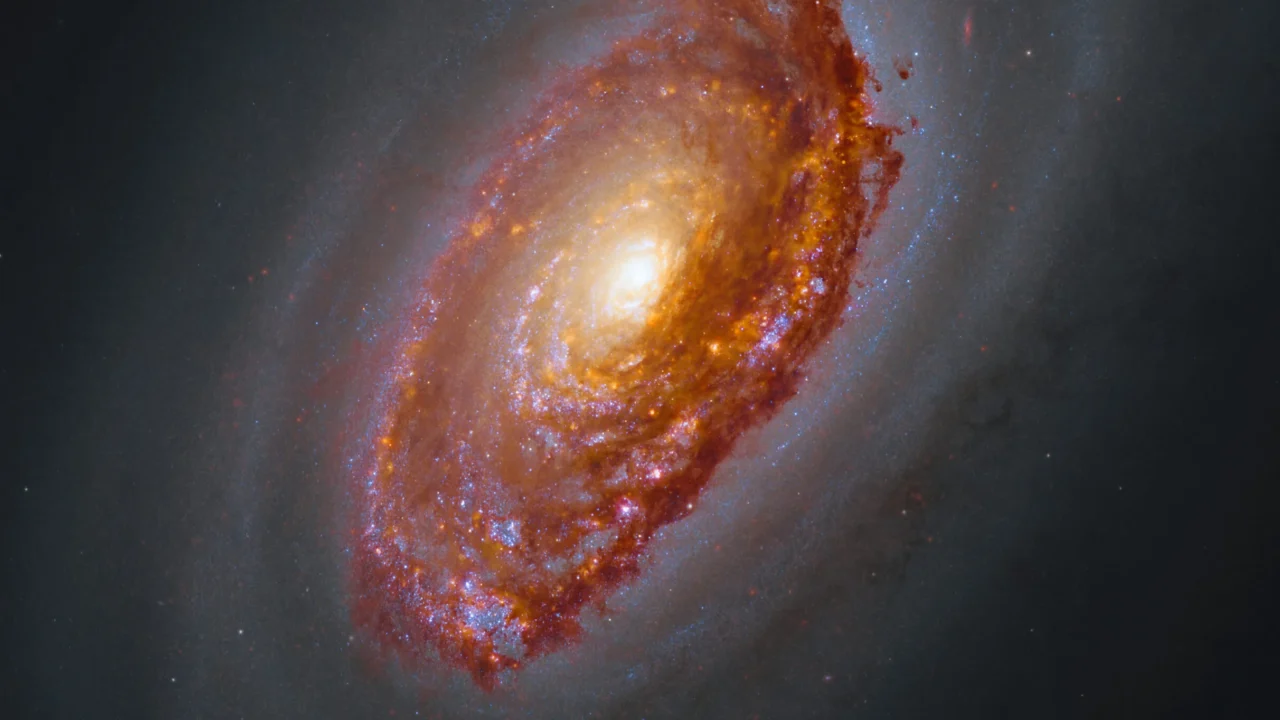
NASA’s Hubble Space Telescope and James Webb Space Telescope have jointly produced a striking composite image of Messier 64, known as the Black Eye Galaxy. Captured on March 20, 2026, the observation unveiled the galaxy’s unusual internal dynamics using a combination of infrared, ultraviolet, and visible light.
What Happened
On March 20, 2026, NASA released a composite image of Messier 64, created by combining near- and mid-infrared data from the James Webb Space Telescope with ultraviolet, visible, and near-infrared data from the Hubble Space Telescope. This collaborative imaging effort showcased the galaxy’s complex structure and internal motion.
Key Facts
- Messier 64 is also called the Black Eye Galaxy, notable for a dark dust band obscuring its bright core.
- The image integrates data across wavelengths: Webb observed near- and mid-infrared, Hubble captured ultraviolet, visible, and near-infrared light.
- The galaxy exhibits bizarre rotation: gas in the outer regions spins opposite to gas and stars in the inner regions.
- Image credits include NASA, CSA, ESA, and multiple academic collaborators, with image processing by Gladys Kober (NASA/Catholic University of America).
Why It Matters
This combined imaging clarifies the dynamic processes shaping Messier 64, especially its counter-rotating gas layers. Understanding such phenomena informs knowledge of galaxy evolution and past interactions, providing clues about how cosmic mergers affect galactic structure.
Background
The Black Eye Galaxy has long been studied for its distinctive dust lane and counter-rotating gas. Scientists hypothesize this irregular motion stems from a merger over a billion years ago, when Messier 64 accreted a smaller satellite galaxy, creating its unusual internal rotation pattern.
Analysis
Researchers including Francesca Belfiore (European Southern Observatory) and Jonathan Lee (Space Telescope Science Institute) emphasize that the multi-wavelength approach from Hubble and Webb enhances understanding of both the galaxy’s star-forming regions and dust-obscured structures. This synergy allows detailed study of galactic dynamics not visible at a single wavelength.
Who Is Affected
Astronomers and astrophysicists studying galaxy formation and evolution are directly impacted by these findings, which refine models of cosmic mergers and rotational dynamics. The wider scientific community benefits from deeper insights into spiral galaxy behaviors.
What Remains Unclear
Specifics about the merging satellite galaxy’s properties, the long-term effects of the counter-rotation on star formation, and precise timeline details remain subjects for ongoing research and data analysis.
What Comes Next
Further observations combining Webb’s infrared capabilities with Hubble and other telescopes are planned to deepen understanding of Messier 64’s structure and evolution. Analysis of the collected data will continue to refine models of galactic mergers and internal gas motion.
Sources
This article is based on reporting and publicly available information from the following source:
Read more Space & NASA stories on Goka World News.