
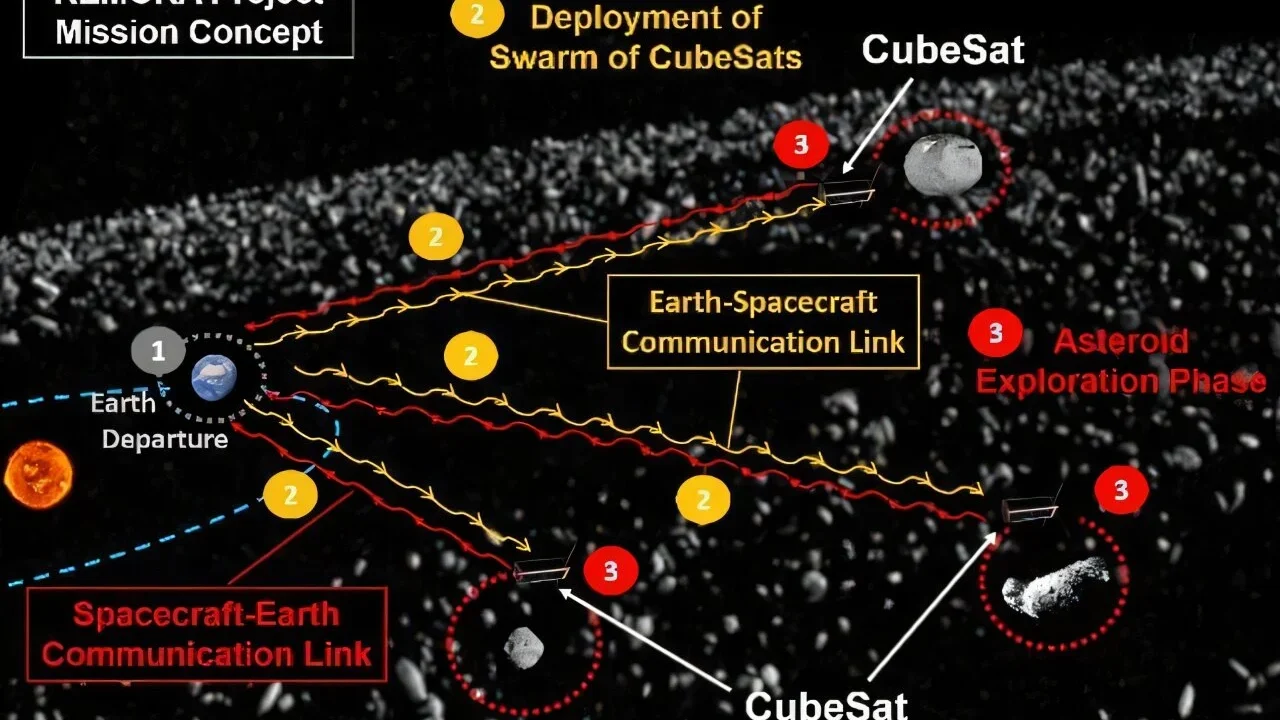
The REndezvous Mission for Orbital Reconstruction of Asteroids (REMORA) is a UK-based proposal for an autonomous swarm of CubeSats designed to tag, track, and characterize near-Earth asteroids. Developed by a team including University of Liverpool researchers, the mission aims to address limitations in asteroid observation through remote sensing by sending small satellites directly to orbit or attach to asteroids.
What Happened
In a white paper submitted to the U.K. Space Agency’s 2035 Space Frontiers program and published on the arXiv preprint server in June 2026, REMORA was described as a Mini-F-class mission featuring a fleet of six autonomous CubeSats. These satellites would hitch rides to known near-Earth asteroids to study their composition and dynamics in situ. The mission design includes innovative software for autonomous navigation and fuel-efficient operation around asteroids, with physical testing at Liverpool’s Zero-G Astrolab.
Key Facts
- Proposed mission budget: approximately €50 million, categorizing it as a Mini-F-class mission.
- Fleet size: six autonomous CubeSats designed to study individual near-Earth asteroids.
- Software: Near-Earth Asteroid Regions (NEAR) suite, including dynNEAR for dynamic modeling and goNEAR for autonomous pathfinding and fuel optimization.
- Testing facility: University of Liverpool’s Zero-G Astrolab featuring an epoxy air-bearing floor for hardware-in-the-loop experiments.
- Launch timeframe context: aligned with the close Earth approach of asteroid Apophis in 2029.
- Industry collaboration potential: integration with Surrey Satellite Technology Ltd. (SSTL) small satellite platform.
Why It Matters
REMORA advances asteroid science and planetary defense capabilities by enabling close-proximity observation and interaction with multiple asteroids using affordable, autonomous spacecraft. It addresses current observational gaps, such as tracking asteroids approaching from the sunward direction—a blind spot in existing detection systems highlighted by the 2013 Chelyabinsk event. The mission’s autonomous software reduces the need for constant Earth-based operation, which is critical given the cost constraints.
Background
The UK has made significant contributions to asteroid missions like NASA’s DART and OSIRIS-REx but currently lacks a dedicated domestic program for asteroid exploration. REMORA seeks to establish such a pipeline by leveraging UK academic and industrial strengths, including expertise from the University of Liverpool and Surrey’s small satellite industry cluster.
Analysis
Lead author Stefania Soldini and collaborators highlight the mission’s affordability and autonomy as key advantages, emphasizing the potential of the NEAR software to enable fuel-efficient navigation without continuous terrestrial control. The Zero-G Astrolab offers a unique environment for validating hardware and software, strengthening the mission’s technical readiness.
Who Is Affected
The REMORA proposal primarily impacts UK space science and technology sectors by potentially fostering domestic asteroid mission capabilities. It also holds significance for planetary defense agencies and researchers worldwide seeking improved methods to monitor and analyze near-Earth objects.
What Remains Unclear
- Whether the UK Space Agency will fund REMORA or similar missions remains uncertain given current budget constraints.
- The operational performance and robustness of the NEAR software under mission conditions will require extensive testing beyond laboratory simulations.
- Integration logistics with SSTL’s platforms and the timeline for mission development and launch have not been finalized.
What Comes Next
The white paper advocates starting with a Phase 0 pilot study to integrate scientific payloads onto future SSTL missions as a proof of concept. The mission timeline is set in part by Apophis’s close approach in 2029, providing a target event for demonstrating REMORA’s capabilities.
Sources
This article is based on reporting and publicly available information from the following source:
Read more Space & NASA stories on Goka World News.