
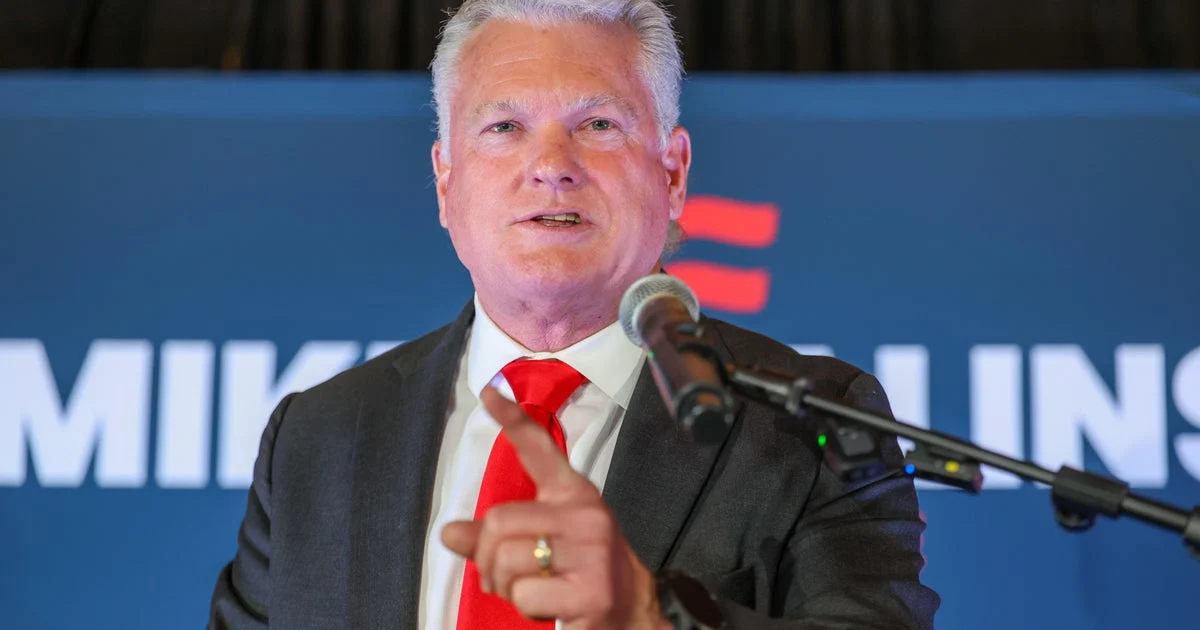
Rep. Mike Collins is projected to win the Georgia Republican Senate primary runoff held on June 16, 2026, positioning him to face Democratic Sen. Jon Ossoff in the November general election. The runoff followed a May primary where no candidate reached a majority, and Collins defeated former football coach Derek Dooley to secure the GOP nomination.
What Happened
On June 16, 2026, Mike Collins was projected as the winner of the Georgia GOP Senate runoff, defeating Derek Dooley. Collins received about 41% of the vote in the runoff, while Dooley garnered around 30% in the initial May primary. The runoff was necessary as no candidate surpassed 50% in the May contest, which also saw Rep. Buddy Carter eliminated. Collins will now challenge incumbent Sen. Jon Ossoff in November.
Key Facts
- Collins is a two-term U.S. Representative from Georgia and owner of a trucking business.
- Derek Dooley, an attorney and former University of Tennessee football coach, was Collins’ primary runoff opponent.
- President Donald Trump endorsed Collins on June 14, calling him a “true Friend, Fighter, and WARRIOR.”
- Georgia Gov. Brian Kemp endorsed Dooley, highlighting a political split with Trump.
- Senator Jon Ossoff, first elected in 2021, is the only Democrat seeking reelection in Georgia in 2026.
- Collins touted his sponsorship of an immigration bill named after Laken Riley, a Georgia nursing student murdered by an undocumented immigrant.
- Ossoff is considered a vulnerable incumbent as Georgia has not elected a Republican senator since 2016.
- There is an ongoing House Ethics Committee investigation into allegations of Collins misusing congressional funds, which he denies.
Why It Matters
This runoff victory is significant as it sets up a pivotal November Senate race in Georgia, a state critical for control of the U.S. Senate. With currently 53 Republicans, the GOP aims to hold the chamber by defeating Ossoff. Georgia’s status as a battleground state means the outcome could influence the Senate majority and future legislative agendas.
Background
The primary runoff was triggered because no candidate achieved a majority in the May 2026 GOP Senate primary, where Collins, Dooley, and Carter competed. The race has been marked by a proxy battle between Trump, who supports Collins, and Kemp, who backs Dooley. Trump’s endorsement came after Kemp resisted efforts by Trump to overturn Georgia’s 2020 presidential election results.
Analysis
Observers note that Collins’ close alignment with Trump may energize the president’s base but also gives Democrats material to critique. Democrats plan to focus on Collins’ ties to Trump, unpopular national policies, and ethics allegations. Meanwhile, Collins framed the contest as crucial to removing Ossoff, whom he labeled an “out-of-touch far-left liberal.” Dooley argued that the Georgia voters’ endorsement matters most and claimed to be better positioned to defeat Ossoff.
Who Is Affected
The primary groups affected include Georgia’s Republican and Democratic voters, the wider Senate balance of power, and the campaigns of Mike Collins and Jon Ossoff. Georgia residents will see intensified party efforts through November as both sides vie for Senate control.
What Remains Unclear
- Whether the ethics investigation into Collins will have electoral consequences prior to November.
- The exact vote tallies from the runoff beyond projections.
- How the general election campaign will shift with Collins as the GOP nominee.
What Comes Next
The general election between Collins and Ossoff is scheduled for November 2026. Both campaigns are expected to escalate efforts in this high-stakes Senate race.
Sources
This article is based on reporting and publicly available information from the following source:
Read more Politics stories on Goka World News.