
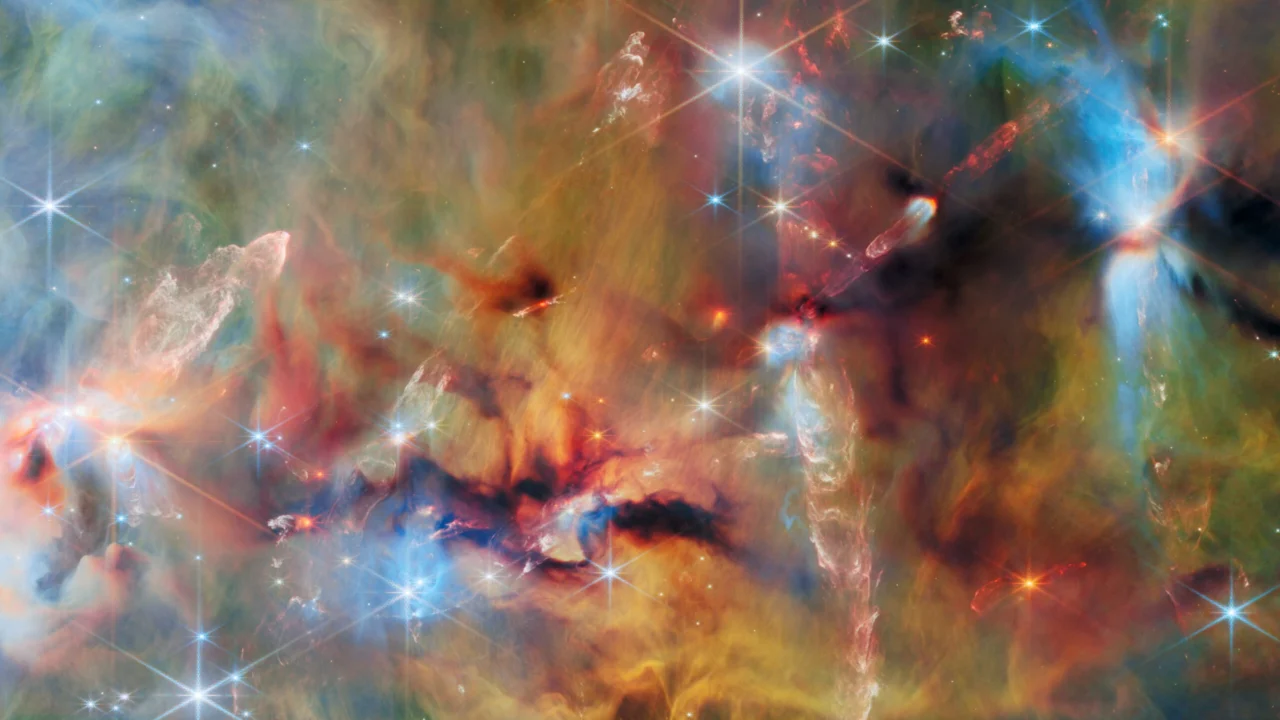
NASA’s James Webb Space Telescope has provided a striking new image capturing the entire process of star formation within a segment of the Orion A molecular cloud. This detailed observation showcases a 150-light-year stretch of cold gas and dust beyond the Orion Nebula, illustrating the birth and early lives of stars in unprecedented clarity.
What Happened
On June 5, 2026, the James Webb Space Telescope, in collaboration with the European Space Agency (ESA) and the Canadian Space Agency (CSA), released a high-resolution image revealing a portion of Orion A—one of the longest and most massive molecular clouds known for star formation. The image captures a rich variety of celestial phenomena, including the youngest stellar embryos, protoplanetary discs, and newly formed pre-main sequence stars. These features are embedded within the cold, dense filament of gas and dust that stretches across approximately 150 light-years.
Key Facts
The Orion A molecular cloud segment imaged by Webb is located beyond the well-known Orion Nebula. The image was officially released by NASA, ESA, and CSA and credits researchers T. Megeath and M. Zamani. It represents some of the most detailed observations of star formation to date captured by Webb’s advanced instrumentation. The scene includes every recognized phase of star formation from nascent stellar embryos to early stellar development phases within a single continuous region.
What This Means
This comprehensive image from the James Webb Space Telescope offers a unique glimpse into the continuous and complex process of star formation in our galaxy. By capturing all critical stages within one frame, astronomers can study how stars evolve in the same environment, improving models of stellar birth and early planetary system formation. The clarity of Webb’s observations helps bridge gaps in understanding how protoplanetary discs develop and how newborn stars emerge from their dense molecular clouds, potentially clarifying conditions that may lead to planet formation like in our own solar system.
The Orion A image also reinforces the power of Webb’s infrared capabilities, which can penetrate dense clouds of dust where visible light telescopes see only darkness. This advancement extends humanity’s ability to explore star-forming regions deeply obscured until now, laying groundwork for further discoveries about stellar life cycles and the evolution of galaxies.
Background
Orion A is part of the larger Orion Molecular Cloud Complex, a vast star-forming region that has been studied extensively as a laboratory for understanding stellar evolution. Previous missions, including the Hubble Space Telescope and ground-based observatories, have identified dynamic stellar nurseries there, but Webb’s enhanced sensitivity in the infrared spectrum provides unprecedented detail. This region is a natural laboratory hosting numerous young stars and protostars across different developmental phases.
Sources
This article is based on reporting and publicly available information from the following source:
Read more Space & NASA stories on Goka World News.