
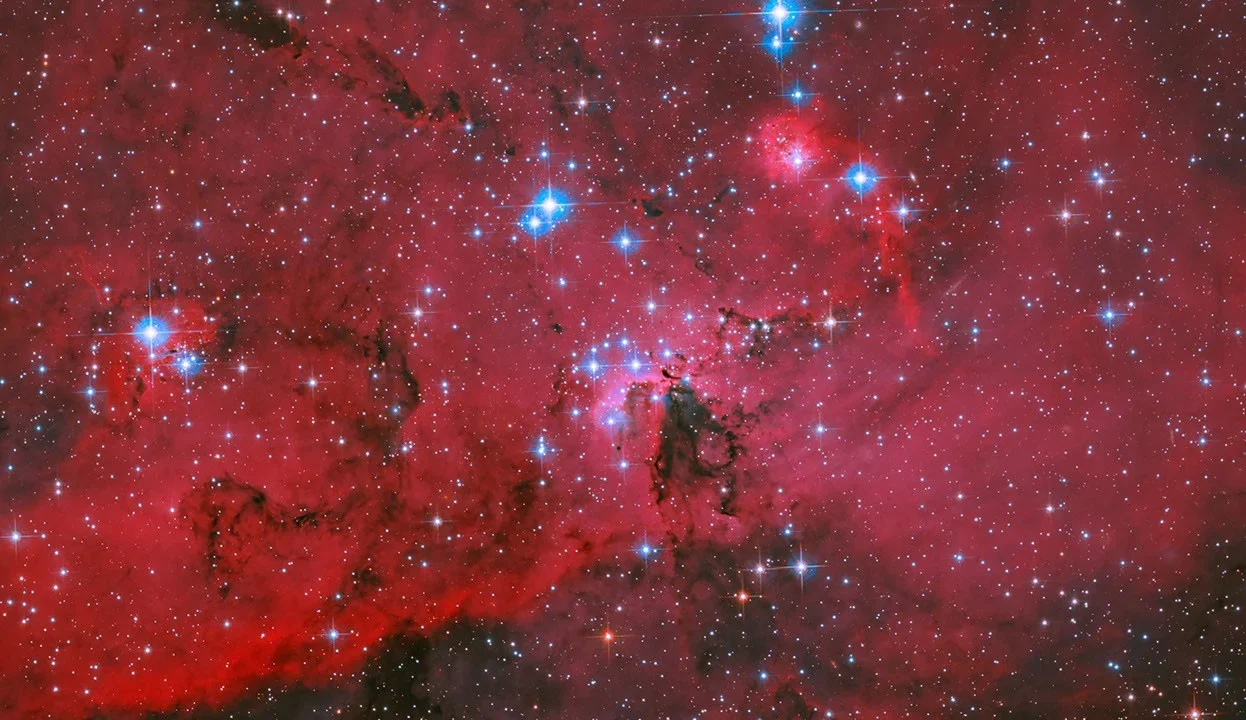
NASA’s Hubble Space Telescope has produced stunning images of the stellar nursery known as LH 95 within the Large Magellanic Cloud (LMC), a dwarf galaxy orbiting the Milky Way. The observations reveal brilliant blue and white infant stars sparkling against the glowing crimson backdrop of hydrogen gas, providing a vivid look at ongoing star formation in this nearby galactic environment.
What Happened
The Hubble Space Telescope observed the LH 95 region, capturing detailed images showcasing a rich stellar association composed of low-mass infant stars alongside massive blue giant stars. These most massive stars, over three times the mass of the Sun, emit intense ultraviolet radiation and stellar winds that heat and shape the surrounding hydrogen gas, causing it to glow in hydrogen-alpha emissions that appear crimson in the imagery.
The data reveal nearly 2,500 pre-main-sequence stars in LH 95 — young stars that have mostly gathered their mass but have not yet ignited core hydrogen fusion. These stars formed from collapsing gas clouds and remain in the process of contraction before fully turning on as main-sequence stars. The images also show dusty filaments contrasting sharply against the glowing gas, highlighting the complex interplay of forces molding the nebula.
Key Facts
- LH 95 is situated within the Large Magellanic Cloud, a dwarf galaxy orbiting the Milky Way.
- The nebula’s crimson glow is due to hydrogen-alpha emissions, a key signature of star formation.
- Approximately 2,500 pre-main-sequence stars are present, many still accreting matter from surrounding disks.
- The region hosts massive blue stars exceeding three times the Sun’s mass, with the largest star weighing approximately 60–70 solar masses.
- The most massive star is about a million years younger than the bulk of stars, which are roughly 4 million years old.
- Accretion rates of young stars decrease with age but can persist for several million years.
- Hubble’s observations complement data from other NASA missions like the James Webb Space Telescope and the upcoming Nancy Grace Roman Space Telescope.
What This Means
The detailed Hubble images of LH 95 provide astronomers with a close-up view of a star-forming region outside the Milky Way, offering critical data on how stars develop over time in an environment relatively free of obscuring dust. This clarity allows scientists to study multiple generations of stars forming side-by-side, challenging the idea that star formation happens in one discrete burst. Instead, LH 95 demonstrates a prolonged period of star birth, providing a natural laboratory to refine models of stellar evolution.
Understanding the accretion behavior of pre-main-sequence stars has broad implications for theories on planetary system formation, as the disks of gas and dust around young stars are the birthplace of planets. Discovering that star accretion can continue longer than previously assumed suggests that planet-forming environments might also have extended development periods. For the general public, these insights enhance our grasp of the cosmic origins of stars and planetary systems, including those that eventually give rise to life.
Background
The Large Magellanic Cloud, located approximately 163,000 light-years from Earth, is a satellite galaxy of the Milky Way known for its active star-forming regions. LH 95 is one of many such stellar nurseries within the LMC and has been a subject of study due to its distinct stellar population and relatively transparent environment compared to similar regions in our galaxy. Hubble has captured numerous important images of star-forming regions over its three decades in orbit, complementing newer infrared data from NASA’s James Webb Space Telescope.
What Comes Next
NASA plans to expand on these observations with forthcoming missions such as the Nancy Grace Roman Space Telescope, scheduled to launch later this year. Roman’s wide-field infrared capabilities will enable astronomers to survey star-forming regions like LH 95 on a larger scale and with enhanced sensitivity, further advancing our understanding of stellar birth and galaxy evolution.
Sources
This article is based on reporting and publicly available information from the following sources:
Read more Space & NASA stories on Goka World News.