
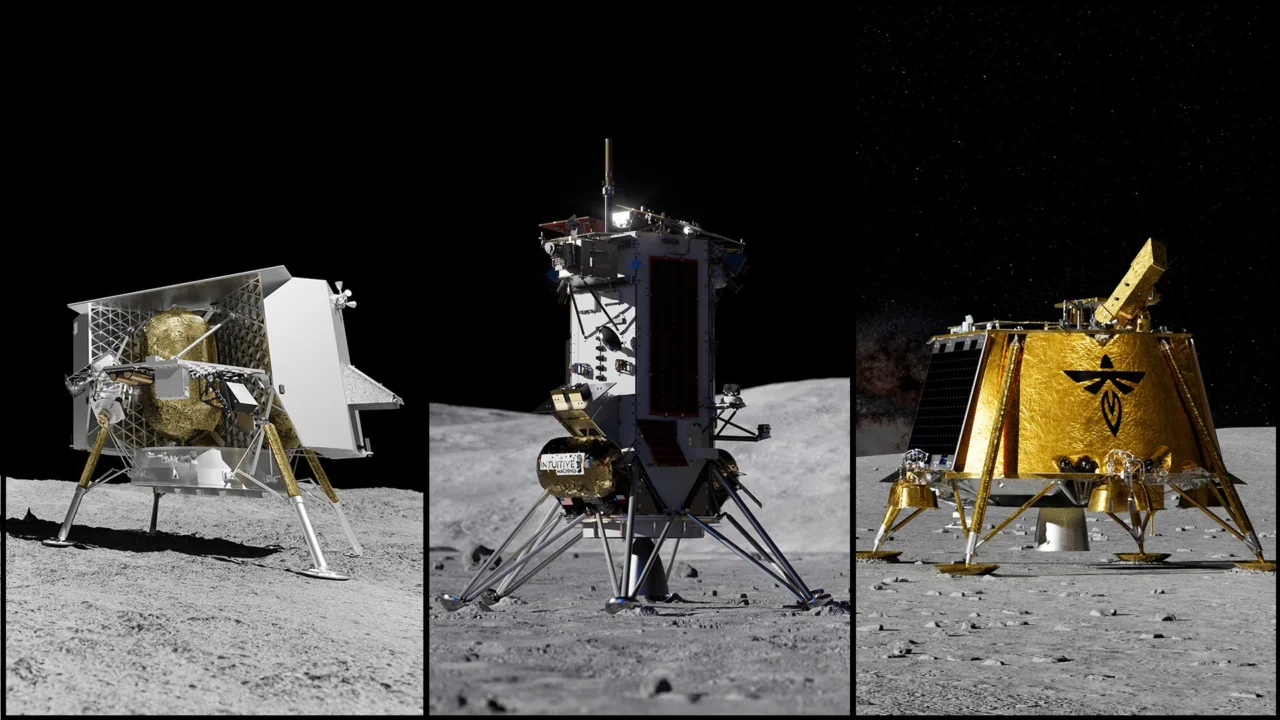
NASA announced the selection of three commercial companies—Astrobotic, Firefly Aerospace, and Intuitive Machines—to conduct four lunar lander missions in late 2028 as part of its Moon Base Program. These missions, funded at nearly $600 million total, will deliver science payloads to the Moon’s surface, bolstering NASA’s efforts to develop a long-term presence on the Moon and prepare for future human exploration.
What Happened
On June 30, 2026, NASA revealed awards for four missions under the agency’s Commercial Lunar Payload Services (CLPS) initiative. Astrobotic will conduct two deliveries funded at $297.9 million, while Firefly Aerospace and Intuitive Machines each received contracts valued at $144.2 million and $148.3 million respectively for one delivery apiece. These companies will employ updated versions of proven lunar lander designs, expanding NASA’s capability to increase mission cadence and reliability as infrastructure builds on the Moon.
The landers will each carry a standardized suite of three NASA scientific instruments designed to study the lunar environment, including dust plume behavior during landings, precise surface positioning, and radiation monitoring. Additionally, NASA is considering deploying PROMISE, a hybrid rover based on Mars rovers Perseverance and Curiosity, to conduct surface and subsurface exploration and resource prospecting in upcoming lunar missions.
Key Facts
The awards total almost $600 million across the four lunar lander missions planned for late 2028. Astrobotic is responsible for two landings, with Firefly and Intuitive Machines each conducting one. All payload landers will carry three primary instruments:
- Stereo Camera for Lunar Plume Surface Studies (SCALPSS): Four cameras using stereo photogrammetry to generate 3D images of the lunar dust plumes caused by rocket exhaust during landings. This data will inform models of lunar dust behavior vital for landing larger assets safely.
- Laser Retroreflector Array (LRA): A passive device with quartz prisms that reflects laser beams from orbiters or other surface craft, aiding precision navigation and orbit determination. This technology builds a network of permanent location markers on the Moon.
- Linear Energy Transfer Spectrometer (LETS): A radiation detector employing advanced silicon sensors to quantify the energy and type of space radiation on the lunar surface. This data supports astronaut safety and mission planning for long stays.
These instruments have flown on prior CLPS missions and international landers, enabling consistent environmental monitoring. NASA will also solicit proposals for additional lunar technology demonstrations, landers delivering power and avionics experiments, and a South Pole optical imager.
What This Means
These contracts mark a significant milestone in NASA’s plan to establish a sustainable Moon Base by rapidly expanding its lunar surface logistics and scientific research capabilities. Delivering multiple payloads through commercial partnerships not only accelerates lunar infrastructure development but also provides diverse data sets to understand the complex lunar environment better. This is crucial for protecting future astronauts and ensuring safe landings amid increasing activity near lunar bases.
The inclusion of instruments that monitor dust plumes and radiation directly addresses the operational hazards unique to the Moon, which differ greatly from Earth or Martian environments. By standardizing payloads across landers, NASA creates a network of environmental monitoring akin to earthbound weather stations, providing continuous situational awareness that informs engineering design and mission planning.
Furthermore, commercial companies’ involvement and their responsibility to incorporate lessons from previous missions underline NASA’s strategy to mature a robust lunar supply chain, which will be critical as missions grow in complexity. The PROMISE rover concept, blending capabilities from notable Mars rovers to explore the Moon, reflects NASA’s innovative approach to repurpose proven technology for new frontiers.
Background
Since initiating the CLPS program, NASA has contracted multiple companies to deliver payloads and landers to the lunar surface, forming the backbone of its Moon Base development. These efforts are part of broader plans to send astronauts on progressively challenging missions to expand the human footprint on the Moon, generate scientific discoveries, and create the foundational technology for eventual crewed Mars exploration.
What Comes Next
NASA will open solicitations for additional Moon Base-related missions, including landers focusing on power systems, avionics, communications, and surface imaging. The agency is also seeking proposals for a lunar communication and navigation relay system to improve connectivity between lunar assets and Earth. The lunar landers awarded in 2026 remain scheduled for launch in late 2028, marking a rapid escalation in operational tempo.
Sources
This article is based on reporting and publicly available information from the following sources:
Read more Space & NASA stories on Goka World News.