
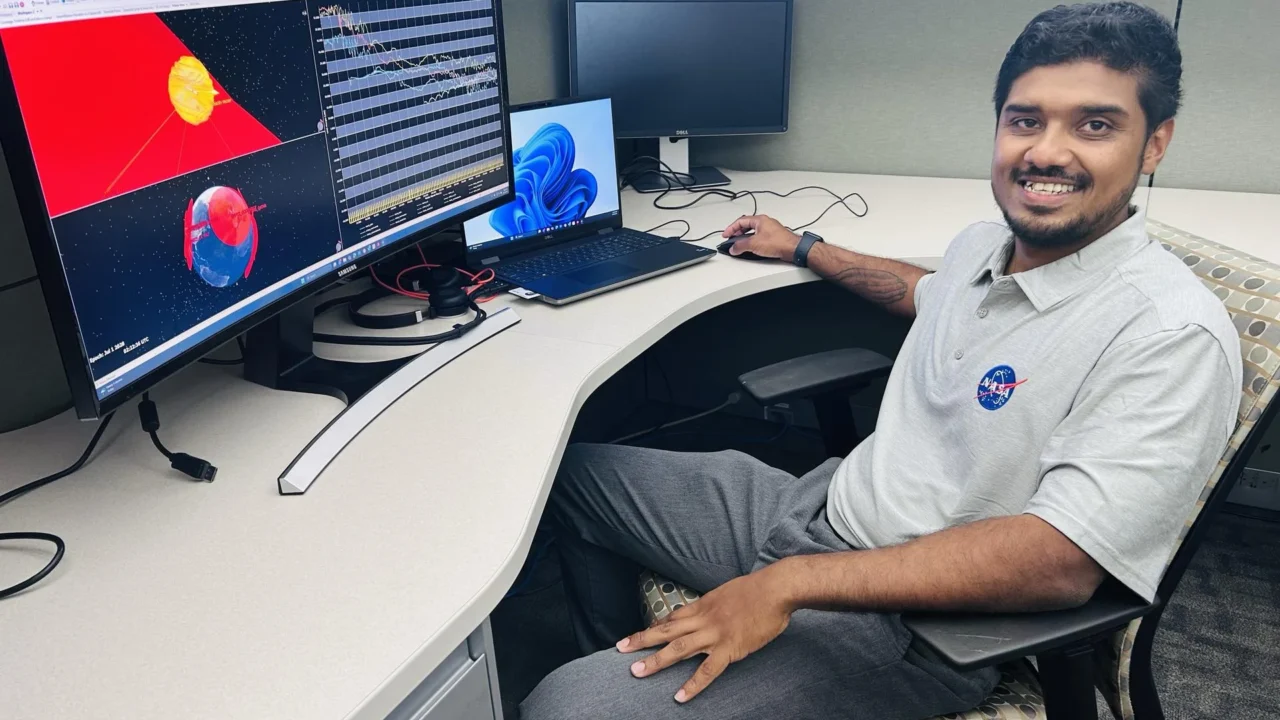
Rohit Goeptar, an engineer at NASA’s Launch Services Program, recently shared his remarkable journey from his impoverished beginnings in Suriname, South America, to becoming an integral part of NASA missions involving critical launch vehicle systems. His work ensures the reliable communication and compatibility of electrical components during space missions.
What Happened
Born into a struggling family in Suriname, Goeptar faced numerous hardships, including family separations and homelessness. At age 13, he became a U.S. citizen and later served six years in the U.S. Marine Corps as a technical operator, where he gained valuable skills assisting disaster-stricken communities. After pursuing dual degrees in computer and electrical engineering while raising three children, he received a call in spring 2025 from NASA’s Kennedy Space Center for an impromptu interview. Shortly thereafter, he began as an intern on the Expendable Launch Vehicle Integrated Support (ELVIS) contract and transitioned to a full-time NASA contractor and then civil servant by early 2026.
Key Facts
- Goeptar works on electromagnetic interference, electromagnetic compatibility, and radio frequency systems that support NASA and commercial launch vehicles.
- He is responsible for ensuring that avionics and electrical components do not interfere with each other and maintain continuous communication with ground control during missions.
- His contributions have impacted several NASA missions, including Sentinel-6B, JPSS-4 (Joint Polar Satellite System), and IMAP (Interstellar Mapping and Acceleration Probe).
- Goeptar identified and resolved an analytical flaw related to pitch, yaw, and roll movements during rocket launches, improving the accuracy of radio frequency link analysis.
- He was recently accepted to master’s programs in electrical engineering at Johns Hopkins University and the University of Central Florida.
What This Means
Goeptar’s story exemplifies how perseverance and opportunity can transform lives, emphasizing NASA’s role not only in space exploration but in providing pathways for diverse talent. His behind-the-scenes work is crucial for mission success, as maintaining electromagnetic compatibility and reliable communication ensures rockets and payloads can operate safely and effectively in orbit. This technical vigilance supports scientific endeavors and commercial partnerships, laying groundwork for continued advances in space access. For readers, his journey highlights the intersections of personal resilience, advanced engineering, and national space goals—reminding us that NASA’s missions are powered by dedicated individuals shaping the future of exploration.
Background
The NASA Launch Services Program at Kennedy Space Center oversees contracts like ELVIS, which provide technical support for expendable launch vehicles that deploy satellites and science payloads. Sentinel-6B is a satellite mission focused on measuring sea-level rise, JPSS-4 is part of an Earth-observing weather satellite constellation, and IMAP aims to map interstellar particle acceleration—demonstrating the variety of projects Goeptar supports.
What Comes Next
Goeptar continues his work ensuring electromagnetic compatibility across upcoming NASA and commercial launch missions. His pursuit of advanced graduate studies indicates ongoing personal growth alongside NASA’s mission advancement. Meanwhile, his son’s aspiration to become an astronaut reflects the inspirational ripple effect of his career at Kennedy.
Sources
This article is based on reporting and publicly available information from the following source:
Read more Space & NASA stories on Goka World News.