
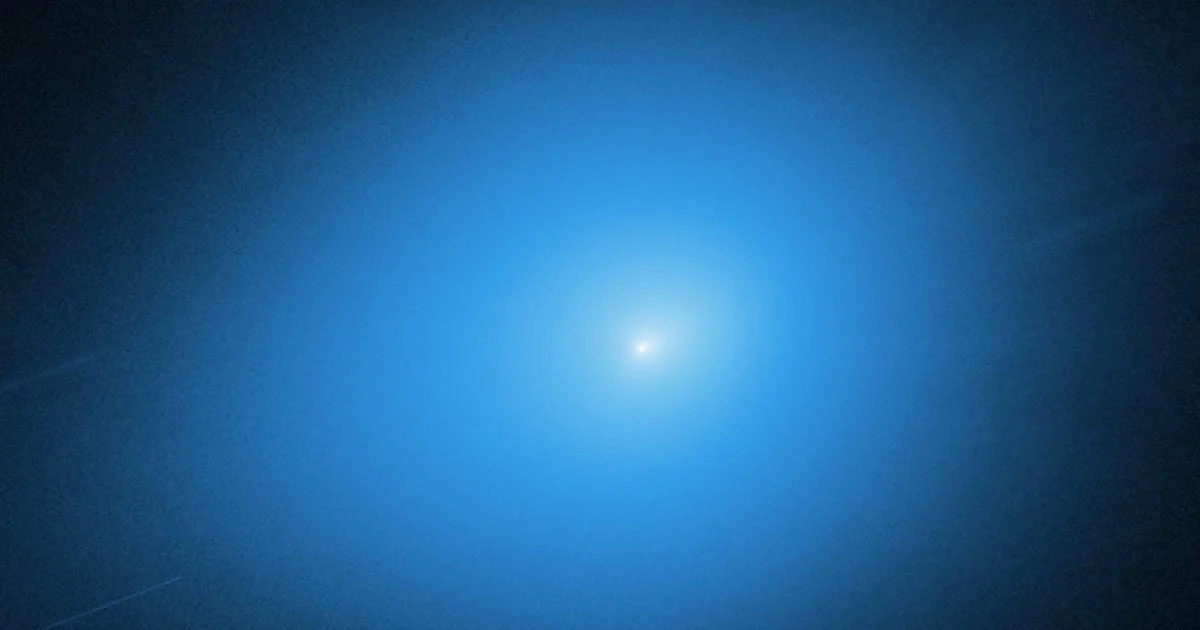
A recently studied interstellar comet, 3I/ATLAS, which passed through the solar system last year, could be the oldest and coldest object ever observed within our cosmic neighborhood, according to a new study published by an international team of astronomers. This discovery offers unprecedented insight into the composition and history of matter from beyond our solar system.
What Happened
3I/ATLAS, first detected in July 2025, is the third known comet to enter our solar system from interstellar space. Experts used data captured by the James Webb Space Telescope along with the Atacama Large Millimeter/submillimeter Array (ALMA) in Chile to analyze the comet’s isotopic composition. Researchers from NASA’s Goddard Space Flight Center headed the study, which identified unusual ratios of isotopes, indicating the comet might be up to 12 billion years old—far older than our 4.5-billion-year-old solar system.
Key Facts
The principal finding is the comet’s extremely high ratio of deuterium, a heavy isotope of hydrogen, which is about ten times greater than that found in solar system comets. According to Martin Cordiner, lead scientist from NASA Goddard, such a high abundance of deuterium suggests the comet formed in an environment with temperatures near -243 degrees Celsius, making it potentially one of the coldest objects studied. This chemical signature significantly differs from typical solar system bodies and points to an origin in a very cold and chemically primitive part of the Milky Way, possibly close to star-forming regions during what astronomers term “cosmic noon”—a period approximately 10 billion years ago marked by intense star formation activity.
What This Means
The findings offer critical evidence about the conditions in which primitive galactic objects formed and have endured over billions of years. For ordinary readers, this means we are beginning to understand the diversity of solid material that contributed to the early galaxy’s evolution long before the solar system existed. The comet’s survival over billions of years on vast trajectories around the Milky Way suggests that interstellar visitors could serve as time capsules, preserving chemical and thermal conditions from distinct epochs of galactic history. This deepens our perspective not only on the origins of comets but also on the chemical processes shaping galaxy evolution. Although 3I/ATLAS is now exiting the solar system and will not return, further detections of similar objects—such as those expected from the Vera C. Rubin Observatory in Chile—will enhance our understanding of material exchange across the galaxy and may reshape models of planetary system formation by offering real samples of primordial interstellar matter.
Background
Before 3I/ATLAS, only two other interstellar objects have been observed: ‘Oumuamua in 2017 and 2I/Borisov in 2019, neither bright enough to allow for detailed isotopic study. These previous observations had raised questions about interstellar matter composition but lacked sufficient data to draw definitive conclusions about their age or formation environments.
What Remains Unclear
Despite strong isotopic evidence, the exact origin location of 3I/ATLAS within the galaxy remains unknown. There are also “edge-case scenarios” not ruled out by scientists, which could offer alternative explanations for the comet’s unusual elemental makeup. Further study is needed to fully understand its formation history and the implications for galactic chemical enrichment.
What Comes Next
Astronomers anticipate detecting many more interstellar objects in the coming years with the Vera C. Rubin Observatory becoming operational. These future discoveries promise to broaden the field of interstellar research and provide additional data for comparative studies, potentially unlocking more secrets of the galaxy’s formative years.
Sources
This article is based on reporting and publicly available information from the following sources:
Read more Science Discoveries stories on Goka World News.