
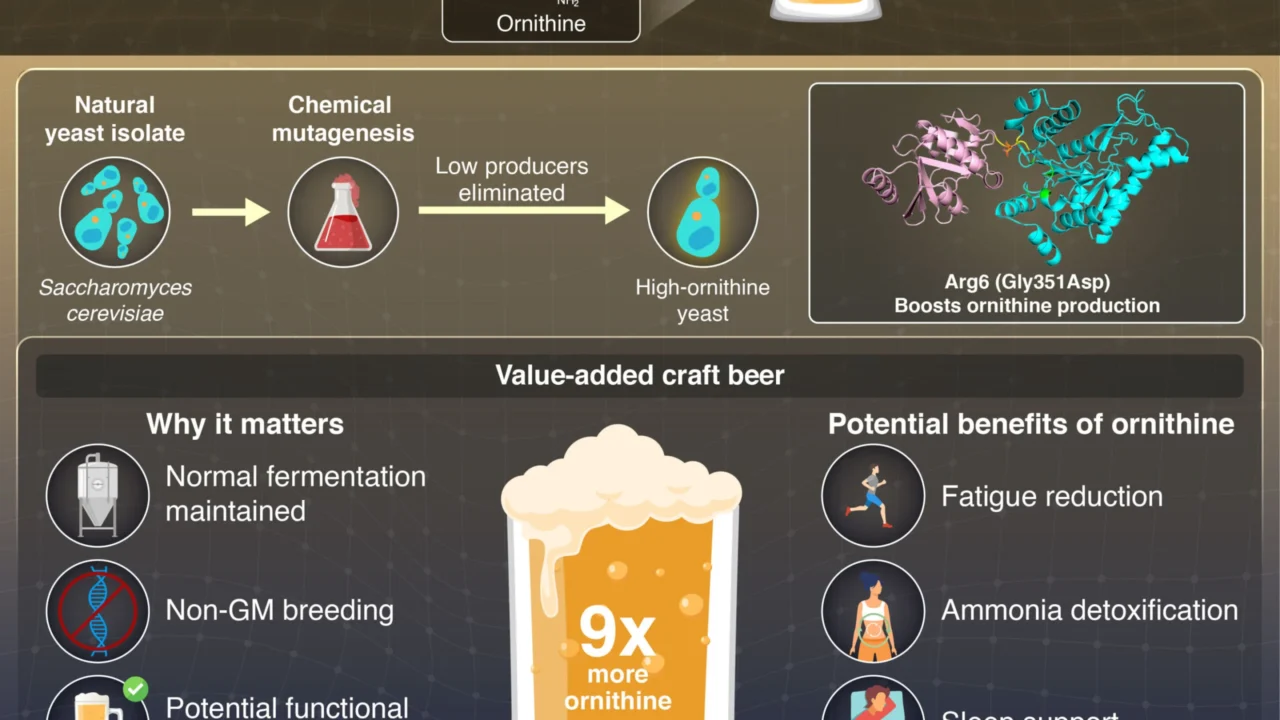
A research team at Japan’s Nara Institute of Science and Technology (NAIST) has developed a non-genetically modified (non-GM) brewing yeast strain that produces significantly higher levels of the amino acid ornithine during fermentation. This advance, combining traditional microbial breeding with modern molecular techniques, offers a practical route to crafting beer enriched with beneficial ornithine without sacrificing fermentation quality.
What Happened
Led by Professor Hiroshi Takagi and his colleagues, the Laboratory of Fermentation Science team started their study by isolating a wild strain of Saccharomyces cerevisiae from a university campus environment. Rather than applying gene editing, they induced mutations chemically and then selected candidate yeasts using canavanine, a toxic analog of arginine that challenges conventional metabolic pathways. Among hundreds of mutants, one strain named ADHorn49 exhibited more than nine times the intracellular ornithine concentration compared to the original strain.
Subsequent whole-genome sequencing pinpointed a single amino acid substitution—Gly351Asp—in the ARG6 gene, which encodes an enzyme key to ornithine biosynthesis. Introducing this precise mutation into other industrial brewing yeast strains consistently enhanced ornithine accumulation. Structural modeling suggested this mutation might weaken the enzyme’s usual metabolic regulation, allowing greater ornithine production. Importantly, fermentation trials confirmed that the mutant yeast produced carbon dioxide levels comparable to the parent strain, signifying unchanged fermentation efficiency, while secreting 7.0 mg/L of free ornithine into the beer.
Key Facts
The research was published in the Journal of Industrial Microbiology and Biotechnology in 2026. The mutant yeast strain ADHorn49 demonstrated an over ninefold increase in intracellular ornithine. Genome sequencing revealed the mutation as a Gly351Asp swap in ARG6, an enzyme critical for ornithine synthesis. Fermentation tests verified that CO2 output remained consistent with non-mutant yeast, while final broth ornithine concentration reached 7.0 mg/L, a level achieved under conditions relevant to commercial brewing. The combination of traditional chemical mutagenesis and modern genomic tools enabled this non-GM, practical enhancement.
What This Means
This development holds significance for the brewing and fermented food industries by offering a viable method to naturally enhance nutritional value during the fermentation process. Ornithine plays important roles in human metabolism, including urea cycle function and liver detoxification, which may make ornithine-enriched beer attractive to health-conscious consumers. The use of non-GM methods maintains broad consumer acceptance and regulatory ease compared to genetically engineered strains. Moreover, since the enhanced yeast retains industrial fermentation performance, producers can adopt the strain without altering existing brewing operations.
By leveraging wild yeast biodiversity and combining it with molecular insights, this research exemplifies how traditional and modern biotechnologies can intersect to innovate sustainably. It also suggests potential applications beyond brewing, such as in other fermented foods where amino acid enrichment is desirable without costly additives. This approach could pave the way for more naturally fortified products, aligning with consumer trends toward clean-label and functionally enhanced nutrition.
Background
Ornithine is a non-proteinogenic amino acid involved in several biological pathways, but enhancing its biosynthesis in brewing yeast is difficult due to tight metabolic regulation. Previous attempts to increase ornithine typically relied on genetic modification, which faces regulatory and consumer acceptance challenges. This study’s reliance on chemical mutagenesis and classical screening offers a distinct pathway to achieve similar metabolic results without direct genetic engineering.
What Remains Unclear
While the laboratory-scale fermentation performance of the mutant yeast has been demonstrated, large-scale brewing trials and long-term stability assessments remain to be conducted. The effects of elevated ornithine on beer flavor, shelf life, and consumer acceptance also await evaluation. Regulatory responses to non-GM yet genetically characterized strains may vary between regions and require further clarification.
What Comes Next
The research team has indicated plans to expand exploration of wild yeast biodiversity to identify additional strains with unique fermentation properties. Further development will likely include scaling fermentation tests and assessing the applicability of the ARG6 mutation in diverse industrial yeast backgrounds under commercial brewing conditions.
Sources
This article is based on reporting and publicly available information from the following source:
Read more Science Discoveries stories on Goka World News.