
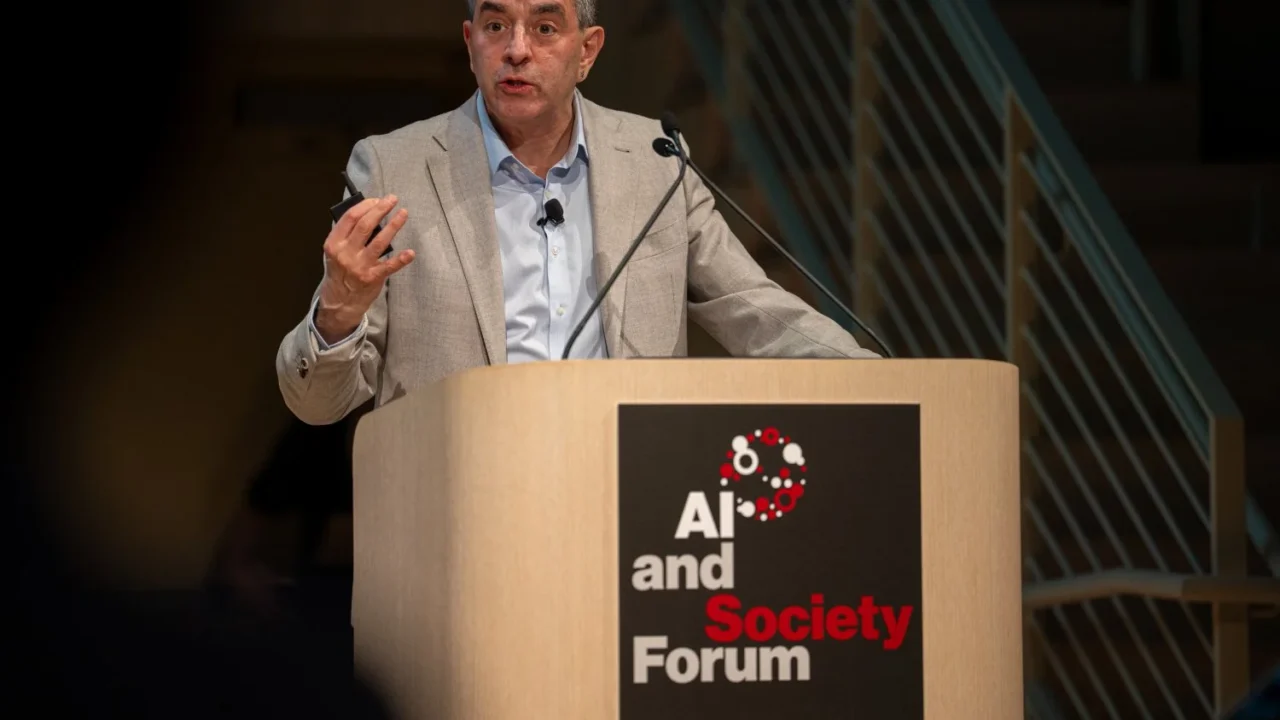
MIT recently hosted the AI and Society Forum to examine the broad societal impacts of artificial intelligence, focusing on labor market shifts and the future of democracy. Experts from MIT’s economics and computing departments, including leaders from its AI labs and social science schools, engaged in deep discussions about both the promise and risks presented by AI technologies.
What Happened
The event took place on May 12 at MIT’s Linde Music Building and brought together scholars and strategists across disciplines. Organized collaboratively by the School of Humanities, Arts, and Social Sciences (SHASS) and the Social and Ethical Responsibilities of Computing (SERC), the forum featured keynote speeches, panel discussions, and a performance illustrating AI’s role in creative arts. Prominent speakers included MIT Economics Professor David Autor, Computer Science Professor Daniela Rus, and political scientists examining AI’s effects on elections and governance. The event also presented research audits on how AI language models interact with election information during the 2024 U.S. presidential cycle, highlighting concerns about bias and misinformation.
Key Facts
MIT’s digital and social sciences faculties collaborated under the umbrella of initiatives such as the MIT Generative AI Impact Consortium (MGAIC) and the MIT Human Insight Collaborative (MITHIC). David Autor challenged the prevailing notion that AI will only eliminate jobs, articulating that AI’s influence depends on whether it substitutes routine or expert human tasks, potentially creating new specialized roles. Panels moderated by consultants and academics from McKinsey & Company and MIT’s Schwarzman College addressed how AI could enhance workplace efficiency while underlining the critical role of human judgment in decision-making.
Research led by Chara Podimata focused on auditing biases in AI chatbots relating to election information, demonstrating significant variance in responses based on demographic inputs. Other political science experts raised warnings about potential disruptions AI could introduce to democratic processes, particularly around elections, with concerns about misinformation, erosion of democratic rituals, and the slow adaptability of government institutions compared to technology’s pace.
What This Means
The discussions held at MIT underscore the complex dual nature of AI’s integration into society. Rather than simply replacing jobs, AI may transform labor markets by reallocating value toward specialized expertise and requiring proactive policy interventions such as workforce retraining and wage protections to mitigate displacement. This highlights the importance for governments, employers, and educators to anticipate shifts and prepare workers for evolving roles that leverage uniquely human skills alongside AI.
On democracy, the forum illuminated the risks posed by AI-powered misinformation and the uneven adoption of AI technologies within political systems. The potential for AI to accelerate democratic decision-making contrasts with fears that it may erode key participatory rituals and increase systemic vulnerability to manipulation. This dialogue suggests that incorporating democratic values—such as transparency, inclusiveness, and autonomy—into AI design and deployment is crucial to preserve political legitimacy in a technologically advanced society.
Ultimately, the forum reflects a growing recognition among leading technologists and social scientists that managing AI’s societal impacts demands interdisciplinary collaboration. The convergence of technical expertise and an understanding of human and political dynamics will be vital to harness AI’s benefits without disproportionate harm.
Background
MIT’s longstanding leadership in AI research is exemplified by its Computer Science and Artificial Intelligence Laboratory (CSAIL) and affiliated initiatives like MGAIC that focus on assessing generative AI’s societal consequences. The institution has increasingly emphasized ethical and social considerations alongside technical innovation, aligning with the growing global focus on responsible AI development.
What Comes Next
MIT plans to continue its interdisciplinary inquiry into AI’s impact with further studies, including ongoing auditing of AI’s role in the 2026 U.S. midterm elections. These efforts seek to refine understanding of AI bias and develop safeguards for democratic integrity. Meanwhile, researchers advocate for policy frameworks to support workforce adaptation as AI technologies mature and diffuse more widely across industries.
Sources
This article is based on reporting and publicly available information from the following sources:
Read more Artificial Intelligence stories on Goka World News.