
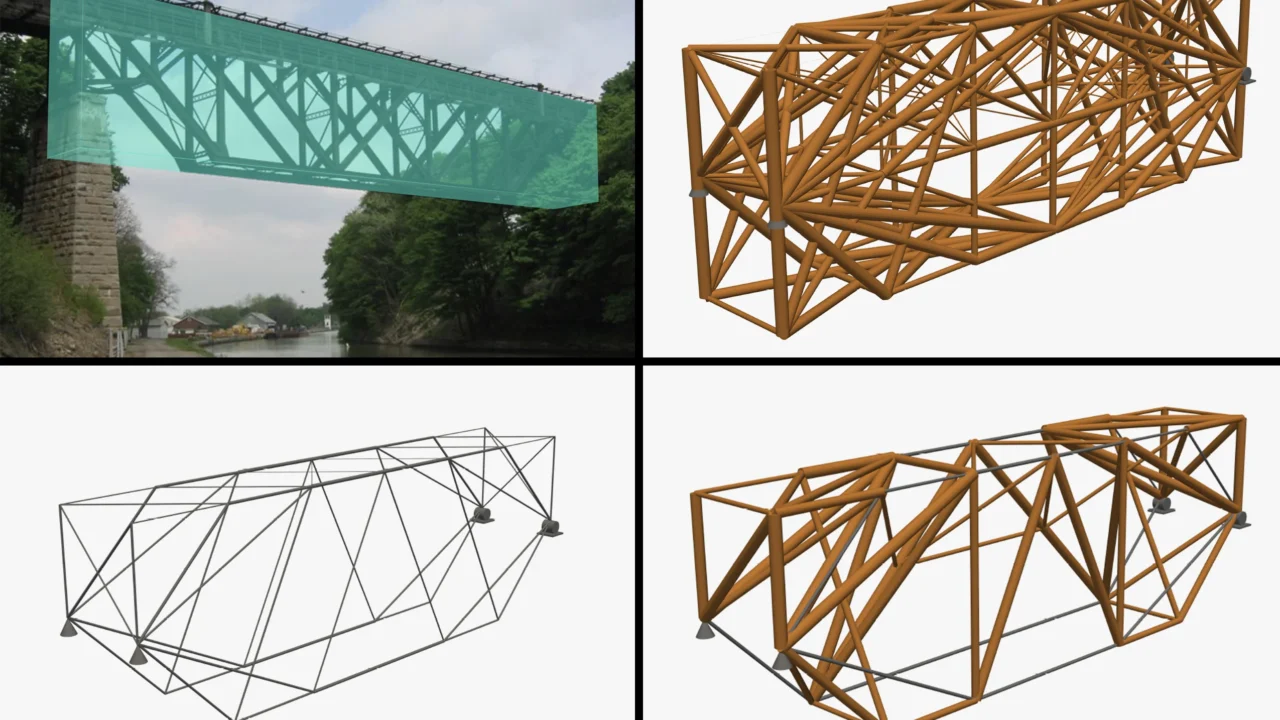
MIT researchers have unveiled a novel computational framework that enhances topology optimization to create building and bridge structures using significantly less material while ensuring their practical buildability. Published in Automation in Construction, this method addresses longstanding issues that have limited the adoption of topology optimization in large-scale engineering projects, where designs must be both efficient and feasible to construct on budget and schedule.
What Happened
Topology optimization is a computational technique that distributes material in a structure to maximize strength while minimizing weight. Although capable of reducing material usage by up to 90%, it has mostly been confined to laboratory-scale applications such as 3D printing, due to the complexity of resulting designs which are difficult to build using conventional construction methods.
Led by Josephine Carstensen, MIT’s Gilbert W. Winslow Career Development Professor in Civil Engineering, the research team developed an approach that integrates user-defined constraints—such as limiting the number of parts meeting at a point, minimum part size, and allowable angles between components—to simplify and make the designs more practical to build. Their method also incorporates different material properties and enables designs combining steel and wood components optimized for load distribution and environmental impact.
Key Facts
The study, published in Automation in Construction in 2024, was conducted by Josephine Carstensen and first author Zane Schemmer, a PhD student in civil and environmental engineering at MIT. Their work focused on truss structures typical for buildings and bridges. The researchers employed mixed integer algorithms to handle discrete decisions regarding material selection and connection design, improving the realism of structural models. Using the example of the Lockport “Upside-Down Bridge” near Buffalo, New York, the team demonstrated that applying practical constraints significantly alters the design and potential carbon footprint of structures.
What This Means
This breakthrough has the potential to bridge a crucial gap between theoretical carbon savings possible through optimized designs and the actual reductions achievable in real-world construction. Traditional topology optimization creates efficient but overly complex designs that deter contractors and engineers. By tailoring structural complexity and material use with direct user input, MIT’s framework enables designs that are not only environmentally sustainable but also practical and feasible for widespread industry adoption.
For the construction industry, this means a new pathway to substantially lower the carbon emissions linked to building materials—which contributed over 7% of global carbon emissions in 2022—without sacrificing structural integrity or buildability. The ability to balance multiple materials such as steel and timber based on location-specific availability and carbon costs further supports sustainable infrastructure development worldwide.
In the broader context of climate action, enhancing design tools to reduce material waste during construction represents a strategic intervention point. It empowers engineers to make better decisions early in the design phase, where material choices have the most significant impact on a project’s carbon footprint.
What Remains Unclear
The researchers acknowledge that further validation of their computational framework is necessary, particularly through constructing scaled-down physical models based on their designs. Additionally, while the framework currently handles steel and wood, expanding it to include a wider array of materials and more extensive infrastructure types remains a future goal.
What Comes Next
The MIT team plans to develop prototype structures using their optimized, constructable designs to empirically test and refine the model’s performance. They also aim to incorporate additional constraints to improve usability for structural engineers and facilitate integration into standard design workflows. This advancement could accelerate the deployment of low-carbon building practices at scale.
Sources
This article is based on reporting and publicly available information from the following sources:
Read more Science & Technology stories on Goka World News.