
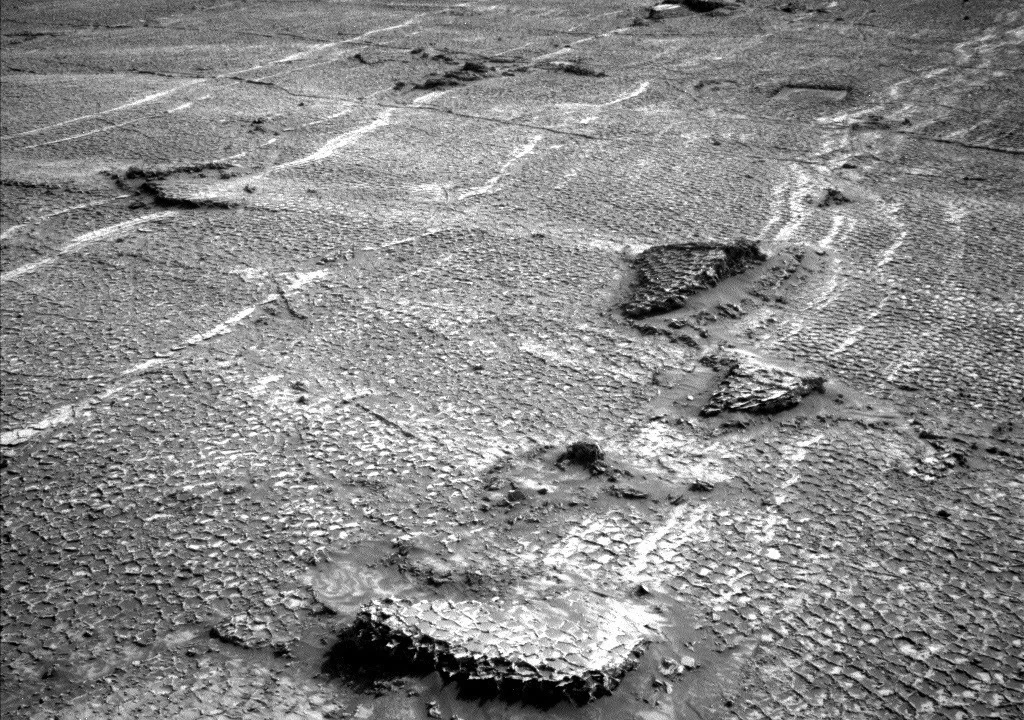
NASA’s Curiosity rover has uncovered unexpected geological features on Mars while exploring an area that initially appeared smooth in orbital images. Close-up imaging revealed complex textures, including polygons, veins, and laminations, challenging prior assumptions based on remote observation.
What Happened
During the planning period around June 18, 2026 (sols 4927–4933), the Mars Science Laboratory team directed Curiosity to drive approximately 35 meters (115 feet) toward a terrain patch that appeared smooth and promising for deploying its Dust Removal Tool (DRT). This target area was selected based on orbital images that showed fewer surface irregularities. However, post-drive images taken by the rover’s Mast Camera revealed a richly textured surface featuring small-scale geological formations not visible from orbit.
Following the discovery, the mission team scheduled extensive imaging to document the site. Mast Camera took a full left-eye panorama and detailed right-eye mosaics. ChemCam captured Remote Micro Imager pictures and conducted laser-induced breakdown spectroscopy (LIBS) analyses on three selected rock targets named “Rio Chimore,” “Rio de Lava,” and “Rio de Salta.” Meanwhile, the Alpha Particle X-Ray Spectrometer (APXS) examined the bedrock and ridge targets known as “Pampa Grande” and “Iquique Ridge.” The Mars Hand Lens Imager (MAHLI) provided highly detailed close-up imagery to further analyze the fine structures.
Key Facts
The rover operated near the Cordillera base outcrop, an area mapped via orbital images highlighting various surface textures in orange and beige hues. The drive covered about 35 meters to a pre-identified smooth-looking site from orbit, where Curiosity planned to use its DRT. Although the terrain looked smooth remotely, close inspection revealed polygons and veins just a few centimeters across—features too small to be seen in navigation or Mastcam images from a distance.
The ChemCam instrument used LIBS to analyze the chemical composition of multiple rock targets, and passive spectral observations were conducted on additional blocks. Environmental monitoring, including dust devil detection and atmospheric opacity measurements, continued alongside geological investigations.
What This Means
This unexpected discovery underscores the value of in situ exploration compared to orbital reconnaissance alone. The revealing of small-scale geological features such as polygons and veins indicates complex surface processes that cannot be detected remotely, offering new insights into Mars’ geological history.
Understanding these fine surface details has direct implications for reconstructing the planet’s past environmental conditions, such as water activity and climatic changes. These features might point to past interactions between different minerals and fluids, expanding scientists’ knowledge of Martian geochemistry and habitability potential.
For the public and the scientific community, this finding also emphasizes the necessity of carefully combining orbital and rover data to interpret extraterrestrial landscapes accurately. It demonstrates the dynamic challenges in planetary geology and the continuing surprises Mars holds for exploration missions.
Background
The team planning this exploration area used geological maps based on orbital imagery, color variations, and surface roughness to identify promising sites for Curiosity’s detailed study. Prior investigations at the Cordillera outcrop had highlighted useful targets for rock compositional analysis using ChemCam, APXS, and MAHLI instruments. This ongoing approach allows researchers to systematically characterize diverse Martian terrain types, enhancing understanding of sedimentary and surface-alteration processes.
What Comes Next
The mission team will continue analyzing the high-resolution images and spectral data collected to identify mineralogical compositions and geological formation mechanisms at this site. Further drives will explore adjacent terrain features that exhibit similarly intriguing textures and compositions, aiming to build a broader geological context around the rover’s position on Mars.
Sources
This article is based on reporting and publicly available information from the following sources:
Read more Space & NASA stories on Goka World News.