
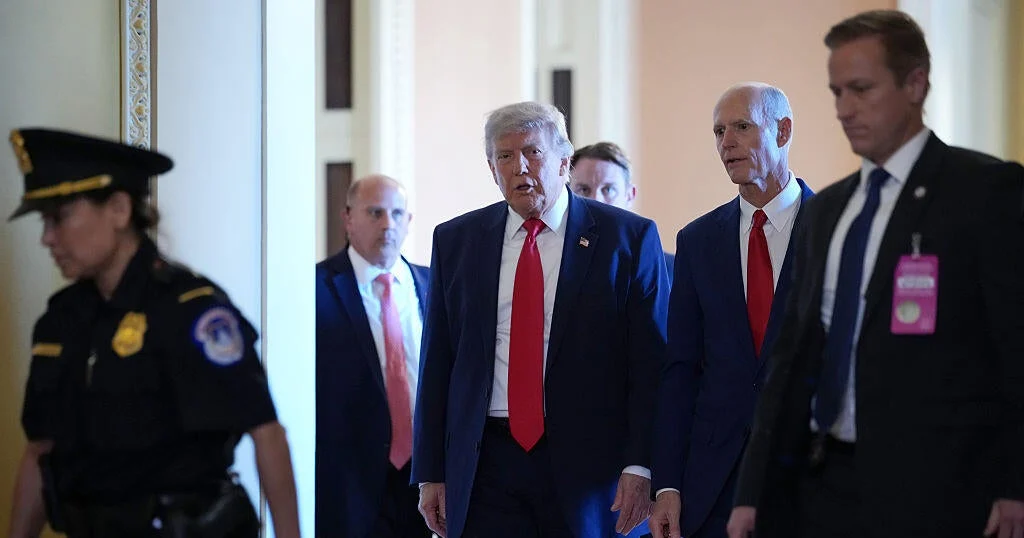
President Donald Trump held a tense meeting with Senate Republicans on June 24, where he sharply criticized colleagues who supported a Democrats-led Iran war powers resolution and pressed for passage of his signature SAVE America Act. The more-than-hourlong gathering included a heated exchange with Louisiana Sen. Bill Cassidy, illustrating deep divisions within the GOP ahead of the November midterm elections.
What Happened
The meeting centered primarily on legislative battles over the War Powers Resolution and the SAVE America Act. Earlier on June 23, the Senate approved a symbolic Democrat-led resolution intended to restrict the president from ordering further military action against Iran. Four Republicans, including Cassidy, voted in favor. President Trump expressed frustration with these senators, particularly targeting Cassidy, who had recently lost the Louisiana Republican primary to a Trump-backed challenger.
During the meeting, Cassidy attempted to respond to the president but was told to sit down by Trump in a sharp moment of confrontation. Cassidy acknowledged raising his voice as well but emphasized he was standing up for the American people despite the tension. Alaska Sen. Lisa Murkowski arrived late and later criticized Trump’s decision to delay signing a bipartisan housing bill until the SAVE America Act passes, stating that holding up his own agenda was unhelpful.
Trump also suggested eliminating the Senate filibuster to secure the SAVE America Act’s passage, a controversial move opposed by Senate GOP leadership. The president told senators Republican voter turnout in November hinged on passing the bill, which includes a requirement for voters to prove citizenship at registration. Despite the president’s pressure, Senate Republicans have indicated the bill currently lacks the necessary support.
Key Facts
The Senate approved the concurrent Iran war powers resolution on June 23 with four Republicans joining Democrats in support. Sen. Bill Cassidy did not advance to the runoff in the 2026 Louisiana GOP Senate primary, which was backed by Trump. Trump’s SAVE America Act includes voter ID provisions requiring proof of citizenship to register to vote. Senate GOP leaders oppose eliminating the filibuster, a move Trump advocated during the meeting. The bipartisan housing bill signing was postponed by Trump pending passage of the SAVE America Act.
What This Means
This meeting highlights ongoing divisions within the Republican Party as it navigates key strategic and legislative priorities. Trump’s confrontational tone toward senators who diverge from his agenda underscores his influence over the party base, especially on election-related measures like the SAVE America Act. The tension over the War Powers Resolution reflects broader concerns about executive military authority and the role of Congress in foreign policy decisions, a hot-button topic as conflict in Iran remains unresolved.
For GOP senators, balancing Trump’s demands with the reality of Senate arithmetic presents a complicated legislative landscape. The president’s push to eliminate the filibuster to pass controversial voting laws reveals how intra-party dynamics on Capitol Hill can shape not only policy outcomes but also how Republicans position themselves ahead of the 2026 midterms. Ordinary voters watching this debate may see it as a test of party unity and priorities, with implications for governance and election law reform.
Background
The Iran war powers resolution came after escalating tensions and military actions involving the U.S. and Iran, with Democrats leading efforts to assert congressional oversight. Trump’s SAVE America Act is a core part of his post-2024 political agenda, outlining stricter voter registration requirements. The filibuster, which requires 60 votes to advance most legislation in the Senate, has been a longstanding procedural tool that some Republicans fear eliminating could backfire politically.
What Remains Unclear
It remains uncertain whether the SAVE America Act can gain enough support in the Senate given GOP leadership resistance and internal opposition. Also unclear is whether the president will sign any bipartisan legislation, such as the housing bill, without prior passage of his preferred election reform package. The final stance of several moderate Republican senators on both the filibuster and the voting law is still developing.
What Comes Next
The Senate is expected to continue discussions on the Iran war powers resolution and consider upcoming legislative calendars that may address the housing bill and other bipartisan measures. There has been no official announcement on if or when the SAVE America Act will come to a full vote. The November midterms will likely heighten pressure on GOP senators to align with Trump’s agenda or face primary challenges backed by the former president.
Sources
This article is based on reporting and publicly available information from the following source:
Read more Politics stories on Goka World News.