
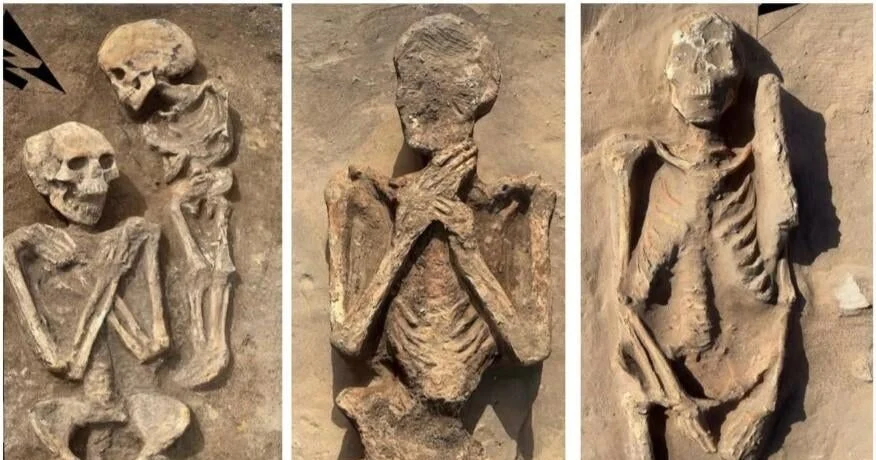
Archaeologists in Egypt have uncovered a significant Greco-Roman burial ground located in Tell Kom Aziza, in the Nile Delta’s northern Beheira province, which reveals over 2,300 years of changing burial traditions. The site’s extensive remains illustrate a transition from a settlement hub into a cemetery, documenting funerary practices spanning approximately from 332 B.C. to 395 A.D.
What Happened
The Tell Kom Aziza excavation has revealed a diverse array of human burials and associated artifacts that span six centuries, providing rare insights into ancient funerary practices. Remains found range from simple earth pits to complex graves lined with mudbricks and painted plaster coffins. Archaeologists identified both individual and collective burials with variations in the orientation of graves—some aligned north-south, others east-west. The body positioning varied as well, with some interred in the “Osirian pose” (arms crossed over the chest), and others with arms folded over the pelvis or resting along the thighs.
The site includes not only human remains but also the complete skeletal remains of two wild boars, a rare find in Egyptian burial contexts. These animals symbolized the deity Seth, associated with chaos and violence in Egyptian mythology, hinting at potential ritual significance. A broad collection of pottery fragments, spanning from the Egyptian Old Kingdom (circa 2686–2181 B.C.) to the Greco-Roman period, were also unearthed, suggesting prolonged or repeated use of the site.
Key Facts
According to the Egyptian Ministry of Tourism and Antiquities, the burials date from approximately 332 B.C. through 395 A.D. This timeline covers parts of the Greco-Roman era and demonstrates continuous cultural shifts over six centuries. Burial types include simple pits, mudbrick-lined graves, and painted plaster coffins, indicating evolving funerary craftsmanship.
Animal remains, specifically two complete wild boar skeletons, are notable for their rarity and religious symbolism linked to the god Seth. Pottery shards dating as far back as the Old Kingdom reflect the site’s long-standing human activity, spanning over two millennia.
What This Means
The discovery at Tell Kom Aziza provides a tangible record of how burial customs in Egypt evolved over centuries under shifting cultural, religious, and social influences. For communities today and historians, this site offers a lens into the complexities of identity, religion, and societal organization in ancient Egypt. The changes in burial styles reflect not only variations in ritual and social hierarchy but also the influence of Greco-Roman culture on traditional Egyptian practices.
This evolving funerary landscape highlights how human settlements can transform over millennia, shifting from living spaces into sacred grounds. Understanding these transformations helps explain patterns of cultural adaptation and religious syncretism in antiquity, which continue to shape Egypt’s heritage tourism and archaeological studies.
Background
The Tell Kom Aziza site is located near the Mediterranean coast within the fertile Nile Delta, an area rich with ancient human activity. Egyptian archaeological records already show extensive burial grounds from the Greco-Roman period, but this discovery stands out for its detailed documentation of funerary evolution and the diversity of burial types over an extended period.
Previous excavation efforts in the region uncovered Greco-Roman cemeteries, but the current finds deepen the understanding of how local Egyptian traditions merged with external cultural influences throughout antiquity.
What Remains Unclear
While the skeletal remains of wild boars were found, it remains uncertain whether these animals were purposefully buried with ritual intent or simply incidental inclusions related to domestic or economic activities. Further analysis is ongoing to determine their precise cultural role.
The full extent of the settlement’s transformation into a burial ground, including exact timelines and social dynamics, is still being studied as excavations continue.
What Comes Next
Excavations remain active at Tell Kom Aziza as archaeologists seek to uncover more artifacts and burials, aiming to piece together a comprehensive timeline of human activity and funerary tradition changes. The team intends to integrate these findings into broader historical narratives concerning ancient Egyptian and Greco-Roman cultural interplay.
Sources
This article is based on reporting and publicly available information from the following source:
Read more Science Discoveries stories on Goka World News.