
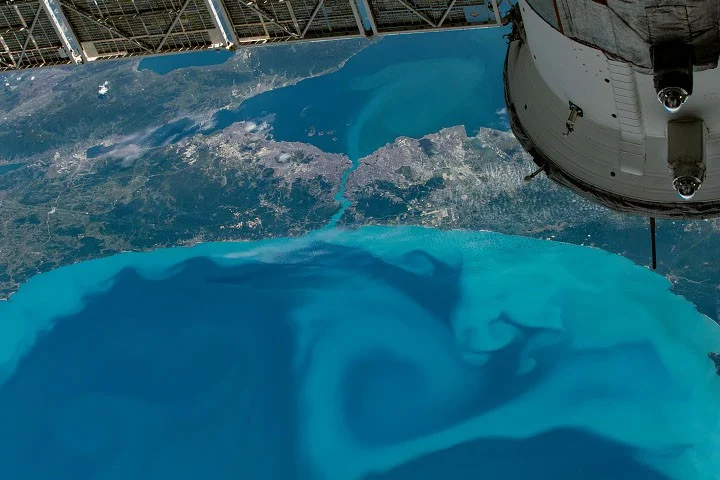
NASA’s PACE satellite observed an extensive milky blue-green phytoplankton bloom transforming the surface of the Black Sea and adjacent waterways during the spring and summer of 2026. The turquoise tint, caused primarily by coccolithophores—microscopic algae with calcium carbonate plates—was captured in high-resolution imagery, highlighting seasonal changes in this vital marine region.
What Happened
On June 22, 2026, the Ocean Color Instrument (OCI) aboard NASA’s PACE (Plankton, Aerosol, Cloud, ocean Ecosystem) satellite captured detailed imagery of the Black Sea waters exhibiting a striking turquoise hue. This coloration corresponds to large blooms of coccolithophores, known to peak in late spring and early summer. A month earlier, on May 27, 2026, an astronaut aboard the International Space Station photographed the Bosphorus Strait near Istanbul, showing similar blooms tracing the currents in this narrow but ecologically significant waterway connecting the Black Sea to the Sea of Marmara.
Key Facts
The turquoise coloration results from coccolithophores shedding calcium carbonate plates that scatter sunlight, producing the milky blue appearance visible even from orbit. These blooms differ from the darker water color caused by diatoms, another dominant type of microscopic algae. NASA’s imagery combined the satellite data from PACE’s OCI with astronaut photographs from the ISS Expedition 74 crew. Official data were sourced from NASA’s Earth Observing System Data and Information System (EOSDIS) and the Ocean Biology Distributed Active Archive Center (OB.DAAC).
What This Means
This recurring coccolithophore bloom is more than a visual spectacle; it plays an essential role in the region’s carbon cycle. As these phytoplankton photosynthesize, they absorb carbon dioxide from the atmosphere, storing it in their calcium carbonate plates. When the algae die and sink, they transport carbon to the seafloor, potentially locking it away for long periods. Understanding the timing, extent, and frequency of these blooms via satellite monitoring offers valuable insights into carbon sequestration processes in marine ecosystems.
Additionally, the ability to detect blooms remotely enables researchers to monitor ocean health and productivity over areas where direct sampling is difficult or sparse. Tracking these patterns also aids in studying marine food webs, nutrient cycles, and the impacts of climate variability on regional seas that bridge continents—critical factors for communities and industries relying on these waters.
Background
The Black Sea is a transcontinental inland sea, bordered by Europe and Asia, connected to the Mediterranean through a series of straits and seas. It experiences seasonal phytoplankton variations, with coccolithophores dominating late spring into summer, while diatoms are more prevalent at other times. Past NASA Earth Observatory reports from 2012 and 2022 also documented similar bloom phenomena, underscoring the cyclical nature of these events.
What Comes Next
NASA continues to use the PACE mission and Earth-observing platforms like the ISS to regularly monitor the Black Sea’s biogeochemical changes. Future image captures and data analyses aim to determine whether the 2026 coccolithophore bloom represents an anomalous event or fits within emerging regional trends influenced by environmental changes.
Sources
This article is based on reporting and publicly available information from the following sources:
Read more Space & NASA stories on Goka World News.