
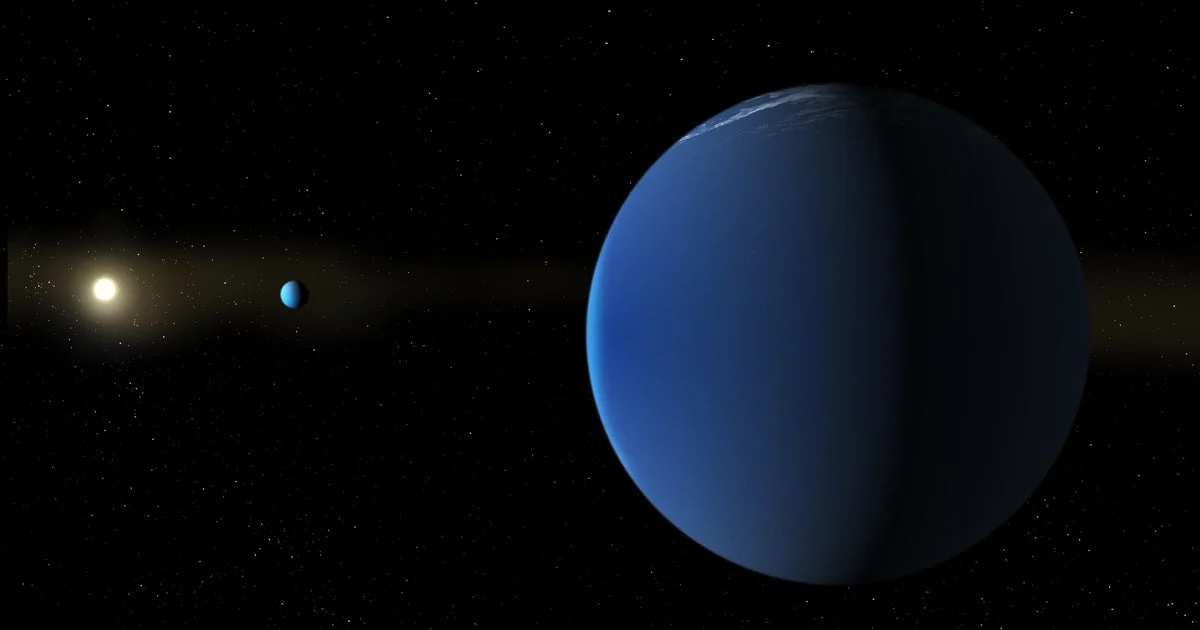
Astronomers have identified two giant exoplanets with astonishingly low densities, lighter than cotton candy, orbiting a distant star approximately 1,110 light-years from Earth. The discovery, reported by researchers from the University of Oxford and published in Monthly Notices of the Royal Astronomical Society, introduces a rare class of “super-puff” planets that challenge traditional understanding of planetary composition and formation.
What Happened
The pair of inflated gas giants were detected using data collected over the past decade by NASA’s Transiting Exoplanet Survey Satellite (TESS). These super-puffs orbit a star located in the southern constellation Volans, also known as the flying fish. Follow-up observations from Earth-based telescopes helped confirm the planets’ remarkably low densities. One planet completes an orbit around its host star every 139 days, while the other takes 232 days, indicating unusually long orbital periods for planets of their kind.
Key Facts
The two exoplanets are as large as Jupiter yet have densities even lower than cotton candy or shaving foam, according to lead researcher George Dransfield of the University of Oxford. Jupiter, by comparison, is up to 35 times denser than these newly discovered worlds. Their bulk likely consists mostly of hydrogen and helium, but precise chemical compositions await validation through future observations with NASA’s James Webb Space Telescope.
Super-puffs are exceedingly rare—of the nearly 6,300 confirmed exoplanets cataloged by NASA, fewer than 40 belong to this category. These planets are thought to form within gas-rich protoplanetary disks around newborn stars, where an abundance of gas relative to dust allows expansive, low-density atmospheres to develop. Over time, such planets lose much of their gaseous envelopes, making the survival of super-puffs an unusual phenomenon.
What This Means
The discovery of these ultra-low-density planets provides an intriguing puzzle for planetary scientists attempting to understand the diverse processes behind planet formation and evolution. Their existence suggests that under certain conditions, enormous planets can maintain extended, fluffy atmospheres for longer periods than previously anticipated. This could affect models of atmospheric loss and composition, with implications for the characterization of exoplanets as future study targets.
For the broader scientific community and space exploration efforts, these findings highlight the complexity of planetary systems beyond our own and underscore the value of missions like TESS and the James Webb Space Telescope in uncovering exotic worlds. Studying such super-puff planets could ultimately refine our knowledge of how solar systems form, evolve, and what variety of planetary types they may contain.
Background
The term “super-puff” refers to planets with unexpectedly large radii relative to their mass, resulting in extremely low densities. A similar super-puff planet was reported in 2024, located about 1,200 light-years away, noted then as a “cosmic mystery” due to its fragility and structure. The challenge posed by these planets is in explaining how such low-density atmospheres can remain intact instead of dissipating over time.
What Comes Next
Researchers are eagerly awaiting further study using NASA’s James Webb Space Telescope, which will provide more detailed spectral data to confirm the atmospheric composition of these super-puffs. Such observations will be critical in establishing whether the atmospheres are primarily hydrogen and helium and understanding their formation and erosion processes. Continued monitoring of these planets’ orbits and properties will help astrophysicists refine models of planetary development under extreme conditions.
Sources
This article is based on reporting and publicly available information from the following sources:
Read more Science Discoveries stories on Goka World News.