
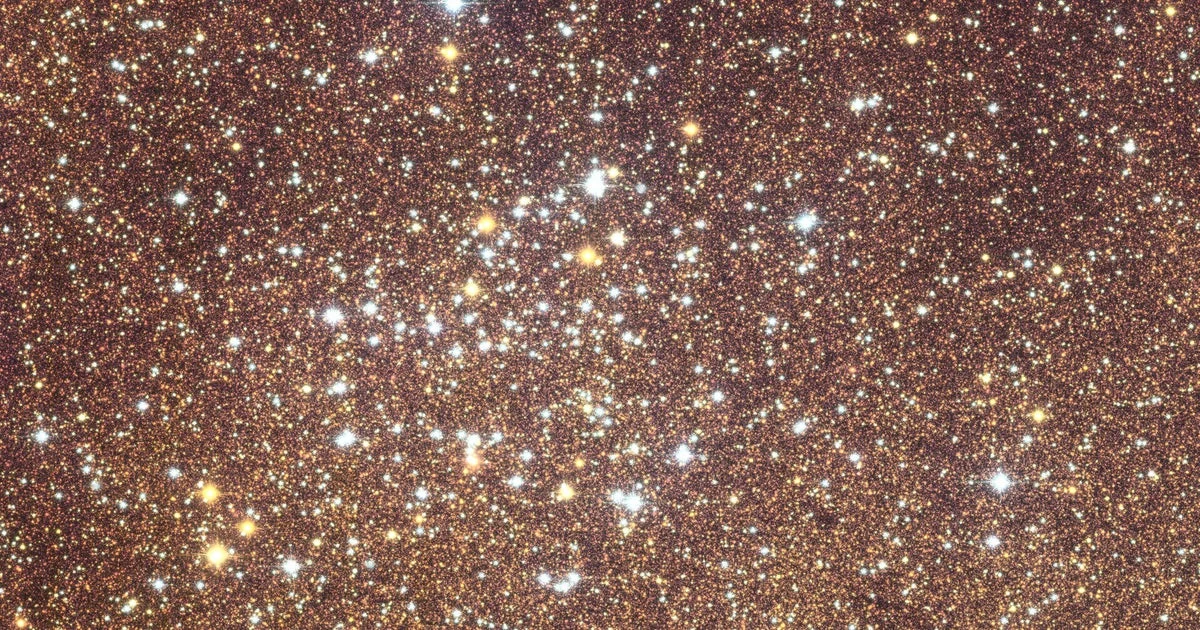
The European Space Agency’s (ESA) Euclid space telescope has captured the largest and most detailed image ever taken of the Milky Way’s densely packed central region, known as the galactic bulge. This groundbreaking photo, containing about 60 million stars, promises to enhance researchers’ ability to study planets beyond our Solar System by improving measurements through gravitational microlensing.
What Happened
In March 2025, Euclid focused on the brightly luminous center of our spiral galaxy, composing a mosaic image from nine separate photographs, each covering an area of the sky larger than the Moon. The image was gathered over 26 hours by Euclid’s visible light camera while the spacecraft was positioned roughly 930,000 miles from Earth. Originally captured in black and white, color was subsequently added using observations from the Canada-France-Hawaii Telescope.
French astronomer Jean-Charles Cuillandre, a member of the Euclid mission team, described the galactic bulge as a massive bubble housing billions of stars. The intent of this imaging effort goes beyond aesthetics—it is a strategic step toward advancing the study of exoplanets by employing the microlensing technique, in which a closer star acts as a “cosmic magnifying glass” to bend and brighten the light of a more distant background star.
Key Facts
The image showcases about 60 million stars within the Milky Way’s bulge. Euclid’s ability to capture such a detailed view of this crowded region marks the largest-scale imaging of the galaxy’s center to date. Euclid was launched in 2023 from Cape Canaveral via a SpaceX Falcon 9 rocket and now orbits about one million miles from Earth, beyond the Moon’s orbit.
Over its six-year mission, Euclid aims to map one-third of the sky to better understand dark matter and dark energy. It has previously captured significant images of distant galaxy clusters, such as Abell 2390 and the Perseus cluster. The current image contains 51 known planetary systems and will assist in the analysis of many more expected discoveries.
What This Means
This most detailed image of the Milky Way’s bulge offers powerful insights into the distribution and mass of stars at the galaxy’s core, a region fundamental to understanding the structure and evolution of our spiral galaxy. For ordinary viewers, this image provides an unprecedented glimpse into a crowded star field that is usually obscured, deepening our appreciation of the cosmos.
From a scientific perspective, Euclid’s breakthrough photograph enhances the precision of microlensing studies, a method key to locating and weighing planets orbiting stars even in these densely packed regions. This can refine estimates of exoplanet populations and characteristics, impacting future astronomical surveys and the search for potentially habitable worlds.
Furthermore, Euclid’s broader mission to chart vast portions of the sky will improve knowledge about mysterious cosmic forces such as dark matter and dark energy, which shape the large-scale universe and influence the environment of galaxies—including the Milky Way.
Background
Since its 2023 launch, Euclid has been tasked with imaging the universe with sensitivity to both visible and near-infrared light, targeting the dark components of the cosmos. Previous Euclid images have revealed distant galaxy clusters billions of light-years away, contributing to the study of cosmic structure formation.
The microlensing technique referenced in this mission has been successfully used over the past two decades, primarily by ground-based telescopes, to discover nearly 300 exoplanets by detecting light variations caused by gravitational effects from intervening stars and planets.
What Comes Next
Euclid will continue its six-year mission capturing further sky surveys, enhancing catalogues of stellar and planetary objects within the galaxy and beyond. The detailed data from the galactic bulge will undergo analysis to better quantify exoplanet signals and could inform follow-up observations by future space telescopes devoted to exoplanetary science.
Sources
This article is based on reporting and publicly available information from the following sources:
Read more Space & NASA stories on Goka World News.