
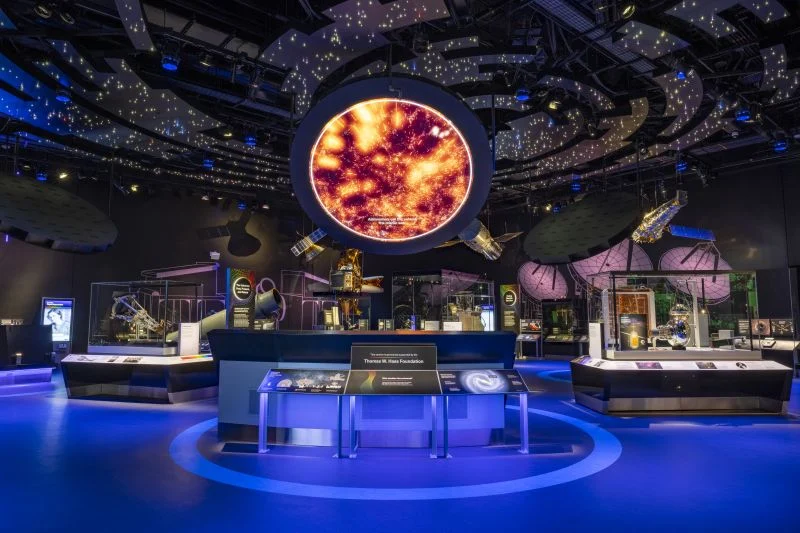
The Smithsonian’s National Air and Space Museum in Washington, D.C., is set to open the “U.S. National Science Foundation Discovering Our Universe” gallery to the public on July 1. Launched in celebration of the museum’s 50th anniversary, the gallery highlights the transformative role that advanced astronomical instruments have played in expanding our understanding of the universe’s origin, composition, and evolution.
What Happened
This newly unveiled gallery chronicles decades of astronomical research funded and supported by the National Science Foundation (NSF). It showcases key artifacts and explains how improvements in measurement precision have led to major scientific breakthroughs. Visitors can explore historical milestones, from early discoveries to contemporary advances such as the first-ever black hole image captured by the Event Horizon Telescope and the detection of gravitational waves by the Laser Interferometer Gravitational Observatory (LIGO).
Additional highlighted instruments include the spectrograph used by Vera Rubin that provided the first evidence for dark matter and a neutrino detector that identified neutrinos originating beyond our galaxy. Through these exhibits, guests learn how astronomical inquiry evolves, revealing new mysteries with each discovery and advancing humanity’s exploration of cosmic phenomena.
Key Facts
The Discovering Our Universe gallery is part of the Smithsonian National Air and Space Museum’s 50th anniversary initiative and opens as the nation approaches its 250th birthday. The museum is located at 650 Jefferson Drive S.W., Washington, D.C., and is open daily except Christmas, from 10 a.m. to 5:30 p.m. Admission is free but requires timed-entry passes for visiting.
The exhibit features authentic, historically significant instruments from NSF-supported projects, emphasizing tools that marked paradigm shifts in astrophysics research. The gallery is designed with accessibility in mind, including audio descriptions, tactile exhibits, and a hands-on Discovery Cart to enhance public engagement and learning experiences.
What This Means
The new NSF gallery offers more than static displays; it represents the ongoing evolution of our cosmic understanding driven by technological innovation. For the public, it provides a tangible connection to how abstract scientific concepts—such as black holes, gravitational waves, dark matter, and cosmic neutrinos—were revealed through persistent inquiry and cutting-edge instrumentation. This fosters an appreciation of both the complexity and the accessibility of astronomical science.
By incorporating interactive elements and educational programming, the exhibit extends the museum’s reach beyond its physical walls, supporting classrooms globally. It illustrates how foundational research investments enable groundbreaking insights that shape not only scientific knowledge but also inspire generations to pursue STEM fields. The gallery’s celebration of astronomy’s past achievements alongside future research prospects situates visitors as part of a shared journey toward understanding the universe.
Background
The gallery draws on historical milestones in astronomy that have reshaped physics and cosmology. For example, Vera Rubin’s use of spectrography during the late 20th century provided key evidence validating the existence of dark matter, a major unsolved problem in astrophysics. The 2019 first image of a black hole by the Event Horizon Telescope and the 2015 detection of gravitational waves by LIGO stand as recent landmark moments that revolutionized how scientists observe extreme phenomena in space.
What Comes Next
Beyond public exhibition, the Discovering Our Universe gallery is equipped for interactive educational outreach, enabling Smithsonian experts to broadcast lessons to classrooms worldwide. This dynamic component will ensure ongoing engagement and inspire future research participation. The museum continues to develop its programs as part of its broader effort to celebrate science and fuel public curiosity during the nation’s milestone anniversaries.
Sources
This article is based on reporting and publicly available information from the following sources:
Read more Space & NASA stories on Goka World News.