
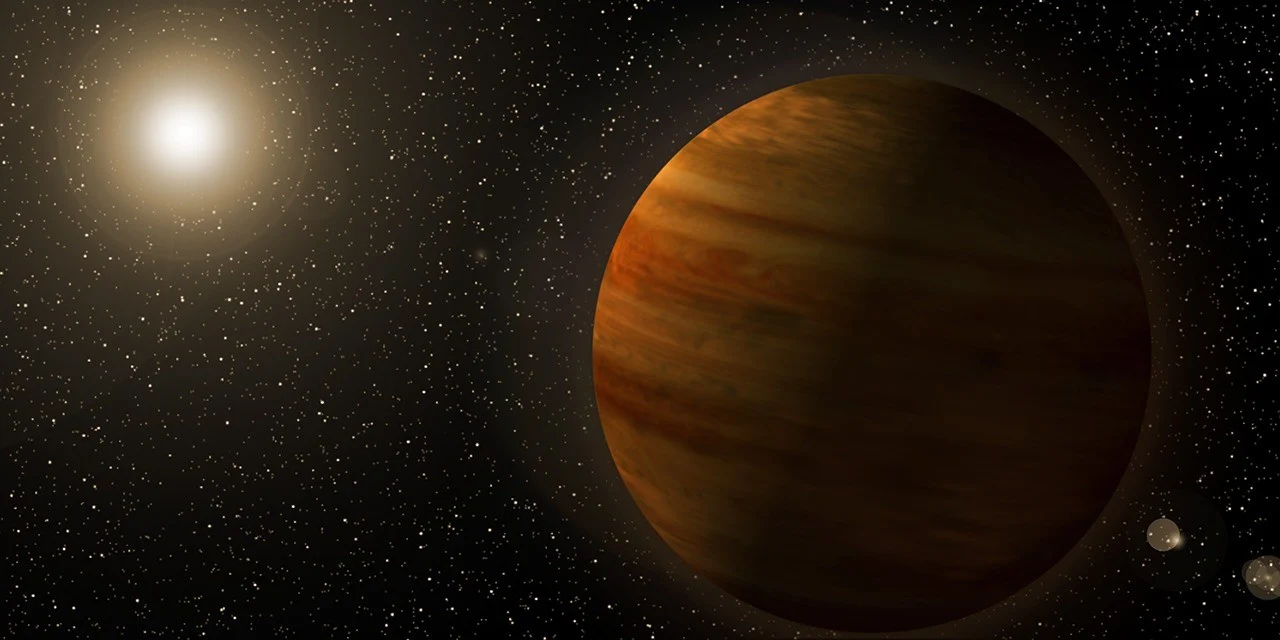
NASA’s Transiting Exoplanet Survey Satellite (TESS) has, for the first time, detected an exoplanet orbiting a distant star by observing gravitational microlensing, a method quite different from its traditional planet-hunting technique. This breakthrough highlights TESS’s unexpected capability to find distant planets, broadening its scientific impact beyond close-in transiting worlds.
What Happened
The exoplanet, designated Gaia23bra b, was initially hinted at by the European Space Agency’s now-retired Gaia space telescope in 2023, which detected a stellar brightening event caused by gravitational microlensing. Researchers then revisited archived data from NASA’s TESS, which happened to be monitoring the same region of the sky. TESS’s higher-frequency observations revealed additional details in the light curve indicating the presence of a planet.
This planet orbits an orange dwarf star with approximately 80 percent of the Sun’s mass, located about 40,000 light-years from Earth—far beyond TESS’s usual observational reach of roughly 150 light-years. The discovery was published on July 1 in The Astrophysical Journal Letters, confirming that TESS can detect planets at much greater distances and through alternative methods.
Key Facts
Gaia23bra b is a super-Jupiter-class planet with a mass about 1.6 times that of Jupiter, orbiting at a distance comparable to Jupiter’s orbit in our own solar system. The planet was identified through gravitational microlensing, a technique that detects the magnification of light when a foreground star passes in front of a background star, with planetary companions adding distinctive spikes to the brightness curve.
Prior to this finding, approximately 75 percent of over 6,000 confirmed exoplanets were discovered via the transit method, which detects planets passing in front of their stars and causing periodic dimming. Microlensing, by contrast, accounts for less than 5 percent of known exoplanets, as it captures rarer, non-repeating alignment events.
The TESS discovery is notable because microlensing had been considered beyond its design capabilities. The complementary nature of microlensing and transit techniques allows astronomers to explore planetary populations across vastly different distances and orbital configurations.
What This Means
This discovery expands the scientific reach of NASA’s TESS mission, demonstrating that it can contribute to microlensing planet detections despite originally being designed to survey nearby stars for transiting exoplanets. Finding a super-Jupiter nearly 40,000 light-years away opens new avenues to study distant planetary systems in the galaxy’s less crowded regions.
Unlike transit detections that favor large, close-orbiting planets, microlensing is uniquely capable of revealing planets with wider orbits and even those in habitable zones. The success with Gaia23bra b suggests that other microlensing events could be hidden in TESS’s vast archive, awaiting discovery.
Moreover, this complements the upcoming Nancy Grace Roman Space Telescope’s microlensing survey planned for launch in 2026. Roman will focus on the densely star-packed galactic bulge, while TESS’s sky-wide perspective samples different parts of the galaxy, facilitating comparative studies of planetary systems under distinct stellar environments. This will help scientists better understand how planetary formation and evolution vary throughout the Milky Way, which is crucial for assessing the prevalence of solar system analogs and habitable worlds.
Background
TESS was launched by NASA to monitor nearby bright stars for periodic dips in light caused by planets transiting their host stars. Its primary mission has been to identify planets within about 150 light-years. Gravitational microlensing, a method relying on the bending of light due to a foreground star’s gravity, often detects planets much farther away but is limited by rare and non-repeating alignments.
Prior to Gaia23bra b, microlensing detections were mostly associated with ground-based surveys or specialized space missions. This new detection proves that even missions not designed for microlensing might yield valuable findings from such events.
What Comes Next
The Nancy Grace Roman Space Telescope, scheduled for launch on August 30, 2026, will conduct an extensive microlensing survey of the Milky Way’s galactic center. It is expected to detect thousands of planets using microlensing and transits, providing a statistically significant sample of distant, varied planetary systems.
Meanwhile, researchers will continue to analyze TESS’s data archives to uncover additional microlensing events, potentially revealing more planets across different regions of the galaxy.
Sources
This article is based on reporting and publicly available information from the following sources:
Read more Space & NASA stories on Goka World News.