
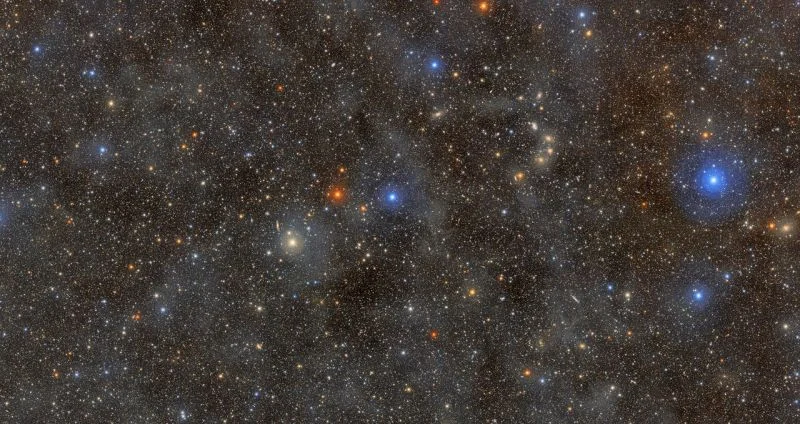
The Vera C. Rubin Observatory, funded by the U.S. National Science Foundation and Department of Energy, has commenced its groundbreaking Legacy Survey of Space and Time (LSST), marking the start of an unparalleled effort to create the most extensive cinematic record of the universe. Located on a mountaintop in Chile, this observatory is set to revolutionize how dynamic cosmic phenomena are studied over the next decade.
What Happened
Following over 20 years of development, the Rubin Observatory began its 10-year LSST campaign after completing final commissioning and operational readiness assessments. Operating under the joint management of NSF NOIRLab and DOE’s SLAC National Accelerator Laboratory, the observatory employs a 3,200-megapixel camera—the largest digital camera in the world—that captures a new wide-field image of the southern sky every 40 seconds.
The observatory aims to revisit each point in the southern sky approximately 800 times over ten years, providing ultradeep and time-resolved imaging. Early test surveys revealed thousands of new asteroids, including near-Earth and distant trans-Neptunian objects. Nightly operations generate about 10 terabytes of data and millions of alerts on celestial changes, streamed to brokers for rapid scientific analysis.
Key Facts
The LSST’s first images were captured in mid-2025 from its site in Chile’s clear, dark skies. The Rubin Observatory is a U.S. government facility managed collaboratively by NSF NOIRLab, operated by the Association of Universities for Research in Astronomy (AURA), and the DOE’s SLAC National Accelerator Laboratory. Through continuous imaging—approximately 1,000 images per night—the project compiles data on billions of objects and trillions of measurements, all planned for public release.
The survey’s 3,200-megapixel camera enables rapid, high-sensitivity capture across a wide field of view, allowing detection of faint, fast-changing phenomena such as pulsating stars, supernovae, and potentially new, unknown cosmic events. Early optimization work identified over 11,000 new asteroids, including 33 classified near-Earth objects.
What This Means
The Rubin Observatory’s decade-long survey represents a transformative leap in astronomy by delivering a dynamic, time-rich dataset that will enable scientists to track changes in the cosmos with unprecedented clarity and frequency. For ordinary readers, this means future discoveries will not only deepen knowledge of distant galaxies and cosmic structures but also improve awareness of nearby solar system objects that may intersect Earth’s path.
Moreover, the survey’s ability to rapidly detect transient cosmic events will accelerate multi-messenger astronomy, coordinating observations across electromagnetic and gravitational wave signals to provide a holistic understanding of cosmic explosions, black hole activity, and other fleeting phenomena. This expanded observational power could significantly shift scientific paradigms regarding dark energy, dark matter, and the evolution of the universe, influencing broader scientific and educational landscapes.
Background
The Rubin Observatory project follows decades of astronomical survey development, aimed at expanding on previous large-scale sky surveys by introducing time-domain astronomy on an unprecedented scale. This methodology captures the evolving universe, rather than static snapshots, offering new insights into astrophysical processes that unfold over varying timescales. Prior work in asteroid detection and transient event monitoring paved the way for this survey’s design and scientific priorities.
What Remains Unclear
While initial results are promising, researchers have yet to fully determine how many new cosmic phenomena will be uncovered or precisely how this volume of data will reshape current astrophysical models. The classification of many of the newly observed transient events and asteroids requires ongoing analysis. Further, the survey’s impact on dark energy and dark matter theories remains to be fully established as the data accumulates.
What Comes Next
The Rubin Observatory will continue nightly observations throughout the next decade, with periodic data releases planned to make its extensive dataset accessible worldwide. Researchers globally will analyze this data to pursue both predicted scientific goals and unforeseen discoveries. The observatory team encourages public engagement, inviting scientists and citizens alike to explore the dynamic universe through its open data platform.
Sources
This article is based on reporting and publicly available information from the following sources:
Read more Space & NASA stories on Goka World News.