
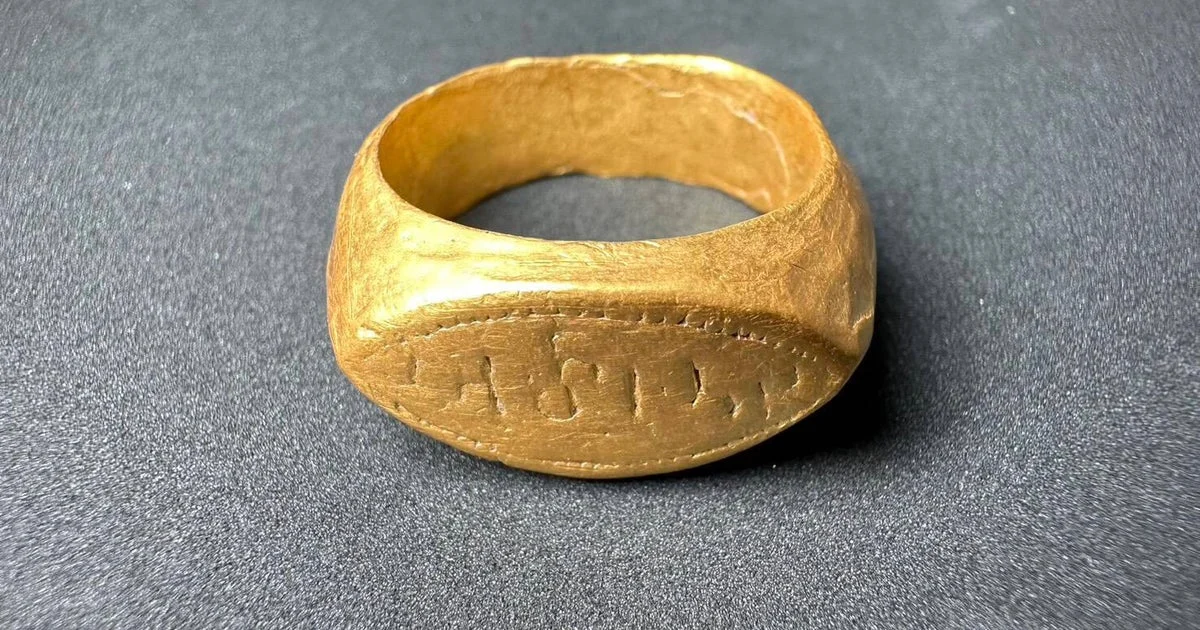
Archaeologists in western Thailand have unearthed two gold rings estimated to be around 2,000 years old, discovered alongside human skeletal remains at an Iron Age burial site. These artifacts were found during ongoing excavations at the Don Yai Thong archaeological site in Phetchaburi province, offering valuable insight into ancient cultural and societal practices in the region.
What Happened
During a recent dig at Don Yai Thong, about 80 miles southwest of Bangkok, the Thai Fine Arts Department confirmed the discovery of two gold rings alongside multiple human bones. The excavation began earlier this year after local residents discovered fragments of ancient bronze drums in a rice field, prompting a detailed archaeological survey. Since February, the team has uncovered eight human skeletons, bronze and gold jewelry, pottery, and other artifacts suggesting ceremonial burials.
One of the gold rings, found on Thursday, was engraved with an inscription resembling the ancient Brahmi script, an Indian writing system. Experts preliminarily interpreted the inscription as “pusarakhitasa,” meaning “the one protected by Pushya,” relating to a favorable zodiac sign in Indian astrology. The second ring is a plain gold band without markings. Researchers believe the rings may have belonged to an individual possibly associated with the Vaishya caste, traditionally merchants in the ancient Indian social hierarchy.
Key Facts
The Don Yai Thong site dates to the late prehistoric Iron Age period, roughly 1,500 to 2,500 years ago, according to the Fine Arts Department. The artifacts and remains indicate the presence of affluent individuals or elites within the community. One of the skeletons is believed to be a young child, notable for having a bronze object placed on the torso, possibly indicating ritual significance. Charcoal samples from the site have been sent for radiocarbon dating in the United States to confirm the precise age of the finds.
The department released footage showing archaeologists examining the skeletal remains and artifacts, emphasizing ongoing efforts to understand the cultural and social context of the site. Excavations are expected to conclude within the next month, with plans to display the findings publicly.
What This Means
The discoveries at Don Yai Thong enrich understanding of Iron Age societies in Southeast Asia, highlighting cross-cultural connections with ancient India, as seen through the Brahmi inscription and implied caste association. Such finds illuminate the social stratification and trade networks that existed around 2,000 years ago, pointing to complex societal structures.
For the local communities and researchers, these artifacts offer a tangible link to the region’s prehistoric past and could deepen appreciation of Thailand’s cultural heritage. The recognition of ceremonial burial practices suggests that these ancient inhabitants had established beliefs around death and social status. For historians and archaeologists, the find underscores the importance of ongoing excavations in revealing human history shaped by environmental and cultural factors.
Additionally, the dating and analysis of these objects may contribute to broader research on human settlement patterns and environmental conditions during the Iron Age in this part of Asia, potentially informing climate studies related to historical human adaptation and land use.
Background
The Don Yai Thong site was first identified after local reports of ancient bronze drum fragments surfaced early in 2026. The Iron Age period in Thailand is characterized by the introduction of metal tools and social developments including trade and hierarchical communities. Previous studies have linked similar finds in the region to early Indian cultural influences, supporting the presence of active exchange routes and cultural interconnections during this era.
What Comes Next
Excavation work at Don Yai Thong is planned to continue for one more month, after which the Fine Arts Department intends to curate and exhibit the recovered artifacts. The charcoal samples sent abroad for scientific dating will provide more precise chronological context, pending lab results. Public display of these findings aims to enhance cultural awareness and educational opportunities regarding prehistoric Thai civilizations.
Sources
This article is based on reporting and publicly available information from the following source:
Read more Science Discoveries stories on Goka World News.