
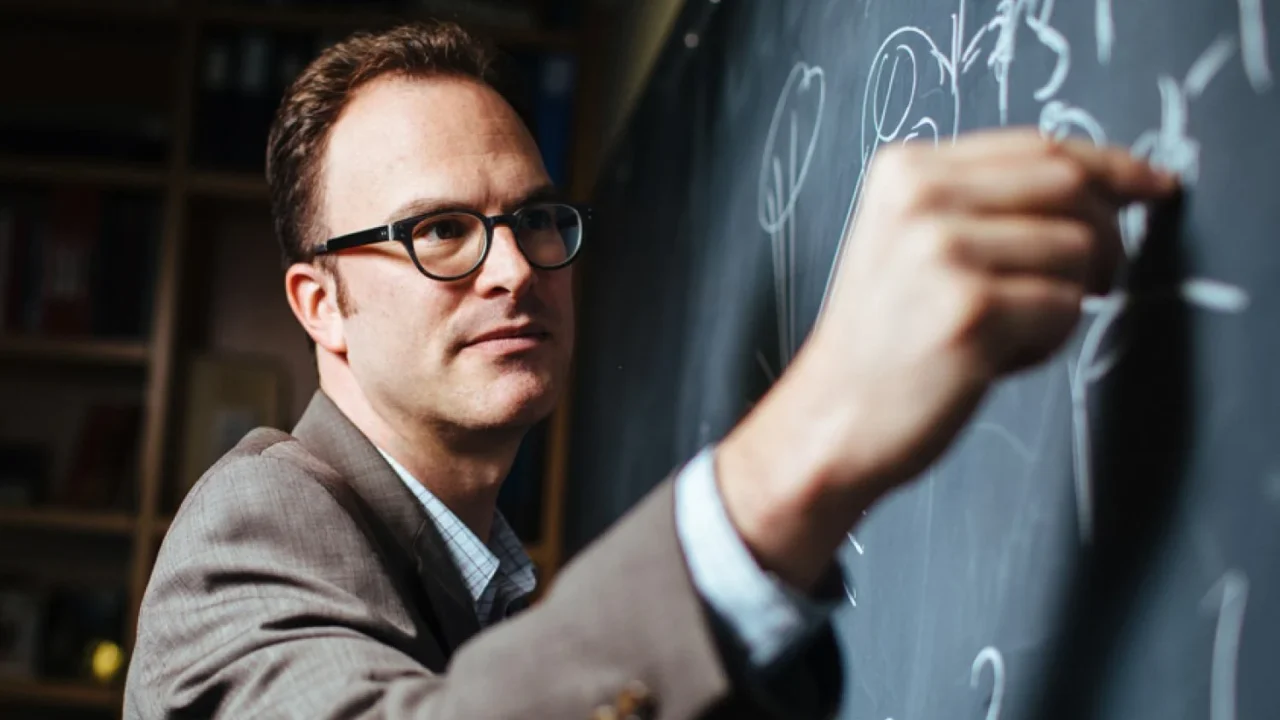
MIT has appointed Professor Jesse Thaler as the new director of its Laboratory for Nuclear Science (LNS), effective August 1. Thaler succeeds Professor Bolek Wyslouch, who led the laboratory for the past ten years. Thaler is recognized for his pioneering research at the confluence of particle physics, quantum field theory, and artificial intelligence.
What Happened
Professor Jesse Thaler, a theoretical particle physicist and William and Emma Rogers Professor of Physics within MIT’s Center for Theoretical Physics, will assume leadership of the Laboratory for Nuclear Science from August 1. His appointment follows a decade-long tenure by Professor Bolek Wyslouch. Thaler has directed the National Science Foundation’s Artificial Intelligence Institute for Fundamental Interactions (IAIFI) since its inception in 2020 and will now oversee LNS, which undertakes research across nuclear and particle physics, cosmology, quantum information science, and field theory.
Thaler’s leadership role will also include oversight of the Leinweber Institute within the Center for Theoretical Physics, which recently received the largest philanthropic donation ever in this research field from the Leinweber Foundation to establish a network of theoretical physics institutes. Meanwhile, Mike Williams, a physics professor, will succeed Thaler as IAIFI director.
Key Facts
MIT’s Laboratory for Nuclear Science, established in 1946, has expanded beyond its original focus on nuclear and particle physics to cover broad domains such as cosmology and quantum information science. Thaler’s research is notable for combining machine learning and quantum field theory to address key problems in fundamental physics, including studies of particle jets at the Large Hadron Collider.
Under Thaler’s direction, IAIFI, funded by the National Science Foundation, was recently renewed for an additional five years. IAIFI also established a doctoral program integrating physics, statistics, and data science and introduced postdoctoral fellowships to foster interdisciplinary research.
Thaler holds a PhD in physics from Harvard University (2006) and a BS in mathematics and physics from Brown University (2002). Prior to joining MIT in 2010, he was a fellow at the Miller Institute for Basic Research in Science at UC Berkeley from 2006 to 2009.
What This Means
Jesse Thaler’s appointment signals a strategic shift at MIT’s Laboratory for Nuclear Science toward embracing artificial intelligence as a core tool for advancing cutting-edge research. His background in both particle physics and AI positions LNS to leverage machine learning algorithms to manage complex datasets from experiments like those at the Large Hadron Collider and to perform intricate theoretical computations.
This fusion of AI with traditional physics research reflects a broader trend in science toward interdisciplinary approaches that enable new discoveries across domains. For the research community, Thaler’s leadership may accelerate innovation in fundamental physics and enhance educational opportunities by fostering collaborations bridging physics, data science, and AI. For society at large, breakthroughs enabled by AI-driven physics could, over time, contribute to technologies with applications spanning energy, computing, and materials science.
Moreover, by continuing the recent establishment of integrated doctoral and postdoctoral programs, Thaler’s direction promises to nurture the next generation of scientists adept at working at the intersection of AI and fundamental sciences.
Background
The Laboratory for Nuclear Science was founded in 1946 at MIT to support nuclear and particle physics research. Its scope has since broadened to include related fields such as cosmology and quantum information science. The center’s research initiatives increasingly incorporate advanced computational methods, including artificial intelligence, aiming to tackle challenges posed by large experimental datasets and complex theoretical models.
Thaler’s tenure as director of IAIFI, a prominent NSF AI institute, has emphasized promoting education and cross-domain research between physics and AI, a model he intends to extend within LNS.
What Comes Next
Jesse Thaler officially takes charge of the Laboratory for Nuclear Science on August 1. Mike Williams will succeed him as director of IAIFI, ensuring leadership continuity at the NSF AI institute. Upcoming initiatives at LNS are expected to further integrate AI techniques into fundamental physics research and educational programs. Details on specific projects or new collaborations at LNS have not yet been disclosed.
Sources
This article is based on reporting and publicly available information from the following sources:
Read more Science & Technology stories on Goka World News.