
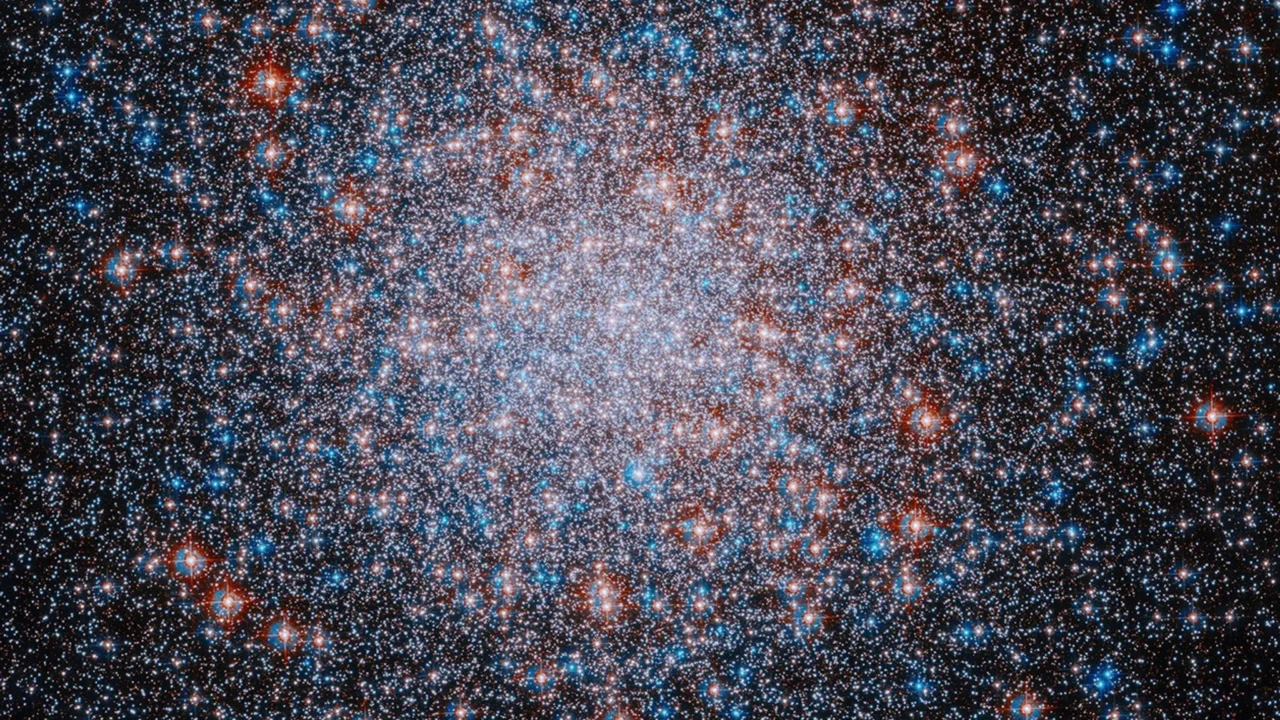
NASA’s Hubble Space Telescope has delivered a striking image of Messier 3 (M3), a densely packed globular cluster containing thousands of ancient stars bound together by gravity. This observation provides astronomers with an opportunity to better understand the cluster’s formation and history within the Milky Way galaxy.
What Happened
Messier 3, one of the Milky Way’s most massive globular clusters, was imaged by NASA’s Hubble Space Telescope, capturing its tightly packed stellar population in exquisite detail. Globular clusters are spherical groups of stars formed from a single cloud of gas roughly at the same time, meaning the stars within them share similar ages and compositions. M3 is located in the outer regions of our galaxy, joining about 150 other known globular clusters orbiting the Milky Way.
Key Facts
The Hubble image of Messier 3 was produced by astronomers including A. Sarajedini from Florida Atlantic University, with image processing by Gladys Kober of NASA’s Catholic University of America. Messier 3 consists of ancient stars formed billions of years ago. Its densely packed nature makes it one of the most massive clusters of its kind within our galaxy.
What This Means
The detailed Hubble observations of Messier 3 refine our understanding of globular clusters as relics of the early universe. By studying M3’s structure and stellar content, astronomers can probe the processes of star formation and galactic evolution dating back billions of years. These clusters serve as cosmic laboratories for understanding how stars evolve in densely populated environments. Additionally, the possibility that M3 formed through a merger of smaller clusters offers insights into the complex history of how galactic features assemble over time.
This research extends beyond astrophysics specialists: it enriches the narrative of how our galaxy—and by extension, our cosmic neighborhood—formed and evolved. For the wider public, such images connect us visually to the ancient past and to the dynamic cosmos, emphasizing that the universe is still revealing its secrets through space-based observatories like Hubble.
Background
Globular clusters like Messier 3 are known to be ancient, with stars typically over 10 billion years old. These clusters orbit the galactic core in the Milky Way’s halo, offering a window into conditions during the early stages of galaxy formation. Previous studies have used globular clusters to trace the chemical composition, ages, and dynamics of the early universe. Messier 3, first catalogued by Charles Messier in the 18th century, has been a subject of ongoing observation due to its brightness and richness in stars.
What Remains Unclear
The exact origins of Messier 3 remain a topic of investigation. While the current Hubble data supports the idea that M3 may have formed from a merger of smaller globular clusters, further research and more detailed analyses are required to confirm this scenario and to understand the cluster’s full evolutionary history.
Sources
This article is based on reporting and publicly available information from the following sources:
Read more Space & NASA stories on Goka World News.