
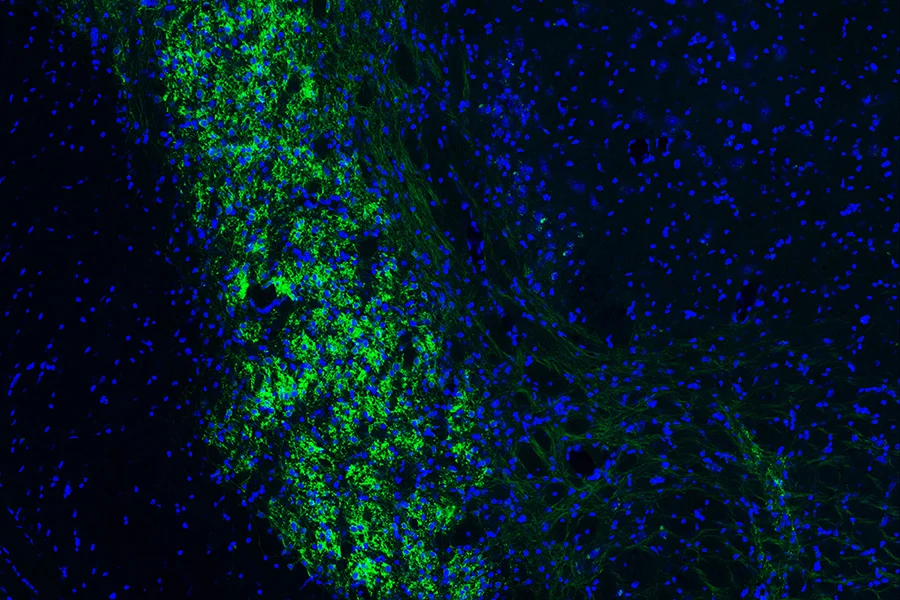
Researchers at MIT have uncovered the neural mechanism enabling mice to estimate the precise distance of objects from their faces by processing touch signals from their whiskers. Published on June 25 in the journal Neuron, the study led by Professor Fan Wang of the McGovern Institute for Brain Research shows how neurons in the brainstem translate mechanical sensations from whiskers into a detailed internal map of a mouse’s surrounding space.
What Happened
The team studied how mice navigate close environments by using their whiskers as sensory rulers. Whiskers are whisked back and forth, bending upon contact with objects, with sensory neurons at their bases firing more vigorously when bending occurs closer to the face. Graduate student Wenxi Xiao and Research Scientist Kyle Severson monitored neural activities in the brainstem’s sensory-processing region while mice moved on a treadmill brushing their whiskers against walls positioned at various distances.
The researchers found that certain brainstem neurons fired in response to proximity, increasing activity when an object was near, while others were finely tuned to specific distance ranges, acting like tick marks on a ruler. For instance, some neurons peaked in activity when an object was about 23 millimeters away, near the longest whiskers’ tips, with others activated by objects at intermediate distances. This array of neurons collectively represents a spatial map of nearby objects based on whisker contact.
Computational modeling and experiments demonstrated that distance coding neurons receive both excitatory signals from proximity-sensitive whisker neurons and inhibitory signals that compare different whiskers’ inputs. This subtraction-like mechanism enables the brainstem to calculate intermediate distances from combined sensory data, providing a precise and discrete map of surrounding space.
Key Facts
The findings were published June 25 in Neuron. The study was conducted by MIT’s McGovern Institute for Brain Research under Prof. Fan Wang, with key contributions from graduate student Wenxi Xiao and Research Scientist Kyle Severson. Neural activity was recorded in mice whisker sensory pathways in the brainstem while the animals walked on a treadmill.
The spatial tuning of neurons correlates with whisker length and contact location, spanning a range around 23 millimeters. The research was supported by grants from the National Institutes of Health (NIH).
What This Means
This discovery illuminates how mammals create an egocentric spatial map—the brain’s internal “ruler”—to understand objects’ distances relative to their own bodies. Such mapping is crucial for everyday activities including reaching, stepping, and avoiding hazards. By uncovering the circuit-level process in the brainstem that transforms tactile inputs into discrete distance codes, this work bridges a gap in knowledge that previously focused largely on spatial mapping via external landmarks, known as allocentric maps.
For humans and other animals, understanding peripersonal space forms the foundation for precise, adaptive interactions with complex environments. This research may influence future studies on sensory processing, motor control, and even disorders where spatial awareness is impaired. Additionally, insights into natural neural computation of space could inspire new designs in robotics and prosthetics aimed at human-like spatial navigation and touch sensing.
Background
Prior neuroscience research has extensively studied allocentric spatial mapping—how the brain uses external landmarks to locate objects. However, the neural underpinnings of peripersonal space—space immediately surrounding the body—have received comparatively limited attention. This study responds to that gap by focusing on how tactile inputs from whiskers, specialized facial sensors in rodents, contribute to egocentric spatial understanding.
What Remains Unclear
The researchers acknowledge that the integration of this newly discovered map code with higher brain centers controlling movement and social behavior remains to be elucidated. The study does not yet clarify how this circuit interacts with visual or other sensory modalities during complex tasks.
What Comes Next
Fan Wang’s team plans to further investigate how the egocentric spatial representation discovered in the brainstem collaborates with broader neural circuits to influence behavior. The findings also set the stage for other laboratories to explore bodily spatial awareness mechanisms across species.
Sources
This article is based on reporting and publicly available information from the following sources:
Read more Science Discoveries stories on Goka World News.