
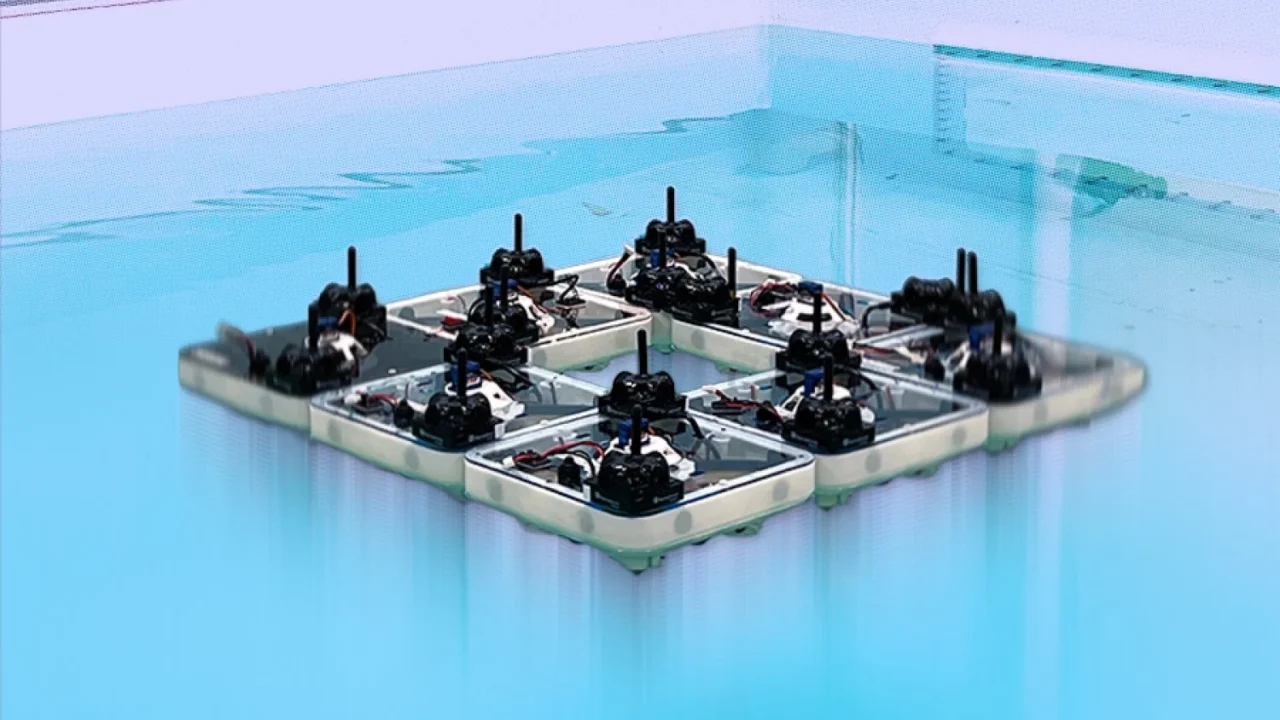
MIT researchers have developed “FloatForm,” a system consisting of small robotic boats that autonomously assemble into larger, adaptable floating structures. Each vessel, about 21 centimeters square, is equipped with thrusters, sensors, and magnetic latches, allowing the fleet to form, dissolve, and rearrange on water with minimal human input. This innovation aims to transform urban waterfronts into programmable spaces, with applications ranging from temporary festival stages to emergency bridges and floating markets.
What Happened
The FloatForm system, created by researchers at MIT’s Computer Science and Artificial Intelligence Laboratory (CSAIL) and the Senseable City Lab, was presented in a paper published in Nature Communications. The project features a swarm of up to eight experimental robotic boats tested in a controlled pool environment, where the robots successfully assembled into a rigid lattice, reconfigured into new patterns, and collectively transported themselves across the water. The process took between four to eight minutes for each configuration. The system uses decentralized coordination, with individual boats exchanging positional data with immediate neighbors and relying on minimal central control, allowing simultaneous movement and scalability.
Key Facts
The research team includes notable figures such as Daniela Rus, director of CSAIL and Panasonic Professor of Electrical Engineering and Computer Science, and Carlo Ratti, director of the Senseable City Lab. The robotic boats each measure 21 centimeters square and incorporate four omnidirectional thrusters and an energy-efficient magnetic latching mechanism derived from origami-inspired auxetic structures. The latches hold the boats firmly in place with minimal power consumption, crucial for battery-limited devices. The experiments demonstrated a 90 percent success rate in four-boat assemblies and 70 percent with eight, with simulations scaling coordination up to 64 boats. Funding came from the Amsterdam Institute for Advanced Metropolitan Solutions and included support from the University of Wisconsin–Madison.
What This Means
FloatForm points toward a future where water surfaces in urban settings become flexible, on-demand public spaces and infrastructure. Unlike static waterfronts or vessels, these robotic boats can dynamically expand or contract to meet temporary needs, such as enabling flood response by forming emergency bridges or hosting events with pop-up stages. The distributed control model enhances system resilience by avoiding single points of failure and allowing quick adaptation to disruptions in real time. For city planners and emergency responders, this technology offers a new method for optimizing underutilized water bodies, potentially easing pressure on congested land infrastructure while enriching public space.
Moreover, the project suggests scalability and resilience improvements over previous centralized robotic systems. By moving computational demands to individual units, FloatForm can grow in swarm size without bottlenecks, a crucial feature for practical deployment in real-world environments. This modular approach may also inspire applications beyond urban canals, including offshore construction platforms, environmental monitoring networks, and flexible docking for maritime operations.
Background
The FloatForm research builds on MIT’s earlier Roboat project, which developed full-sized autonomous vessels for Amsterdam’s canals with goals such as waste collection and cargo transport. While Roboat focused on larger boats navigating city waterways, FloatForm shifts focus to micro-scale robots designed for collective assembly and reconfiguration. This new project draws inspiration from biological models like fire ants, which form floating rafts through decentralized behavior, guiding the system’s minimal central coordination philosophy.
What Remains Unclear
Although experiments in controlled pools have been successful, transitioning FloatForm to rougher real-world water bodies presents challenges. The small craft are limited in their ability to withstand strong currents or waves, and scaling the latches for increased robustness remains a task. Additionally, implementing sensor technologies suitable for outdoor use—such as GPS or vision systems—will be essential to substitute for indoor ultrasonic positioning. The team notes these adaptations are in progress, but no firm timeline has been disclosed.
What Comes Next
Next steps include testing FloatForm-like swarms in real canal or harbor environments and upgrading the hardware for increased durability and sensing capabilities. The researchers envision expanding application scope to urban waterfronts globally as well as offshore scenarios, with potential collaborations to explore real-world deployments. Precise schedules or pilot project announcements have not yet been made public.
Sources
This article is based on reporting and publicly available information from the following sources:
Read more Science & Technology stories on Goka World News.