
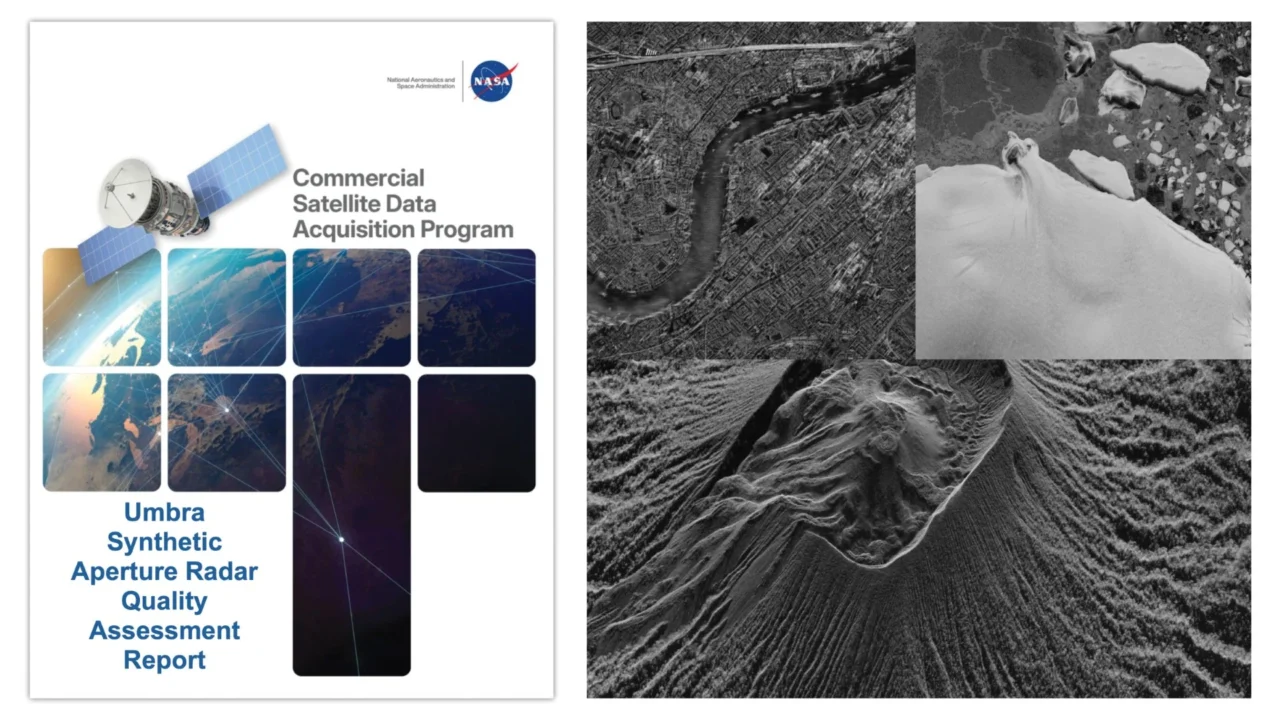
NASA’s Commercial Satellite Data Acquisition (CSDA) program has released two reports assessing the quality of data from Umbra’s X-band Synthetic Aperture Radar (SAR) satellite constellation for Earth science research and applications. These evaluations aim to guide both NASA program managers and the broader scientific community on the utility of Umbra’s commercial SAR data for Earth observation and environmental monitoring.
What Happened
During the evaluation, NASA assigned expert teams access to Umbra’s archived SAR data and the ability to task Umbra’s constellation for new acquisitions. This tasking capability enabled the teams to test the responsiveness of Umbra’s satellite constellation in time-sensitive scenarios, such as rapidly changing environmental conditions including harmful algal blooms. NASA’s evaluation was conducted primarily on Level 1 single-look complex (SLC) data products in Sensor Independent Complex Data (SICD) format, along with select Level 2 science usability products.
Key Facts
The CSDA Umbra Synthetic Aperture Radar Principal Investigator Evaluation Summary highlighted several advantages of Umbra’s SAR system, including very high spatial resolution, high temporal revisit rates with quick data turnaround, flexible imaging geometry options, and Umbra’s Open Data Program fostering data accessibility. However, the evaluation identified geolocation problems characterized by both large and small positional errors along with software compatibility, metadata, and documentation gaps.
Separately, the CSDA Umbra Synthetic Aperture Radar Quality Assessment Report assessed the radiometric and geometric properties against the joint NASA/ESA guidelines (ESA-NASA, 2024). While spatial resolution met Umbra’s published specifications, the geolocation accuracy performance consistently fell short of expectations. Radiometric analyses measuring absolute accuracy, stability, and sensitivity revealed that Umbra’s SAR data underperformed in comparison to well-calibrated reference SAR systems.
What This Means
This thorough NASA evaluation confirms that Umbra’s X-band SAR constellation provides promising capabilities for high-resolution Earth observation, especially with its flexible tasking and revisit opportunities critical for rapid environmental monitoring. These features can enrich NASA’s Earth science missions by supplementing government-operated satellites with commercially sourced data, potentially expanding spatial and temporal coverage.
However, the noted geolocation inaccuracies and radiometric performance issues highlight significant limitations that must be addressed for Umbra data to fully meet the rigorous standards of NASA’s scientific applications. Reliable positioning and calibration are essential for precise measurements of Earth surface changes and phenomena. NASA and partner scientists will need to weigh these weaknesses when integrating Umbra SAR data into operational workflows or climate research, while also encouraging data providers to improve quality assurance.
Overall, the findings illustrate both the growing role and the challenges of incorporating commercial satellite constellations into high-stakes scientific research. This evaluation advances transparency around data quality, helping users make informed decisions on when and how Umbra SAR data can be effectively applied.
Background
The CSDA program was created to identify, evaluate, and acquire valuable data from commercial satellite sources that support NASA’s Earth Science Division goals. Recognizing the potential of private-sector constellations to enhance Earth system science, CSDA aims to foster cost-effective approaches that complement existing government and international remote sensing assets.
What Comes Next
Following these evaluations, NASA will continue to engage with Umbra and other commercial data providers to refine data quality and usability. Further assessments and calibration efforts are anticipated to improve geolocation accuracy and radiometric calibration. Users of Umbra SAR data are encouraged to review the full reports available on the CSDA Umbra vendor webpage for detailed technical insights and updates.
Sources
This article is based on reporting and publicly available information from the following sources:
Read more Space & NASA stories on Goka World News.