
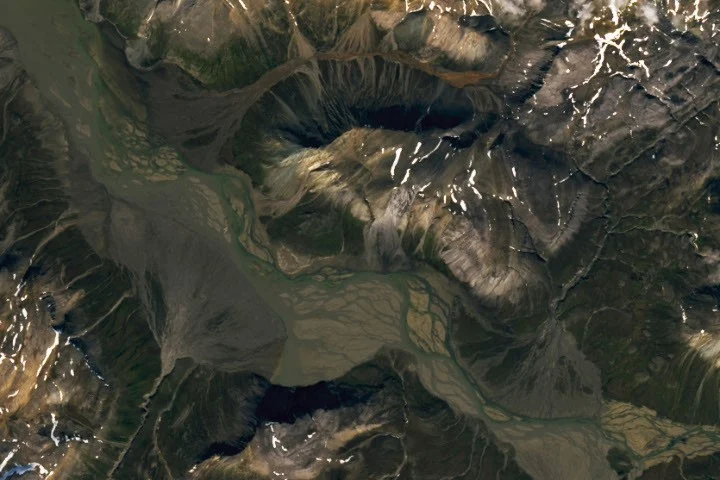
NASA’s Landsat 9 satellite has captured detailed imagery showing sediment-rich rivers creating striking alluvial fans across Severny Island, a remote glaciated landmass in Russia’s Arctic. These fan-shaped sediment deposits form where mountain streams slow and spread after descending from ice-capped terrain, offering insights into both geological processes and the island’s glacial dynamics.
What Happened
On the southern end of Severny Island, part of the Novaya Zemlya archipelago, NASA’s Earth Observatory released satellite images depicting several notably large alluvial fans formed by sediment transported from the surrounding mountain glaciers. The imagery, collected by Landsat 9 and provided by the U.S. Geological Survey, reveals rivers flowing through rugged valleys, depositing sediment as they reach flatter ground. These rivers emanate from glaciers that either terminate on land or in the adjacent Arctic seas, carrying eroded material downslope via meltwater streams.
Key Facts
Severny Island is a mountainous and largely glaciated region situated in the far northern latitudes, characterized by cold Arctic climates and limited human presence. The alluvial fans appear in opposite orientations within northwest-southeast-aligned valleys, alongside a braided river system. Seasonal snowmelt and glacier runoff contribute to higher river flows during warmer months, increasing sediment transport. Recent scientific studies using digital elevation models have indicated significant thinning of land-terminating glaciers across Novaya Zemlya during the first two decades of the 2000s, particularly at lower elevations.
What This Means
The formation of these alluvial fans illustrates the ongoing influence of Arctic glacial meltwaters in shaping local landscapes. As climate warming accelerates glacier thinning, sediment loads carried by rivers are expected to change, potentially altering river behaviors and sediment distribution patterns. This has implications for understanding sediment fluxes in polar environments and predicting how Arctic terrestrial ecosystems respond to melting ice. Beyond geophysical interest, the sedimentary records embedded in these alluvial fans provide valuable chronological archives of past glacier activity and environmental shifts, which are critical for modeling regional climate impacts.
Moreover, these observations underscore the importance of continuous satellite monitoring to track glacial health in remote regions where ground access is limited. Understanding how glaciers and their associated rivers evolve in response to warming helps improve projections of Arctic landscape change and sea-level contributions, topics of global environmental significance.
Background
Novaya Zemlya has been the focus of glaciological research due to its extensive ice coverage and the sensitivity of its glaciers to climate variations. NASA’s long-running Landsat program has been instrumental in documenting these regions’ changing ice masses and associated geomorphological features since the late 20th century. Prior studies by Małecki (2022) and Melkonian et al. (2016) used remote sensing and digital terrain data to reveal the thinning and velocity changes of Novaya Zemlya glaciers, laying the groundwork for interpreting sediment patterns visible in recent satellite imagery.
What Comes Next
Scientists will continue analyzing the Landsat and other satellite datasets to refine understanding of sediment transport dynamics and glacier behavior on Severny Island. Ongoing monitoring aims to assess seasonal and long-term changes in the Arctic’s hydrology and sedimentation, supported by additional remote sensing campaigns and modeling studies to quantify regional climate change impacts.
Sources
This article is based on reporting and publicly available information from the following sources:
Read more Space & NASA stories on Goka World News.