
NASA’s Perseverance rover has been conducting detailed examinations of the “Lac de Charmes” region on Mars, an area containing some of the oldest rocks encountered during its mission. This exploration, led by the Mars 2020 mission team, is providing new understanding of the Red Planet’s early geological history.
What Happened
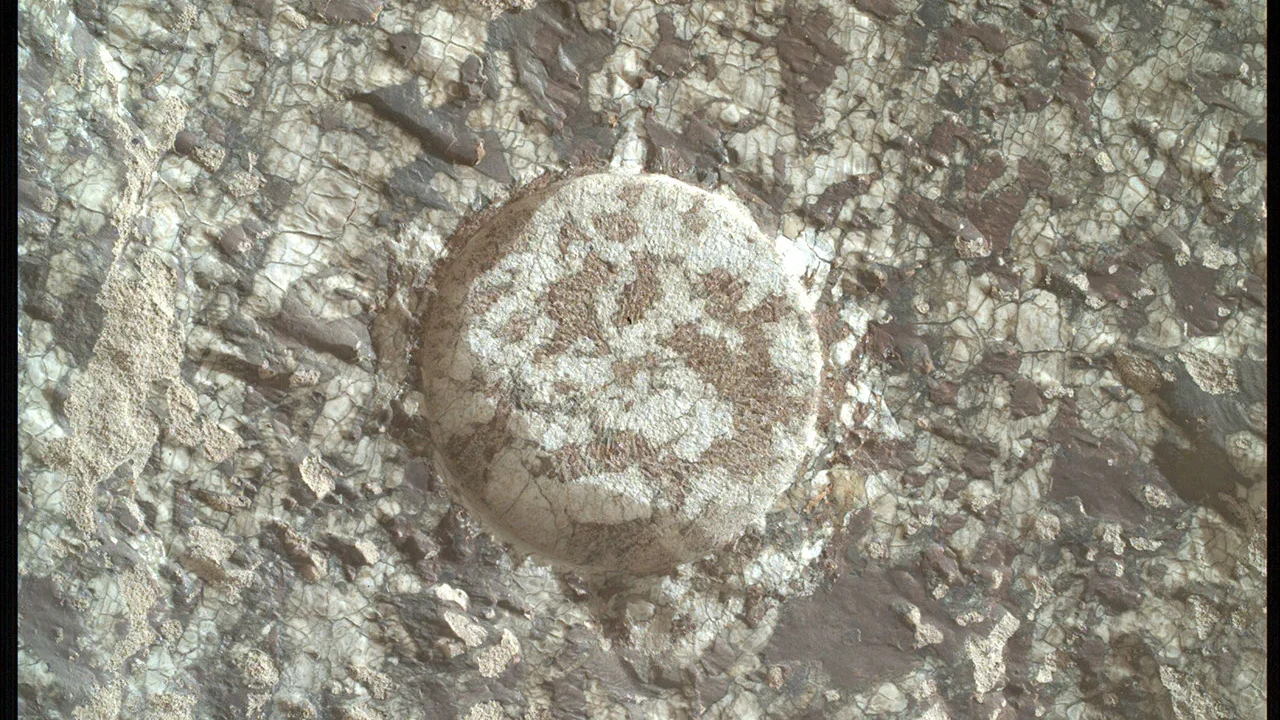
Throughout 2026, Perseverance has methodically explored Lac de Charmes, located west of the Jezero Crater rim. This region of valleys and ridges represents a dynamic and ancient terrain that formed when Mars was a young planet, heavily bombarded by asteroids. Unlike the sedimentary rocks formed in Jezero’s former lakebed, the rocks in Lac de Charmes are predominantly igneous — formed from cooled lava or magma — and others result from intense impacts, known as impactites. The rover’s path traced a looping route through this challenging landscape, creating 13 abrasive patches on various rock targets to analyze their surface and composition in detail.
More recently, Perseverance has moved toward an area nicknamed “Idubi,” distinguished by hundreds of light-toned boulders that exhibit a wide variety of textures and compositions. One of these boulders, designated “Badger Peak,” revealed a striking light-and-dark surface texture unseen before on Mars. However, attempts to collect a sample from this particularly hard rock were unsuccessful, prompting the science team to search for similar rock types elsewhere. Meanwhile, the rover began examining a nearby outcrop called “Gardenia,” which may be a breccia — a composite rock made of fragments from different older rocks. Efforts are underway to abrade this outcrop for closer study.
Key Facts
Lac de Charmes features some of the oldest Martian rocks studied by Perseverance, dating back to the planet’s earliest geological period. The rover has used an improved driving algorithm that repurposes processors initially designed for the Ingenuity helicopter, allowing for longer and more precise traverses between sampling sites.
To date, scientists have identified igneous rocks formed by volcanic processes, impactite rocks shaped by asteroid collisions, and others that combine both origins. The rover’s abrasion tools have helped reveal textures and details on 13 rock patches. The unsuccessful sampling of “Badger Peak” highlighted the challenge of collecting material from exceptionally hard rocks.
What This Means
The discovery and detailed analysis of such ancient rocks is crucial for understanding Mars’ formative years when the solar system was marked by heavy asteroid bombardment and intense geological activity. By studying igneous and impactite rocks, scientists can gather insights into how rocky planets—including Earth—evolved during their earliest eras. These findings help reconstruct Mars’ geological timeline and environmental conditions from more than 4 billion years ago.
Perseverance’s study of the diverse rock types in Lac de Charmes also aids the broader goal of the Mars 2020 mission: to identify and collect the most scientifically valuable samples for eventual return to Earth. Understanding rock hardness and composition informs sample collection strategies, ensuring that future sample retrieval missions can maximize their scientific payoff.
For the public and researchers alike, these investigations underscore the complexity and variety of Martian geology beyond the familiar crater floors, highlighting ongoing discoveries about the Red Planet’s history and its potential for having supported ancient environments suitable for life.
Background
Perseverance landed in Mars’ Jezero Crater in February 2021 as part of NASA’s Mars 2020 mission. Its mission includes exploring promising geological sites to study past habitability, collect rock and soil samples, and prepare for future human exploration. The rover’s investigations are part of the Mars Sample Return campaign, a multi-agency effort to ultimately bring Martian samples back to Earth for comprehensive analysis.
What Comes Next
After completing the current investigations of Lac de Charmes, Perseverance will continue its traverse toward new areas of interest for further geological exploration and sampling opportunities. The mission team will assess abrasion results from “Gardenia” and continue to search for rocks similar to “Badger Peak” that can be successfully sampled. Ongoing data and imagery will be analyzed to deepen understanding of Martian geological processes and guide future mission activities.
Sources
This article is based on reporting and publicly available information from the following sources:
Read more Space & NASA stories on Goka World News.