
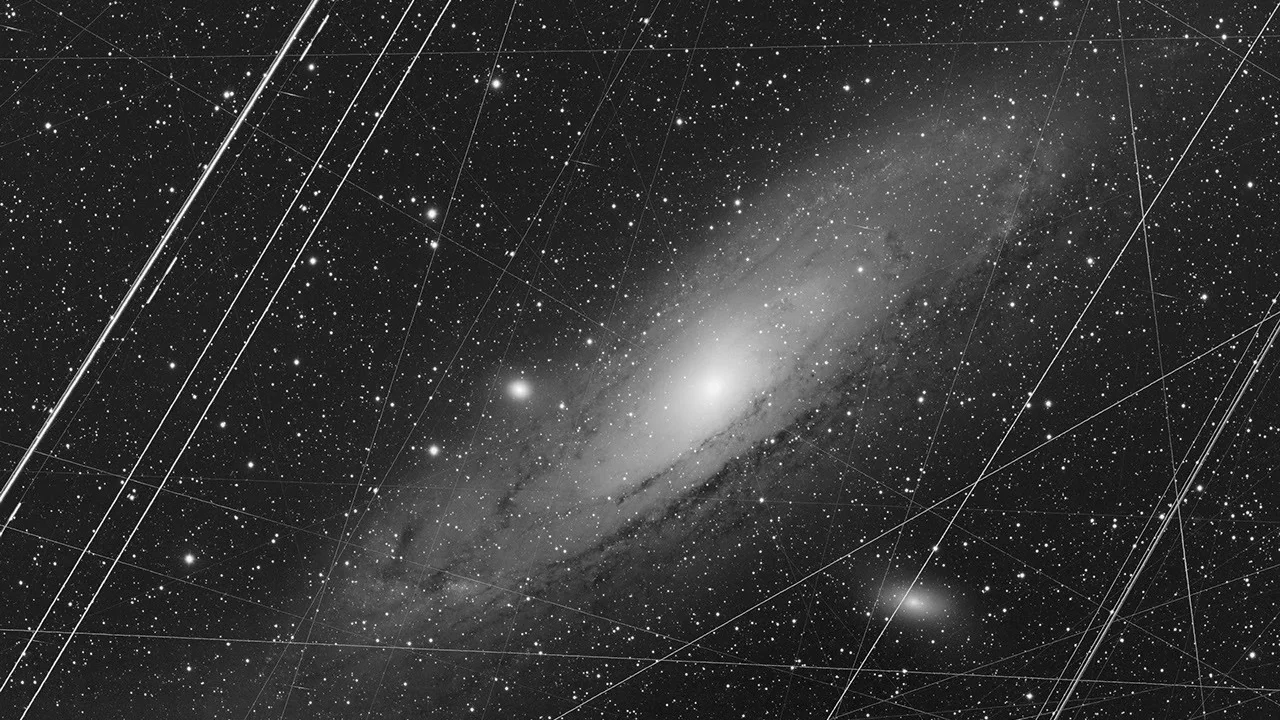
The Astronomy Picture of the Day (APOD) hosted by NASA presents a striking comparison of the Andromeda galaxy as captured raw and after extensive digital processing. This side-by-side feature, showcased on September 27, 2026, reveals both the challenges and solutions involved in ground-based astrophotography of the nearest major galactic neighbor to the Milky Way.
What Happened
The images stem from a composite stack of 223 exposures, each lasting 300 seconds, taken throughout 2019 at a garden observatory located in Portugal. The raw “before” photograph captures the Andromeda galaxy (Messier 31, or M31) as it appears through Earth’s atmosphere and amid pollution from human activity, revealing typical imperfections such as trails from airplanes and satellites, cosmic ray streaks, and sensor defects known as bad pixels.
Rather than applying simple Photoshop tricks, the improved “after” image results from processing with specialized astronomy software packages: Astro Pixel Processor, DeepSkyStacker, and PixInsight. These tools effectively reduce or eliminate interfering Earth-based visual contaminants, enabling a truer representation of the Andromeda galaxy’s intrinsic structure and glow.
Key Facts
The data consist of 223 individual long exposures, each 300 seconds in duration, amassed over sessions in 2019. The telescope setup was situated in Portugal, offering a vantage point subject to typical terrestrial disruptions in imaging. The processing workflow employed three major astronomy software platforms known for calibrating, stacking, and refining astrophotographic data: Astro Pixel Processor, DeepSkyStacker, and PixInsight. These programs are standard among amateur and professional astrophotographers for mitigating various noise and artifacts while preserving celestial detail.
What This Means
This detailed before-and-after comparison illustrates the critical role digital image processing plays in modern ground-based astronomy. The raw images collected by even the most patient amateurs and professionals are contaminated by unavoidable Earth-originating visual noise that obscures fine features of distant galaxies. By employing advanced software pipelines, astronomers can reduce these artifacts without manipulating or falsifying the astronomical subject itself.
For observers and astrophotography enthusiasts, this clear distinction confirms the importance of processing techniques in yielding images that approach what a space-based telescope might see, despite the handicap of Earth’s atmosphere. It also nurtures transparency and trust, demonstrating that enhanced images are not fabrications but rather refinements that restore the true look of celestial bodies.
This approach benefits both scientific study and public appreciation of galaxies like Andromeda, enriching our understanding and visual experience of the local universe.
Background
The Andromeda galaxy is the nearest large galaxy to the Milky Way and is a frequent target for astrophotographers, both amateur and professional. Its proximity and brightness make it an ideal object for studying spiral galaxies. However, capturing Andromeda’s details from Earth is complicated by atmospheric disturbances and man-made light pollution, leading to reliance on techniques like stacking and digital post-processing to extract clearer images.
What Remains Unclear
The APOD presentation mentions that while many imperfections were reduced, some artifacts may persist due to limitations in processing or data quality. The overall fidelity of ground-based astrophotography compared to space telescopes like Hubble remains constrained by atmospheric conditions and instrument sensitivity.
What Comes Next
Future submissions to APOD continue to follow evolving imaging and processing methods, with a new image submission email announced. APOD’s official website is transitioning from apod.nasa.gov to science.nasa.gov/apod, ensuring continued access to daily cosmic imagery and explanations.
Sources
This article is based on reporting and publicly available information from the following sources:
Read more Space & NASA stories on Goka World News.