
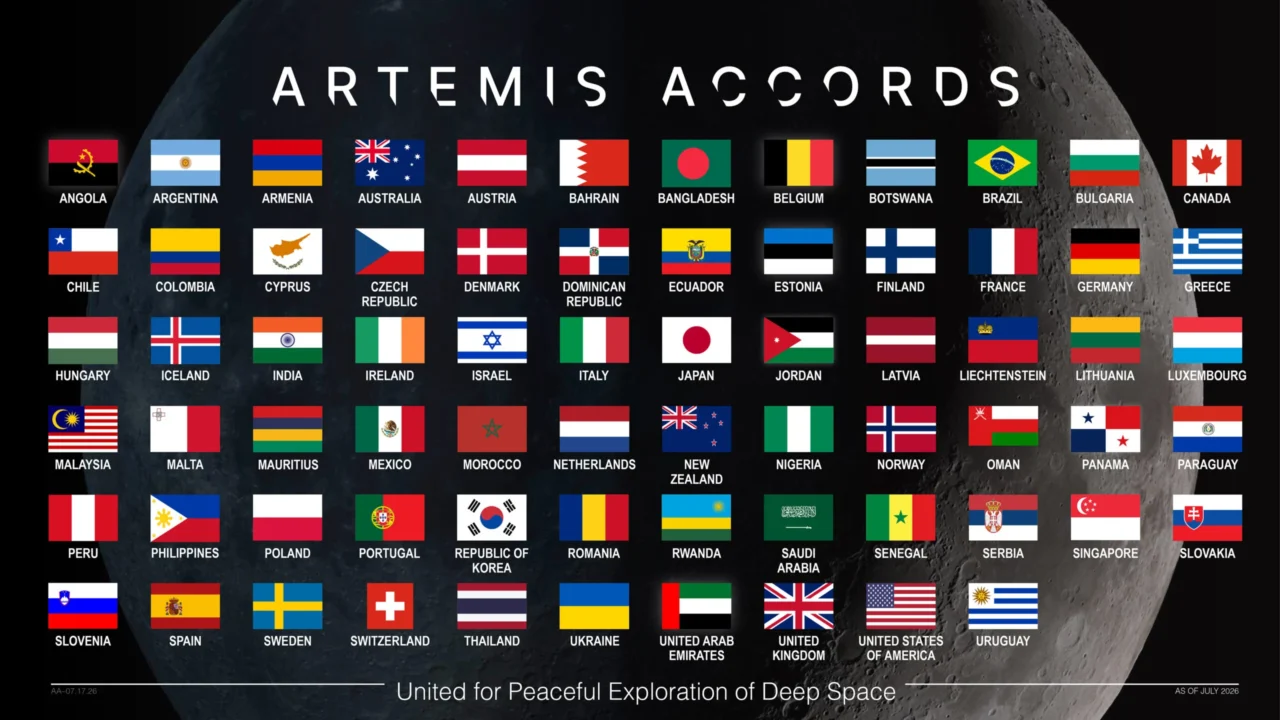
The Republic of Mauritius has officially become the 70th signatory of the Artemis Accords, joining a growing coalition of nations dedicated to responsible and peaceful space exploration. The signing ceremony took place in Ébène, Mauritius, where NASA’s Deputy Administrator Matt Anderson delivered video remarks emphasizing the importance of international cooperation in the next era of space discovery.
What Happened
On Friday, Mauritius formally acceded to the Artemis Accords, an international agreement facilitating collaboration in lunar and space exploration. Mauritius’ Permanent Secretary at the Ministry of Tertiary Education, Science and Research, Navindsing Jugmohunsing, signed the accords on behalf of the island nation. The event was witnessed by U.S. officials including Deputy Assistant Secretary of State for African Affairs Sarah Troutman and Chargé d’Affaires Craig Halbmaier. NASA’s leadership highlighted Mauritius as a new partner committed to advancing the shared goals outlined in the Accords.
Key Facts
The Artemis Accords, first established in 2020 by NASA, the U.S. State Department, and seven founding nations, outline principles for safe, transparent, and peaceful exploration of the Moon, Mars, and beyond. These include commitments to:
- Conduct space activities peacefully and transparently
- Render aid to astronauts in distress
- Enable access to scientific data
- Avoid interference with operations of other actors
- Preserve historically significant sites and artifacts
Mauritius is the seventh African country to join this framework and leverages a historic connection to NASA’s Earth observation efforts during 1965-1980, when its tracking stations helped support satellite imagery used in geodetic analysis foundational to Apollo and Artemis navigation.
What This Means
Mauritius’ inclusion signals expanding global interest and responsibility in space governance beyond traditional spacefaring nations. As a Small Island Developing State, Mauritius brings a unique perspective on protecting Earth’s fragile environments from space and ensuring that space resources benefit all humanity equitably. Their commitment underscores a broader international trend toward shared stewardship of space as exploration advances.
This accession also widens participation in NASA’s Artemis program, which aims to establish a sustainable human presence on the Moon as a precursor to future Mars missions. By joining, Mauritius joins the international community shaping norms and cooperative frameworks that will govern the increasingly congested and contested space domain. For ordinary citizens, this contributes to strengthening peaceful uses of space technologies that impact daily life—from climate monitoring to satellite communications.
Background
The Artemis Accords were launched to meet increasing governmental and commercial lunar activity by defining clear principles and responsible behavior standards. Over the past five years, the Accords have grown from eight founding members to 70 signatories worldwide, reflecting a significant global coalition focused on peaceful cooperation rather than competition.
Mauritius’ prior involvement with NASA’s geodetic satellite tracking stations builds on a decades-long partnership underpinning space navigation capabilities fundamental to current lunar missions, including Artemis.
What Comes Next
As the Artemis program moves forward with plans for a sustained lunar outpost, Mauritius and other signatories are invited to collaborate on exploration, scientific activities, and space governance initiatives informed by the Artemis principles. More nations are anticipated to join the Accords, broadening the multinational foundation of America-led lunar exploration.
Sources
This article is based on reporting and publicly available information from the following sources:
Read more Space & NASA stories on Goka World News.