
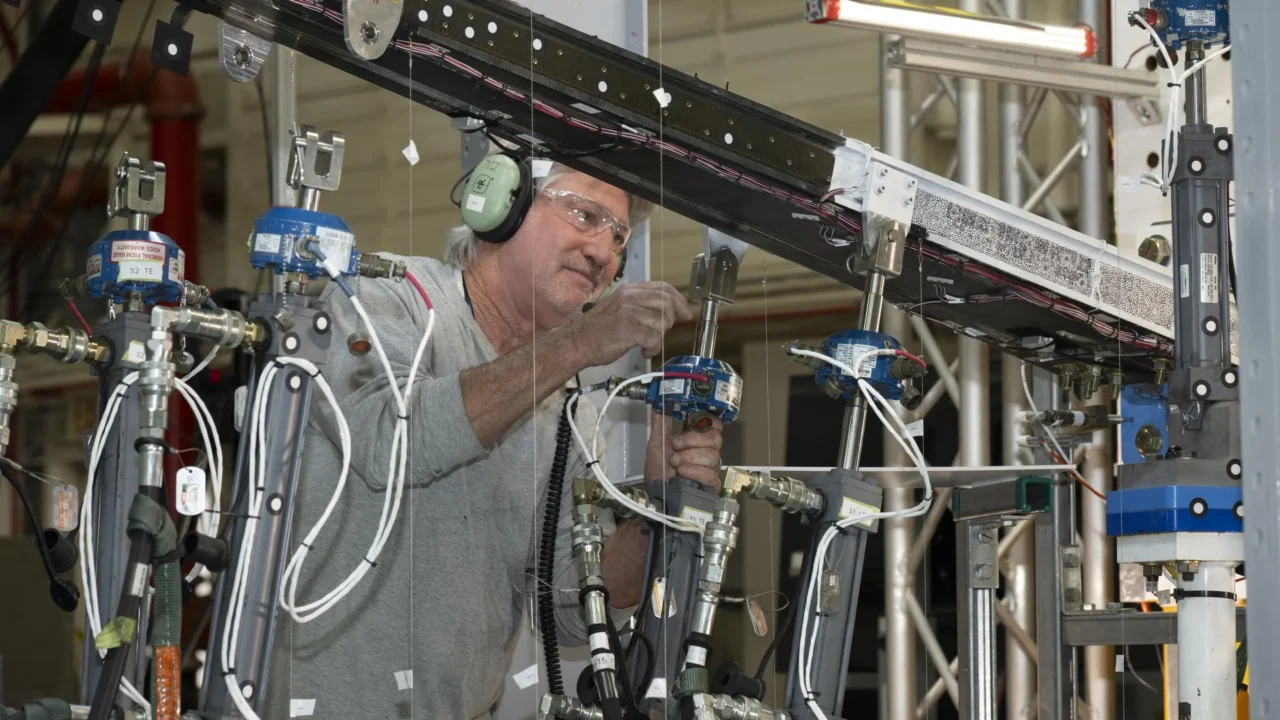
NASA has successfully tested a new 15-foot composite truss-braced wing design, known as SWEET-15, pushing it beyond its intended structural limits. The evaluation, conducted at NASA’s Armstrong Flight Research Center, confirmed the wing’s strength and innovative manufacturing techniques, marking an important step toward future ultra-efficient commercial aircraft.
What Happened
The Structural Wing Experiment Evaluating Truss-bracing (SWEET-15) test article underwent a series of structural load tests designed to simulate forces experienced in actual flight. Developed at NASA’s Langley Research Center in Virginia, the 15-foot-long lightweight wing incorporates an aerodynamic strut for additional support, based on NASA’s earlier Transonic Truss-Braced Wing concept. After design and fabrication at Langley, the wing was transported to Armstrong Flight Research Center in Edwards, California, where engineers applied increasing bending loads in the Flight Loads Laboratory over several months.
During testing, strain and load sensors embedded throughout the wing—including fiber-optic sensors—provided real-time data on structural responses. The wing initially withstood all anticipated in-flight forces without issues. To gain deeper insight, the team conducted a deliberate test-to-failure by applying loads beyond the design limit, ultimately causing damage at approximately 127% of the wing’s specified load capacity. Visible structural damage appeared near the wing’s trailing edge and upper cover, particularly around the joints linking the main strut and a secondary jury strut.
Key Facts
The SWEET-15 wing represents a fusion of five advanced composite manufacturing and assembly technologies, enabled by NASA’s Integrated Structural Assembly of Advanced Composites robot at Langley. The testing validated computer model predictions about the wing’s structural behavior under load. The truss-braced wing configuration tested is the first representative composite design of its kind to undergo this rigorous structural evaluation within NASA’s research programs. The data collection utilized the agency’s Fiber Optic Sensing System, gathering detailed load and strain measurements during each phase of testing.
The structural test concluded with failure at roughly 127% of the design limit load, providing engineers with valuable information on joint behavior under extreme stress conditions. This wing test was part of NASA’s Subsonic Flight Demonstrator project within its Research Technology Mission Directorate.
What This Means
By confirming that the SWEET-15 wing can endure flight-level forces and even surpass its design limits, NASA has demonstrated important advances in composite wing technology and lightweight structural designs. These innovations may lead to the development of commercial airliners that are significantly more fuel-efficient through reduced drag and structural weight. The successful integration of advanced manufacturing methods also promises to lower production costs and improve the durability of future aircraft components.
The detailed understanding of how truss-braced wings perform under stress can inform safer and more robust airframe designs. As aviation faces increasing pressure to reduce carbon emissions, NASA’s work on ultra-efficient wings helps pave the way for greener commercial flight options. The data from this test provides a crucial foundation for transitioning these concepts toward real-world applications.
Background
The SWEET-15 wing concept builds upon NASA’s earlier Transonic Truss-Braced Wing research—which explores long, slender wings supported by aerodynamic struts to reduce drag at subsonic speeds. Previous theoretical studies indicated that such configurations could enable significant fuel savings by making aircraft more aerodynamically efficient. The current testing effort marks a milestone as the first physical structural validation of these composite designs, moving from simulation to practical demonstration.
What Comes Next
NASA researchers will now analyze the extensive structural data collected to refine both design and manufacturing techniques. Insights from SWEET-15 testing will support ongoing efforts to develop next-generation, energy-efficient aircraft within the Subsonic Flight Demonstrator program. Future steps may include scaling up components, integrating wings with full airframe designs, and further flight testing to validate aerodynamic benefits.
Sources
This article is based on reporting and publicly available information from the following sources:
Read more Space & NASA stories on Goka World News.