
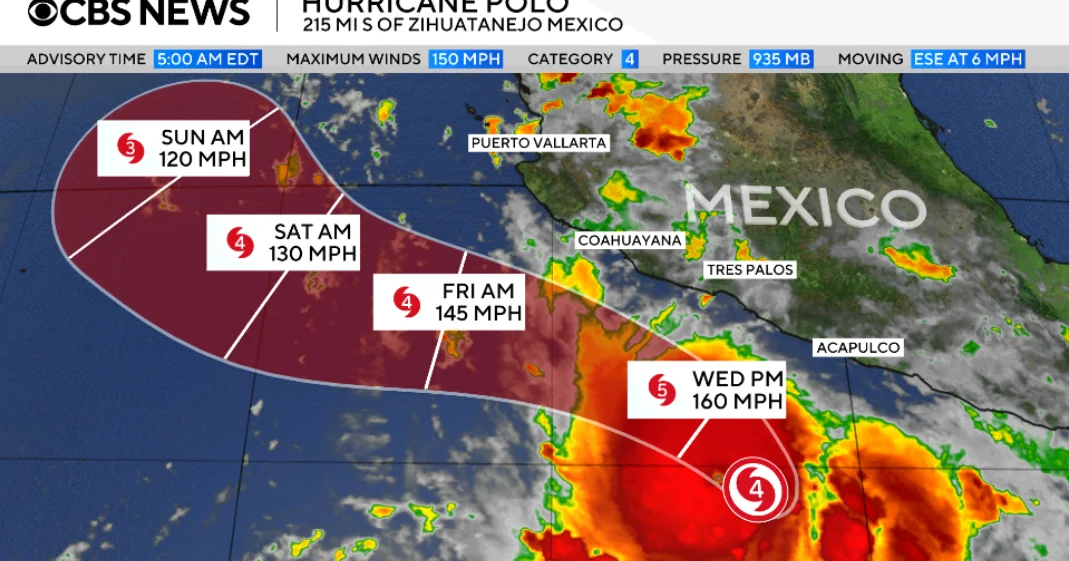
A powerful Category 5 hurricane named Polo rapidly strengthened off the southwestern coast of Mexico, raising alarms about potentially deadly flooding and mudslides in parts of Guerrero and Michoacán. The dramatic intensification of Polo and its volatile path pose serious risks to coastal communities in the region.
What Happened
On Tuesday evening, Hurricane Polo reached Category 5 status with sustained winds of 165 mph, positioned offshore near the resort city of Zihuatanejo in Guerrero and the coastal city of Manzanillo in Colima. According to the U.S. National Hurricane Center (NHC), Polo was nearly stationary after drifting northward along Mexico’s Pacific coastline earlier that day. While the storm’s core remained offshore, it still generated hurricane-force winds extending up to 35 miles from its center.
The Mexican government issued tropical storm warnings for the stretch from Tecpan de Galeana in Guerrero to Punta San Telmo in Michoacán, with a tropical storm watch from Punta San Telmo to Playa Perula in Jalisco. These alerts predict that tropical storm conditions are likely to affect the warned areas beginning early Wednesday, with some extending into Thursday for the watch zones. Polo is forecasted to turn sharply northwest late Tuesday and Wednesday, drawing its core closer to the southwestern coast of Mexico.
Key Facts
Hurricane Polo’s maximum sustained winds reached 165 mph, categorizing it as a Category 5 storm, the highest on the Saffir-Simpson scale. The storm threatens life-threatening flooding and mudslides particularly in steep terrain areas of Guerrero and Michoacán, with rainfall totals estimated between 4 and 8 inches, and some localized spots potentially receiving up to 8 inches through Thursday. Coastal parts of Oaxaca, Colima, and Jalisco may see 2 to 4 inches of rain. Additionally, hazardous surf conditions and rip currents are expected along the southwestern Mexican coast.
The hurricane remains far south of the Baja California peninsula, limiting immediate threats to that region.
What This Means
Hurricane Polo’s rapid escalation to Category 5 highlights the increasing intensity of Pacific hurricane activity impacting Mexico’s vulnerable southwestern coast. The heavy rainfall and strong winds forecasted can cause severe disruptions to local communities, infrastructure, and tourism—key economic sectors in Guerrero and Michoacán. Life-threatening flooding and mudslides pose grave risks particularly to rural and mountainous areas, where access and emergency response may be hampered.
For residents and travelers, the storm’s proximity offshore with its expansive tropical storm-force winds means that even coastal areas not directly in Polo’s path face hazardous conditions. The expected high surf and rip currents threaten lives and complicate maritime activity along the coast. The storm’s uncertain but imminent landward turn increases the urgency of preparations and evacuations where necessary, underscoring the complex challenges posed by major hurricanes near densely inhabited coastal zones.
Background
The National Hurricane Center classified Polo as an “extremely dangerous” storm as it rapidly intensified Tuesday. Hurricanes in the eastern Pacific basin can quickly develop during the active hurricane season, and Mexico’s southwestern coast is frequently in their trajectory. Previous seasons have seen similarly destructive storms threatening heavy rainfall and wind damage, emphasizing the region’s ongoing vulnerability to Pacific hurricanes.
What Comes Next
Forecasters expect Hurricane Polo to maintain very powerful major hurricane status over the next few days, with fluctuations in intensity but no significant weakening forecasted yet. Its path is predicted to track northwestward, bringing the hurricane’s core near the southwestern Mexican coast by midweek. Tropical storm conditions are expected to begin Wednesday morning in affected coastal zones, with vigilance advised through Thursday as heavy rain and dangerous surf continue.
Sources
This article is based on reporting and publicly available information from the following sources:
Read more Climate & Environment stories on Goka World News.