
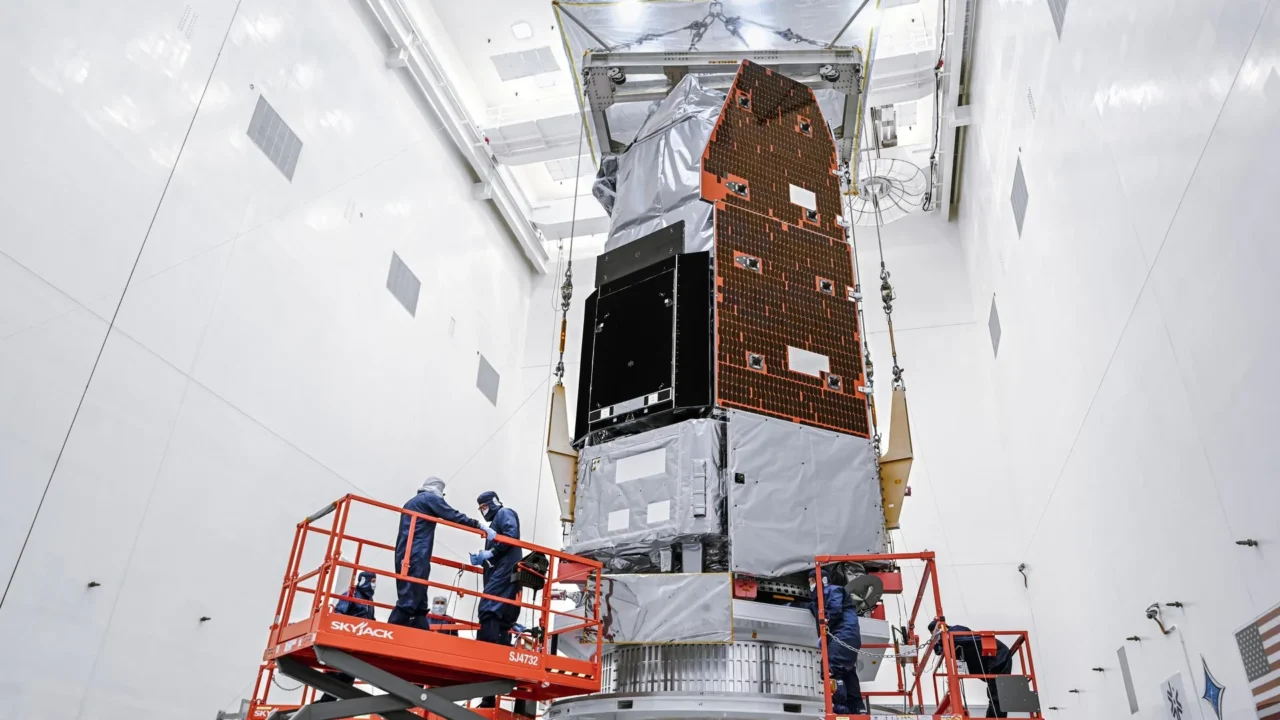
NASA is preparing for the launch of the Nancy Grace Roman Space Telescope with a virtual media briefing set for July 29, 2024. The briefing will offer an overview of the highly anticipated mission, which is scheduled to lift off from NASA’s Kennedy Space Center in Florida on August 30. NASA will stream the event live across multiple platforms, inviting media and the public to engage in this key milestone toward expanding our cosmic understanding.
What Happened
The virtual news conference, scheduled for 2 p.m. EDT on Wednesday, July 29, will outline the Roman Space Telescope mission’s current status and objectives. Participants in the briefing include Shawn Domagal-Goldman, director of the Astrophysics Division at NASA Headquarters; Jackie Townsend, Roman telescope project manager at NASA’s Goddard Space Flight Center; Julie McEnery, Roman telescope senior project scientist; and Jeremy Perkins, integration and test scientist for the mission, also at Goddard.
The Roman Space Telescope, named after NASA’s first chief astronomer Nancy Grace Roman, aims to provide unprecedented panoramic views of the cosmos. The observatory will conduct deep cosmic surveys to detect celestial bodies and phenomena not previously visible, pioneering revelations about the universe’s structure and its hidden components. Its mission includes testing advanced technology designed to directly image exoplanets orbiting nearby stars.
Key Facts
The launch of the Nancy Grace Roman Space Telescope is planned for August 30, 2024, from Florida’s Kennedy Space Center. The mission is managed by NASA’s Goddard Space Flight Center, with contributions from the Jet Propulsion Laboratory (JPL), Caltech/IPAC, the Space Telescope Science Institute, and a consortium of scientists and engineers from various institutions.
The project’s industrial partners include BAE Systems Inc., L3Harris Technologies, and Teledyne Scientific & Imaging. International contributions have come from the European Space Agency (ESA), Japan Aerospace Exploration Agency (JAXA), the French space agency CNES, and Germany’s Max Planck Institute for Astronomy.
What This Means
The Roman Space Telescope represents a transformative step forward in space-based astronomical surveys. Its wide-field imaging capability will allow for an extensive and detailed cosmic census, revealing populations of stars, galaxies, and dark matter distributions with clarity unavailable to previous missions. This will accelerate research into the universe’s expansion, the nature of dark energy and dark matter, and the formation of galaxies and planetary systems.
One of the telescope’s most groundbreaking features is its technology for directly imaging exoplanets. This technology demonstrator is a vital advance toward the long-term goal of identifying Earth-like planets and assessing their potential habitability. For ordinary readers, this mission pushes humanity closer to answering profound questions about our cosmic origins and whether life exists beyond Earth.
The mission’s extensive collaboration with international partners further signifies the global scope and ambition of modern astronomical research, highlighting how space exploration transcends borders to address universal questions.
Background
The Nancy Grace Roman Space Telescope builds upon decades of NASA’s astrophysics missions, following in the legacy of the Hubble Space Telescope by offering a much wider field of view and cutting-edge instruments. It is designed to provide large-scale cosmic surveys efficiently, enabling new types of astronomical observations. The telescope also serves as a pathfinder for future missions aimed at finding and studying planets around other stars.
What Comes Next
Following the July 29 media briefing, the Roman Space Telescope team will focus on final preparations leading up to the August 30 launch. After liftoff, mission controllers will monitor the spacecraft’s complex critical insertion into its orbit and conduct commissioning activities to bring its scientific instruments online and calibrated. The first data returns will mark the beginning of a new era in astrophysical research.
Sources
This article is based on reporting and publicly available information from the following sources:
Read more Space & NASA stories on Goka World News.