
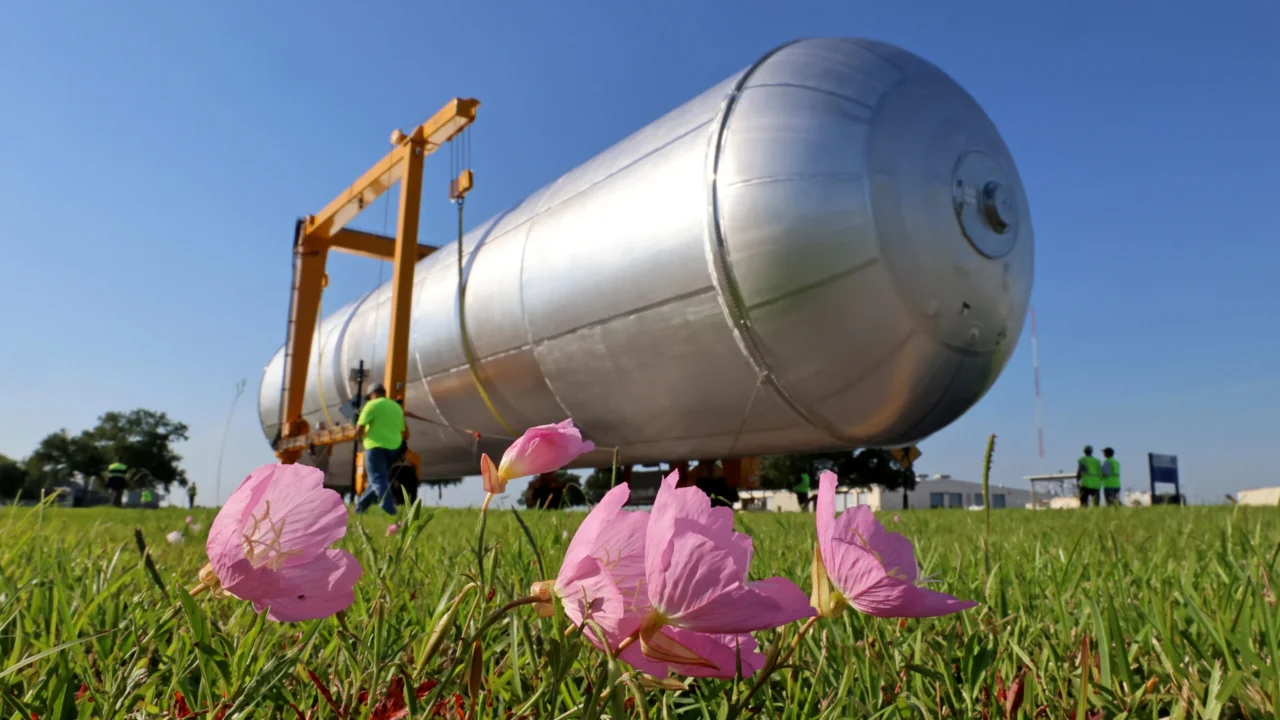
NASA crews at the Michoud Assembly Facility in New Orleans have moved the massive Artemis IV liquid hydrogen tank from its assembly cell to a separate test building on the 829-acre site. This milestone marks a critical phase in preparing the Space Launch System (SLS) rocket’s core stage for future Artemis missions.
What Happened
On May 15, 2026, technicians carefully transported the 130-foot-tall liquid hydrogen tank—destined for the Artemis IV mission—from its production cell inside the main factory building to a detached test facility located elsewhere on the Michoud site. The tank will supply thousands of gallons of super-cooled liquid hydrogen propellant to one of the four RS-25 engines powering the core stage of the SLS rocket. This transfer is part of NASA’s ongoing effort to complete and validate the core stage’s major components ahead of launch preparations.
Key Facts
The liquid hydrogen tank is a central element of the SLS core stage, providing fuel to the highly efficient RS-25 engines. Its height of 130 feet demonstrates the scale of this key rocket element assembled at Michoud, which encompasses 829 acres dedicated to NASA’s heavy-lift rocket hardware. The tank underwent assembly within a dedicated production cell before being moved to a separate test building where it will be inspected and validated further. NASA’s Artemis IV mission will use this core stage as part of their broader effort to return humans to the Moon and beyond.
What This Means
This move is critical in advancing the Artemis IV mission toward launch readiness. The successful transfer of the liquid hydrogen tank signals that the immense structures forming the SLS core stage are progressing through essential integration and testing phases. For the public, this means NASA continues to methodically build the infrastructure required for sustainable lunar exploration, which could eventually lead to establishing a long-term human presence on the Moon. The Artemis program relies on such milestones to ensure that the hardware can meet the rigorous demands of spaceflight, laying the foundation for future crewed missions, including eventual voyages to Mars.
Background
The SLS rocket is NASA’s flagship heavy-lift launch system designed to carry astronauts and cargo beyond low Earth orbit. The core stage, featuring four RS-25 engines, requires two primary propellant tanks—one for liquid oxygen and one for liquid hydrogen. The liquid hydrogen tank, moved here, delivers the super-cold fuel needed to sustain engine operation during launch. The Michoud Assembly Facility has been integral for producing major SLS components since the program’s inception. Prior Artemis missions have similarly relied on parts assembled and tested at this site.
What Comes Next
Following its relocation, the liquid hydrogen tank will undergo detailed testing and outfitting at the test building. This step ensures structural integrity and compatibility with the other core stage components. NASA will continue assembling the full core stage, integrating the liquid oxygen tank and the RS-25 engines. Once complete and verified, the core stage will be transported for full system tests. These ongoing preparations aim to keep the Artemis IV mission on track within NASA’s lunar exploration timeline.
Sources
This article is based on reporting and publicly available information from the following sources:
Read more Space & NASA stories on Goka World News.