
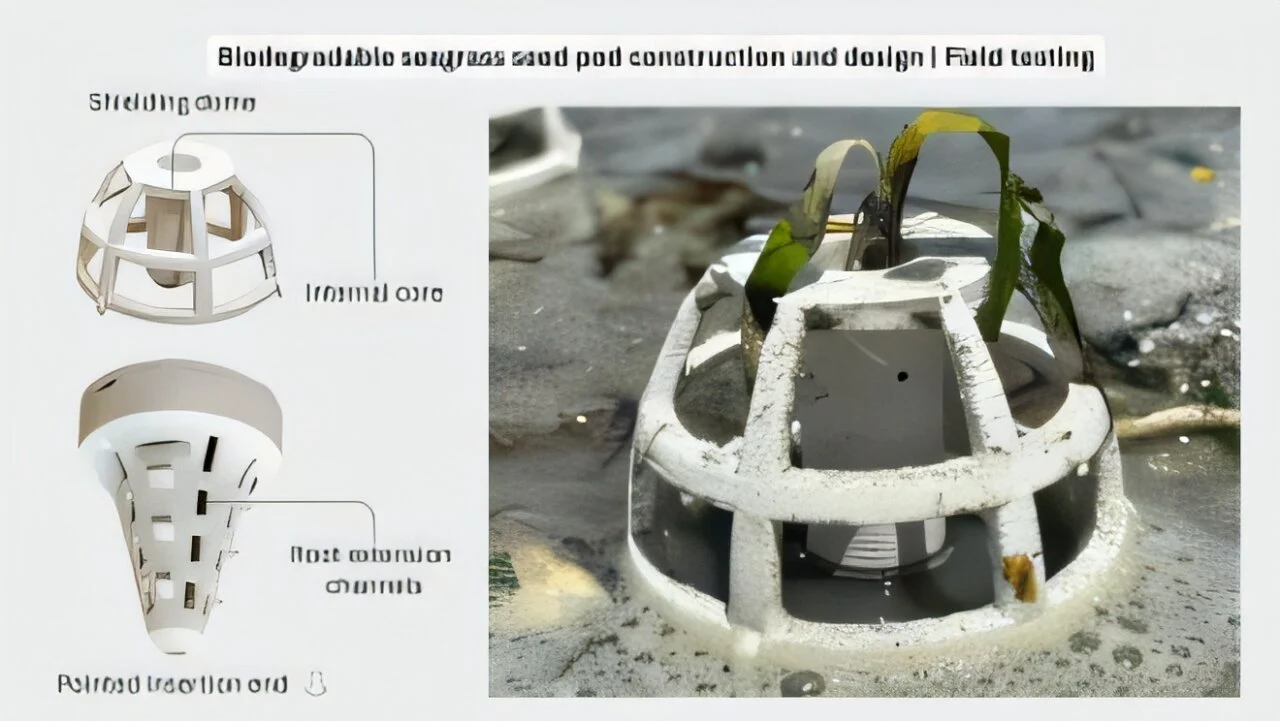
A research team from Murdoch University and Walailak University in Thailand has designed biodegradable 3D-printed pods to aid the restoration of seagrass meadows, a critical habitat for local marine species and coastal communities. This project addresses key challenges in seagrass survival by protecting young plants during their vulnerable early growth stages.
What Happened
The collaborative project targets seagrass meadows around Koh Lidi islands within Mu Ko Phetra National Park, Satun Province, southern Thailand. These meadows serve as nurseries for economically significant marine life such as shrimp, crabs, and fish, and are the main food source for Thailand’s endangered dugong population.
Seagrass restoration has historically been hampered by environmental pressures including wave action, sediment movement, and grazing by marine animals, which prevent young seagrass shoots from establishing roots. To counter this, Walailak University Ph.D. candidates Patsakorn Jeenchuay and Leoniel Jude Giray, guided by Professors Mullica and Krisanadej Jaroensutasinee, partnered with Murdoch University’s Bioplastics Innovation Hub researchers Dr. Alexandra Gulizia and Professor Andrew Macrae to develop 3D-printed pods made from bioplastics.
The pods feature a dome-and-anchor design which encases individual seagrass shoots. The structure’s slots allow root development and protect plants from physical disturbances and grazing until they are self-sufficient. The pods biodegrade naturally after the seagrass establishes itself.
Key Facts
The protective dome is fabricated from polyhydroxyalkanoate (PHA), a bioplastic synthesized through bacterial fermentation using locally sourced microbial strains in Western Australia. The material balances durability to withstand marine conditions with complete biodegradability post-establishment. Production capabilities exist at Murdoch University’s Bioplastics Innovation Hub and Thailand’s Naresuan University Joint Laboratory of Waste and the Circular Economy.
The project remains at the prototype phase, with ongoing safety and packaging tests prior to planned field trials. Leading seagrass expert Professor Jennifer Verduin from Murdoch University is providing expert mentorship throughout the research.
What This Means
This development addresses a critical bottleneck in seagrass restoration by enhancing survival rates of young plants, which have typically faced high mortality due to natural threats and environmental instability. Successfully protecting seagrass transplants could strengthen marine biodiversity by sustaining habitats vital to commercially important fisheries and endangered species such as dugongs.
Beyond ecological benefits, healthier seagrass meadows contribute to coastal protection by stabilizing sediments and potentially mitigating erosion. The biodegradable nature of the pods ensures minimal environmental impact, aligning with sustainability goals in marine conservation.
If field trials confirm the prototypes’ effectiveness, this approach offers a scalable restoration technique potentially adaptable to similar coastal environments throughout Southeast Asia and beyond, where seagrass ecosystems are under threat.
Background
Seagrass meadows are increasingly vulnerable worldwide due to pollution, coastal development, and climate change-related stressors. Previous restoration attempts have struggled because transplanted shoots often fail to root before being dislodged or consumed. Murdoch University researchers bring experience from over two decades of mangrove restoration work in Brazil, applying engineering principles to marine habitat recovery.
What Remains Unclear
The durability and biodegradation timeline of the PHA pods in diverse marine settings remain to be validated through comprehensive field testing. The effectiveness of the pods in improving long-term seagrass survival and ecosystem recovery has yet to be demonstrated at scale. Furthermore, the logistics and costs of large-scale production and deployment in remote coastal regions are not yet determined.
What Comes Next
After completing current safety and packaging assessments, the research team plans to initiate controlled field trials at Koh Lidi. These trials will quantify survival rates of seagrass shoots using the pods compared to traditional transplantation methods. Findings are expected to guide further refinement of pod design and production processes.
Sources
This article is based on reporting and publicly available information from the following sources:
Read more Science & Technology stories on Goka World News.