
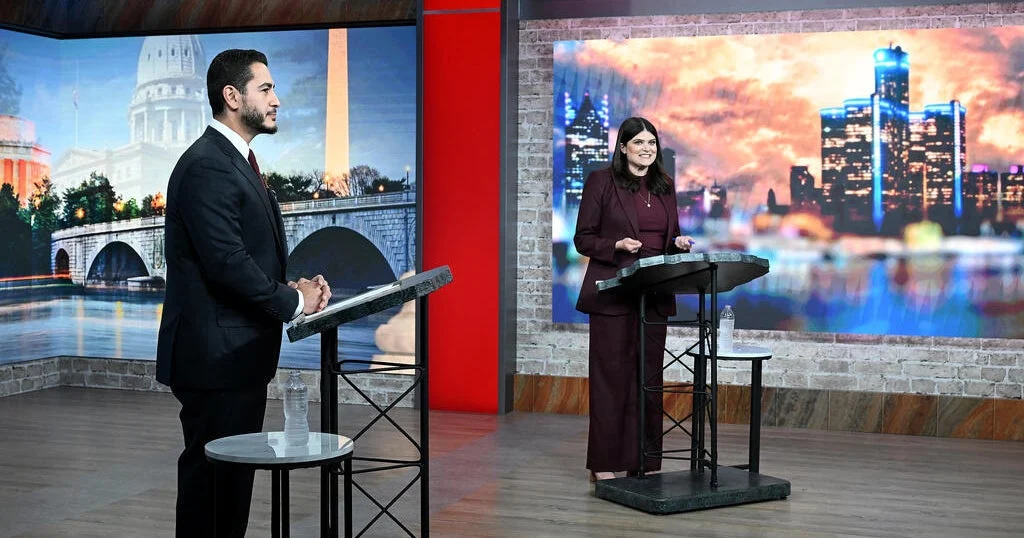
In the final televised debate before Michigan’s crucial Democratic Senate primary on August 4, candidates Haley Stevens and Abdul El-Sayed sharply contested the issue of outside spending, campaign tone, and their respective visions for the party. The debate underscored deeper divisions within the Democratic Party between its moderate and progressive wings as they vie to succeed outgoing Senator Gary Peters.
What Happened
On July 27 in Southfield, Michigan, Rep. Haley Stevens, a moderate known for representing a portion of the Detroit area since 2019, and Dr. Abdul El-Sayed, a progressive former Detroit and Wayne County health official, engaged in a contentious discussion over the influence of external financial backing in their campaigns. El-Sayed criticized Stevens for receiving tens of millions of dollars from super PACs linked to the American Israel Public Affairs Committee (AIPAC), notably questioning her July vote against an amendment to reduce military aid to Israel by $3.3 billion. Stevens defended her position by emphasizing her support for a two-state solution and her criticism of Israeli Prime Minister Benjamin Netanyahu.
Both candidates highlighted the large sums spent by outside groups. Stevens pointed to the “Fighting for Michigan PAC,” which supports El-Sayed and has reportedly received $300,000 from his father-in-law, as evidence that outside spending is a broader issue. Stevens’ campaign and six supporting super PACs have spent over $61 million on ads during the primary, far outpacing El-Sayed’s combined $15.3 million spending from campaign and outside groups.
The debate also touched on electability, with Stevens warning against a progressive approach that she argued might not resonate with Michigan voters. El-Sayed countered by distancing himself from socialist labels and emphasizing his capitalist approach with critiques of monopolies. Both candidates contrasted their endorsements, with El-Sayed backed by progressive stalwarts like Senators Bernie Sanders and Elizabeth Warren, while Stevens counts Democratic Governor Gretchen Whitmer and Senator Peters among her supporters.
Personal attacks surfaced during the debate as well, including discussions about El-Sayed’s past critical comments on prominent figures like Whitmer and Michelle Obama, which Stevens’ side used to question his respectability. El-Sayed denied disrespecting anyone and accused Stevens of benefiting from large-scale outside attack ads. Financial disclosures became a point of contention, with Stevens alleging a lack of transparency from El-Sayed regarding income sources and foreign-held property owned by his spouse.
Key Facts
- Primary election date: August 4, 2026.
- Outgoing senator: Democrat Gary Peters (retiring).
- Super PAC spending in the race: Over $61 million backing Stevens; $15.3 million combined for El-Sayed’s campaign and outsiders.
- Major PACs supporting Stevens: United Democracy Project (AIPAC-linked) spent $19.9 million; “A Stronger Michigan” spent $16.8 million (donors undisclosed).
- Super PAC supporting El-Sayed: Fighting for Michigan PAC spent $2.3 million, including $300,000 from El-Sayed’s father-in-law, Jukaku Tayeb.
- El-Sayed’s endorsements: Sen. Bernie Sanders, Sen. Elizabeth Warren.
- Stevens’ endorsements: Sen. Gary Peters, Gov. Gretchen Whitmer.
- El-Sayed’s financial disclosure: Rental properties in Bangalore and Dubai owned by spouse Sarah Jukaku valued between $100,001 and $250,000 each.
What This Means
This debate highlights the broader national Democratic divide between moderate pragmatists and more progressive challengers often seen in primaries. The dispute over outside spending reveals ongoing frustrations with the role that super PACs and influential lobbying groups play in shaping Senate races and public perception. Michigan voters face a stark choice not only between two policy approaches but also between campaign styles—one that embraces progressive activism and critiques of U.S. foreign policy, and one emphasizing a moderate, pragmatic appeal with establishment support.
The substantial financial advantage for Stevens, driven largely by outside money, underscores the challenges progressives like El-Sayed face in overcoming entrenched party apparatus and interests. At the same time, El-Sayed’s outspoken criticisms of Israel and his policy prescriptions make this primary a litmus test of the party’s ideological direction heading into competitive 2026 midterms.
Voters will also consider the campaign tone and personal integrity concerns raised during the debate, factors that often influence turnout and loyalty in crowded primaries. The intense scrutiny on outside spending and financial disclosures might spur calls for renewed campaign finance reform efforts within the party, a perennial topic during election cycles.
Background
The Michigan Senate seat opened up after Democrat Gary Peters announced his retirement. The contest has drawn national attention as a proxy for intra-party debates over progressivism versus moderation. Efforts to cut military aid to Israel and discussions about U.S. support for the conflict have emerged as flashpoints. Meanwhile, Stevens’ campaign reflects a more traditional Democratic approach with strong establishment backing.
The progressive wing sees El-Sayed as a vehicle for change, endorsed by key figures like Sanders and Warren, contrasting with Stevens’ ties to party moderates and unions. The national Democratic Party leadership has grown concerned about maintaining Senate seats in battleground states like Michigan during the 2026 midterms.
What Comes Next
Michigan voters will decide the Democratic nominee in the August 4 primary. The winner is expected to face Republican former Rep. Mike Rogers, who was recently pictured campaigning alongside former President Donald Trump in Michigan. The general election will test whether the Democrats maintain their four-decade hold on Michigan’s Senate representation amid intensifying ideological and financial battles.
Sources
This article is based on reporting and publicly available information from the following sources:
Read more Politics stories on Goka World News.