
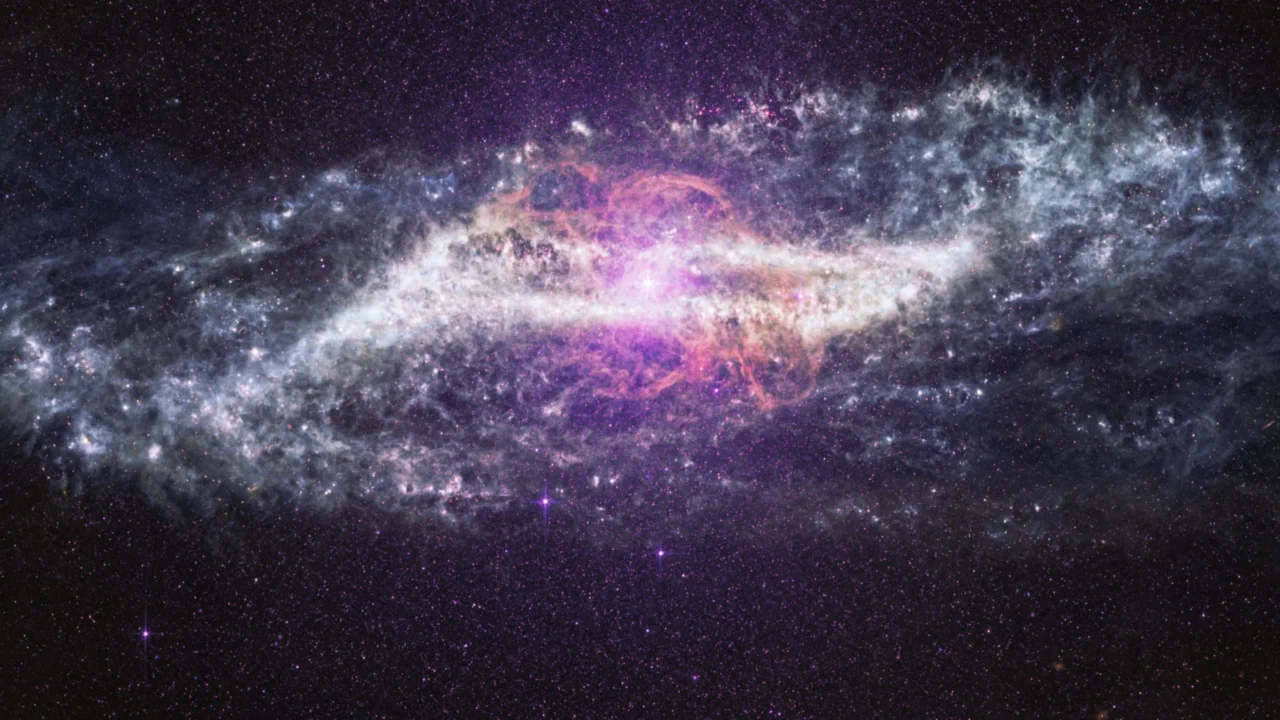
The James Webb Space Telescope (JWST) has captured detailed images of the nearby galaxy Centaurus A, unveiling its complex dusty structures and concealed activity. These observations provide an unprecedented view into one of the most active galaxies close to Earth, helping astronomers study how galaxies and their central black holes evolve together.
What Happened
On July 6, 2026, NASA’s James Webb Space Telescope used its Mid-Infrared Instrument (MIRI) to capture high-resolution images of Centaurus A, a galaxy located about 11 million light-years from Earth. The observations focused on the galaxy’s dusty regions, exposing the hidden dynamics and material shaping its unusual morphology. This nearby but highly active galaxy serves as a natural laboratory for investigating the interplay between galactic structures and black hole activity.
Key Facts
Centaurus A resides approximately 11 million light-years away, making it relatively close in astronomical terms. Its proximity allows JWST’s mid-infrared capabilities to penetrate obscuring dust and reveal inner regions that are otherwise hidden at visible wavelengths. The images were processed by experts at the Space Telescope Science Institute (STScI) and the European Space Agency’s office at STScI, highlighting intricate dust lanes and active galactic features within Centaurus A.
What This Means
This detailed imaging of Centaurus A by JWST significantly advances our understanding of how galaxies with active black holes function. Unlike typical nearby galaxies, Centaurus A displays vigorous activity which can influence its evolution. By studying its dusty environment and internal processes, scientists can better grasp the mechanisms driving black hole growth and their feedback effects on the host galaxy’s formation and development.
For the broader scientific community, these observations help clarify how active galactic nuclei coevolve with their surroundings, bridging knowledge gaps between local and distant galaxies. This has implications for astrophysics at large, including how cosmic structures develop over billions of years.
Background
Centaurus A is a well-known galaxy recognized for its peculiar shape and intense activity, including a supermassive black hole at its center. Prior observations across various wavelengths have hinted at its complex disk of dust and gas, but JWST’s mid-infrared imaging provides clarity by piercing through the obscured regions to study the galaxy’s core activity in greater detail than previously possible.
What Comes Next
Researchers will analyze the collected data to understand the physical processes feeding the black hole and the galaxy’s evolution. Ongoing and future JWST campaigns are expected to complement these findings by examining other active galaxies, expanding knowledge of galactic behavior across cosmic time.
Sources
This article is based on reporting and publicly available information from the following sources:
Read more Space & NASA stories on Goka World News.