
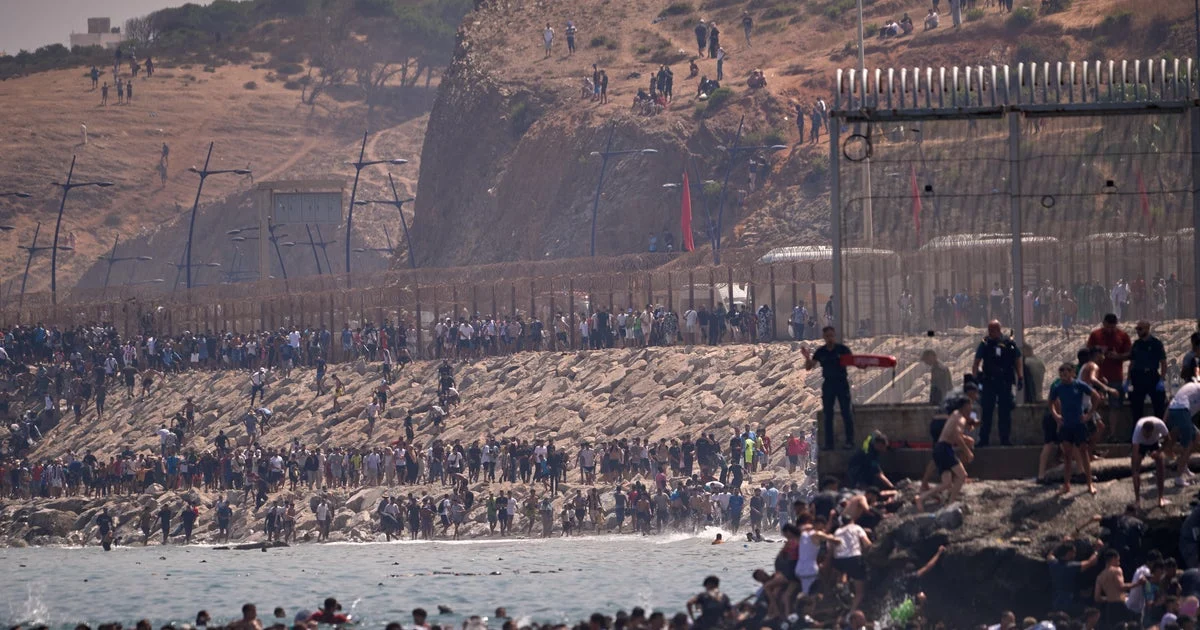
Spain has deployed its military to the border city of Ceuta following a sudden influx of thousands of migrants crossing from neighboring Morocco, a movement that has resulted in at least nine deaths. The Spanish government moved quickly to restore order after local authorities warned that border security had collapsed amid the chaotic crossings.
What Happened
The border city of Ceuta, a Spanish territory located on the northern coast of Africa, experienced a significant surge in migrant arrivals late July 2026. On and before July 30, thousands of migrants—primarily from Morocco—breached the border fence and entered the enclave. Local authorities reported that the situation had become unmanageable, with people crossing in large groups, some swimming across the approximately three-mile stretch from the Moroccan town of Fnideq.
In response to the escalating crisis, the Spanish government announced on July 30 that military forces would be deployed to assist the Civil Guard in maintaining security at the border. Prime Minister Pedro Sánchez joined Interior Minister Fernando Grande-Marlaska to visit Ceuta on July 31 to assess the situation firsthand.
The Spanish Interior Ministry confirmed at least nine migrant deaths during the crossings, with bodies seen floating in the water near the border area. Officials did not provide detailed circumstances of the fatalities but described the scene as chaotic. Further, hundreds of migrants had been arriving in recent weeks, overloading local reception centers and forcing many to sleep outdoors.
Key Facts
- Ceuta is a Spanish enclave on the northern coast of Africa surrounded by Morocco.
- Thousands of migrants crossed into Ceuta around July 29–30, 2026.
- At least nine migrants died during the border crossing attempt.
- Spain deployed its military to assist the Civil Guard in securing the border as local authorities declared the border fence had collapsed.
- Spanish Prime Minister Pedro Sánchez and Interior Minister Fernando Grande-Marlaska visited Ceuta following the surge.
- Migrants crossed primarily from Moroccan towns Fnideq and Belyounech, some swimming roughly 3.1 miles to reach Spanish territory.
- Local authorities in Ceuta requested that Madrid declare a national emergency, which was not granted by the central government.
- Moroccan authorities reportedly cooperated with Spain to control the border but have not publicly commented on the surge.
What This Means
The deployment of Spanish troops to Ceuta underscores the continuing challenges European territories face managing migration amid complex legal, humanitarian, and security concerns. The sheer scale and suddenness of the crossings overwhelmed local authorities and exposed vulnerabilities in border infrastructure that have persisted over years.
This crisis highlights the limitations of local policing and civilian agencies in handling mass migration flows that can fluctuate rapidly due to unseen or unclear triggers. Military involvement signals the severity but also raises questions about how to balance humanitarian needs with border security demands.
For residents and policymakers, this incident renews debates over migration management, legal protections for migrants, and the diplomatic dynamics between Spain and Morocco. The deaths remind observers that perilous attempts to cross borders remain a tragic reality in migration routes, while the inability to declare a national emergency reveals legal constraints in addressing migration-related security threats.
Background
Ceuta has long served as a gateway into Europe for migrants seeking improved economic prospects or safety from violence in Africa. It remains a Spanish possession since 1580, with a mixed population of Christians and Muslims living alongside cross-border workers.
Similar mass border crossings occurred in May 2021, when over 8,000 migrants entered in two days. That event followed a diplomatic dispute between Spain and Morocco linked to Spain hosting the Polisario Front leader for medical treatment.
Recently, Spain’s Supreme Court ruled that migrants arriving by sea cannot be pushed back immediately without due process, unlike those crossing by land, adding complexity to border enforcement policies that might influence migrant behavior.
What Comes Next
Spain’s Interior Ministry stated it would release an updated detailed migration report on August 3, which may clarify the scale of the latest arrivals. Meanwhile, authorities in Ceuta and Madrid continue coordinating security operations while managing humanitarian aid and migrant accommodation challenges.
Diplomatic engagement between Spain and Morocco is ongoing but limited public information has been released. Spain has affirmed its commitment to protecting citizens and maintaining border integrity amid the crisis.
Sources
This article is based on reporting and publicly available information from the following source:
Read more World News stories on Goka World News.