
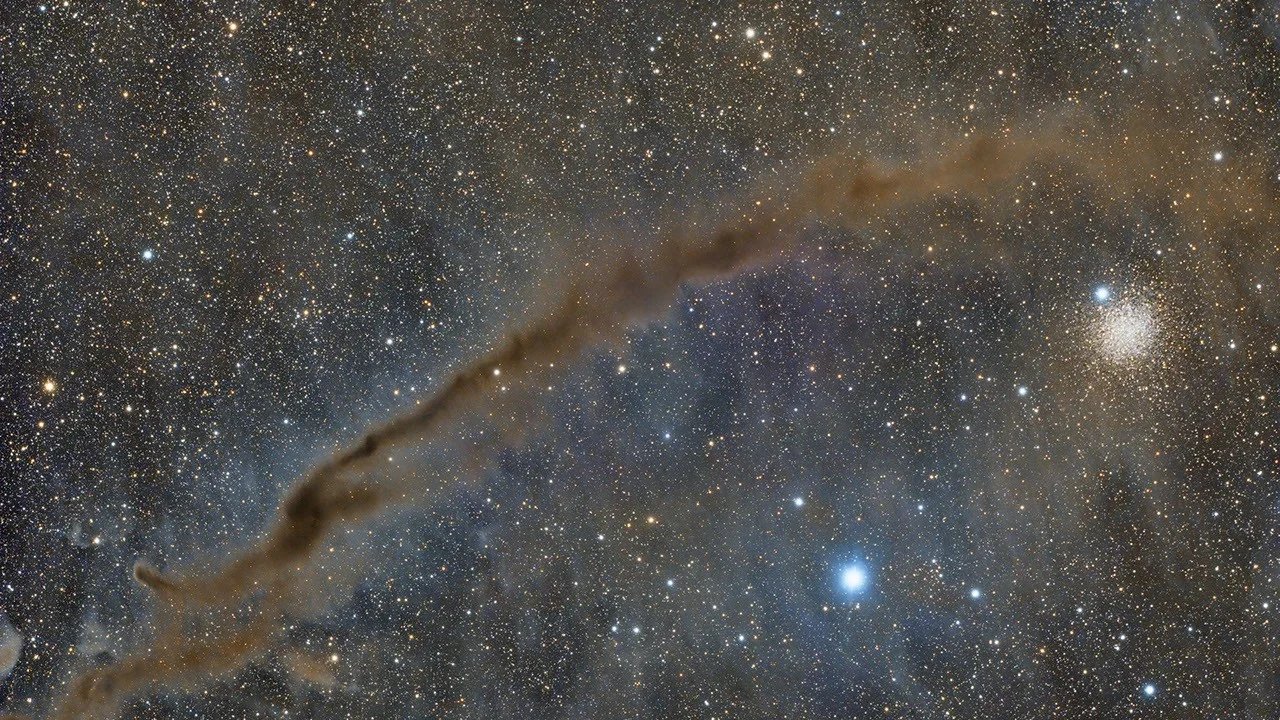
The Dark Doodad Nebula, a striking dusty molecular cloud in the southern sky, is captured in a telescopic image alongside the yellowish globular star cluster NGC 4372. This captivating cosmic pairing showcases two vastly different objects aligned by chance in the direction of the small southern constellation Musca, The Fly.
What Happened
Astrophotographers have imaged the Dark Doodad Nebula stretching about three degrees across a telescopic field toward Musca, just below the bright Southern Cross and near the prominent Coalsack Nebula. The dark cloud, a molecular formation approximately 700 light-years from Earth, forms a silhouette against a dense backdrop of stars. Near its southern tip lies the globular star cluster NGC 4372, seen as a yellowish patch in the same frame. However, NGC 4372 is much farther away—about 20,000 light-years—and part of the Milky Way’s halo. This juxtaposition presents a stunning celestial scene combining a local star-forming cloud with a distant ancient cluster visible in the same line-of-sight.
Key Facts
The Dark Doodad Nebula is roughly 700 light-years distant and extends over 30 light-years in length. It belongs to the Musca molecular cloud complex, known for potential star formation within its dense, dusty gas. The nebula’s distinctive silhouette is visible in southern hemispheric skies and was named “Dark Doodad” in 1986 by astro-imager Dennis di Cicco during observations of Comet Halley in Australia. NGC 4372, visible at the nebula’s southern edge, is a globular star cluster residing about 20,000 light-years from Earth, orbiting within the Milky Way’s halo.
What This Means
This image offers a glimpse into two vastly different scales and stages of cosmic evolution aligned from our vantage point. The Dark Doodad represents a molecular cloud dense with dust and gas, the raw material from which new stars may eventually form. Studying such clouds helps astronomers understand the early conditions that lead to star birth. Meanwhile, NGC 4372 stands as a fossil relic of the Milky Way’s early formation, containing some of the oldest stars orbiting the galaxy. Observations that capture both objects together underscore the layered complexity of our galaxy, where star formation and ancient stellar populations coexist within a single field of view. For enthusiasts and researchers alike, these contrasting features highlight the dynamic processes shaping the cosmos.
Background
The Dark Doodad was first identified and named in 1986 by Dennis di Cicco, an amateur astronomer and astrophotographer who recognized its distinct dark lane while observing Comet Halley’s passage from the Australian outback. It lies near the Coalsack Nebula, one of the most famous dark nebulae visible to the naked eye. Globular cluster NGC 4372 is a well-studied ancient cluster that has been observed by astronomers seeking to better understand the formation and evolution of the Milky Way’s halo population.
What Remains Unclear
While the broad characteristics of the Dark Doodad and NGC 4372 are established, detailed studies of star formation activity within the cloud are ongoing. Astronomers continue to analyze spectroscopic data to confirm whether protostars or other embryonic stellar objects reside within the dusty molecular gas. Likewise, measurements of the cluster’s detailed stellar composition help refine models of galactic evolution but require further observation.
Sources
This article is based on reporting and publicly available information from the following sources:
Read more Space & NASA stories on Goka World News.