
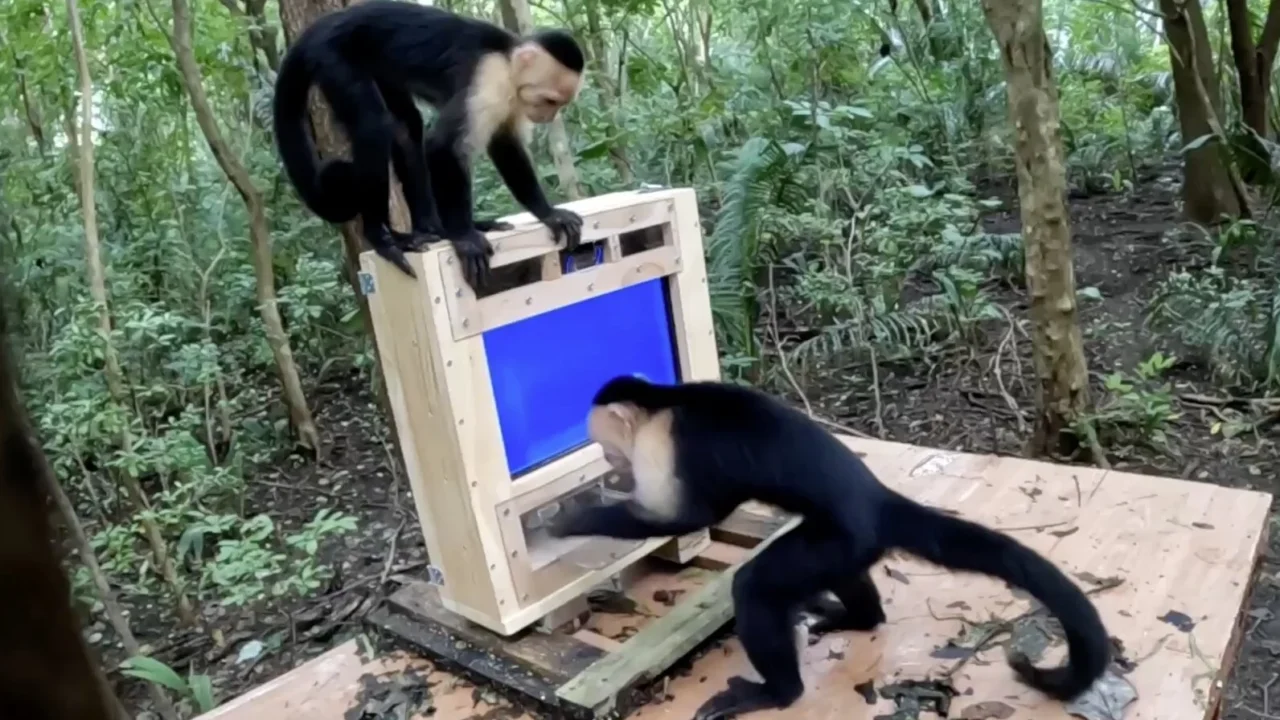
A new artificial intelligence system named CapuchinAI offers a scalable, automated method for studying the cognition of wild capuchin monkeys in their natural habitats. Developed collaboratively by researchers at Emory University and the Georgia Institute of Technology, this system integrates facial recognition technology with touchscreen-based cognitive testing, marking a significant advance in field primatology published in the American Journal of Primatology.
What Happened
CapuchinAI comprises a compact, battery-operated computing platform equipped with a webcam, touchscreen interface, and a food dispenser, housed within a weatherproof enclosure. The system uses AI facial recognition to identify individual capuchins with 97% accuracy based on training from still images and video collected in the Taboga Forest Reserve in Costa Rica. Upon identification, it presents tailored cognitive tasks via the touchscreen and delivers food rewards automatically upon correct responses. Initial field tests demonstrated that wild capuchins rapidly habituated to the platform, learned the touchscreen-reward association, and engaged with tasks, providing data on individual cognitive differences. This marks the first scalable and systematic approach to testing cognition in wild primate populations.
Key Facts
The facial recognition model was developed using the open-source YOLO software, trained on thousands of images and videos featuring six identified capuchin individuals. The system runs on a Raspberry Pi computer, roughly half the size of a smartphone, capable of operating up to eight hours on a single battery charge. The physical platform was constructed using accessible, low-cost materials like pine wood and plastic components with custom 3D-printed parts for the food dispenser. The AI system can differentiate capuchins from other wildlife and limits food rewards per session to prevent dominant individuals from monopolizing access.
What This Means
CapuchinAI bridges a critical gap between highly controlled laboratory studies and ecologically valid field observations by enabling precise measurement of cognitive functions in naturalistic conditions. This advancement allows researchers to study how environmental factors shape cognition in wild animals, an area previously constrained by logistical challenges in the field. The automated approach frees scientists from the labor-intensive demands of traditional cognitive testing, providing continuous and objective data collection on multiple individuals simultaneously. The potential applications extend beyond capuchins, as the methodology and open-source tools developed can be adapted to study diverse primate species and other wildlife, offering new insights into cognitive ecology, evolution, and behavior.
Background
Previous primate cognition research largely relied on captive populations or observational studies in the wild, each with limitations. Laboratory experiments offer experimental control but may lack natural context, while wild observations capture ecological realism but rarely allow direct cognitive assessment. Inspired by the late Frans de Waal’s work emphasizing individual primate personalities in natural settings, this project seeks to enable systematic cognitive testing leveraging AI to overcome these challenges.
Analysis
Marcela Benítez, an Emory assistant professor of anthropology and senior author of the study, highlights the significance of studying cognition in complex, competitive environments where primate brains evolved. Federico Sánchez Vargas, lead author and graduate student, notes that the AI enables “getting into the minds behind the personalities” by quantifying cognition alongside rich life-history data. Georgia Tech’s Jacob Abernethy contributed expertise in computer vision, emphasizing the system’s efficiency and low cost. Their combined interdisciplinary approach exemplifies the integration of anthropology, psychology, biology, and computer science.
What Remains Unclear
The current prototype has been tested with a limited number of individuals in one geographic location, and its performance with larger populations or different species requires further validation. The capacity of the system to present a broader array of cognitive tasks and its long-term reliability in diverse environmental conditions remain areas for continued research.
What Comes Next
The research team is refining CapuchinAI’s facial recognition by expanding its training data with videos from ongoing field tests and is developing cognitive experiments targeting learning, impulse control, cognitive flexibility, and memory domains. By releasing the system’s code and hardware blueprint as open-source, the authors encourage other scientists to adopt and adapt their method to advance comparative cognition studies across wild primates.
Sources
This article is based on reporting and publicly available information from the following sources:
Read more Artificial Intelligence stories on Goka World News.