
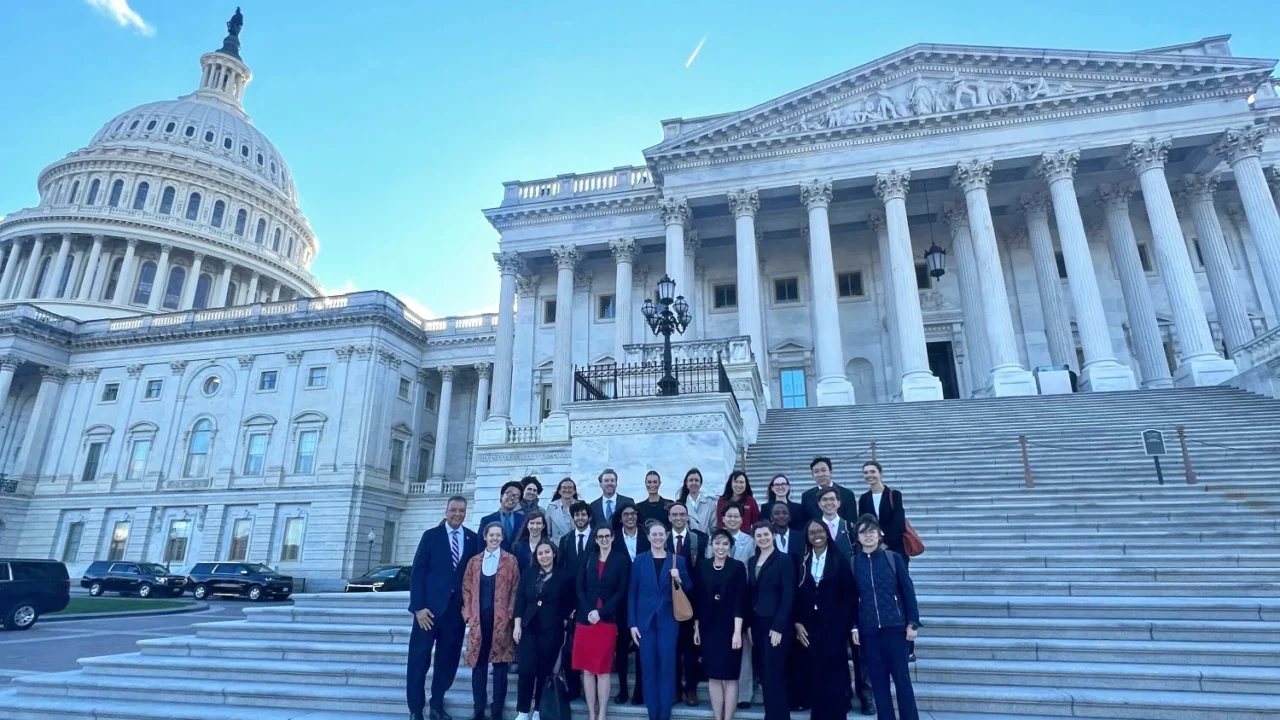
This spring, 25 graduate students and postdoctoral researchers from the Massachusetts Institute of Technology (MIT) traveled to Washington, D.C., to meet with congressional staffers as part of the annual Congressional Visit Days (CVD) program. Their goal was to advocate for sustained federal funding for scientific research and higher education at a time marked by recent budget cuts to National Science Foundation (NSF) programs and uncertainty surrounding the federal research budget.
What Happened
Between March and April 2024, MIT students and postdocs visited 62 congressional offices representing 32 U.S. states during the two-day event. Organized by the MIT Science Policy Initiative (SPI) in collaboration with the MIT Washington Office and the MIT Policy Lab, CVD prepared participants through three training sessions that focused on the federal appropriations process, congressional staff roles, and effective science communication strategies. The visits included discussions advocating for both general science funding and specific policies connected to participants’ research areas, including artificial intelligence, environmental science, energy, space, and health. Congressional staffers showed particular interest in AI privacy and security issues as well as environmental topics such as deep-sea mining impacts.
Key Facts
MIT, a leading research university, hosts the annual Congressional Visit Days through its Science Policy Initiative, which aims to connect scientists with federal policymakers. This year’s delegation included PhD students from civil and environmental engineering, physical oceanography, and other disciplines. The 25 participants met with congressional staff over 62 offices, spanning both majority and minority parties. The event highlighted ongoing concerns about recent NSF budget reductions and emphasized the need for stable federal investment in scientific research and higher education. The program was co-led by Audrey Parker and Ian Robertson, both MIT doctoral candidates. Robertson, affiliated with MIT and Woods Hole Oceanographic Institution, stressed the importance of linking research to concrete policy advocacy during these visits.
What This Means
MIT’s Congressional Visit Days provide a critical bridge between the academic scientific community and federal policymakers, fostering greater understanding and support for science funding at a pivotal moment of budget uncertainty. The engagement of early-career researchers in advocacy prepares them to influence policy informed by scientific evidence, which is increasingly important as disciplines like artificial intelligence and environmental science affect national priorities. For policymakers, meeting firsthand with scientists personalizes the impact of abstract budget decisions, potentially shaping more informed legislative choices. The program also reveals a bipartisan willingness to support science despite broader political polarization, signaling that investment in research remains a unifying issue on Capitol Hill.
Moreover, these visits highlight the growing role scientists may play in policy beyond the laboratory as they communicate their expertise on emergent issues such as AI security and environmental risks related to deep-sea mining. For the scientific community, the initiative underscores the necessity of proactive engagement to secure funding and shape policy directions aligned with research needs. Ultimately, programs like MIT’s CVD nurture a generation of science-trained professionals capable of navigating and influencing complex policy environments.
Background
The MIT Science Policy Initiative has hosted Congressional Visit Days annually to connect graduate students and postdoctoral researchers with the federal policymaking process. These visits are designed to equip scientists with tools to communicate effectively with policymakers and highlight the importance of federal support for research and education. The program builds on MIT’s broader commitment to interfacing research with public policy through its Washington Office and engagement in science advocacy efforts nationwide.
What Comes Next
As the federal budgeting process for FY 2025 progresses, the advocacy efforts from this spring’s CVD underscore the urgency for congressional offices to consider increased or sustained funding for the National Science Foundation and related federal research programs. Future Congressional Visit Days are expected to continue annually, training new cohorts of MIT researchers to participate in the science-policy dialogue and to influence legislative priorities connected to emerging technology and environmental challenges.
Sources
This article is based on reporting and publicly available information from the following sources:
Read more Politics stories on Goka World News.