
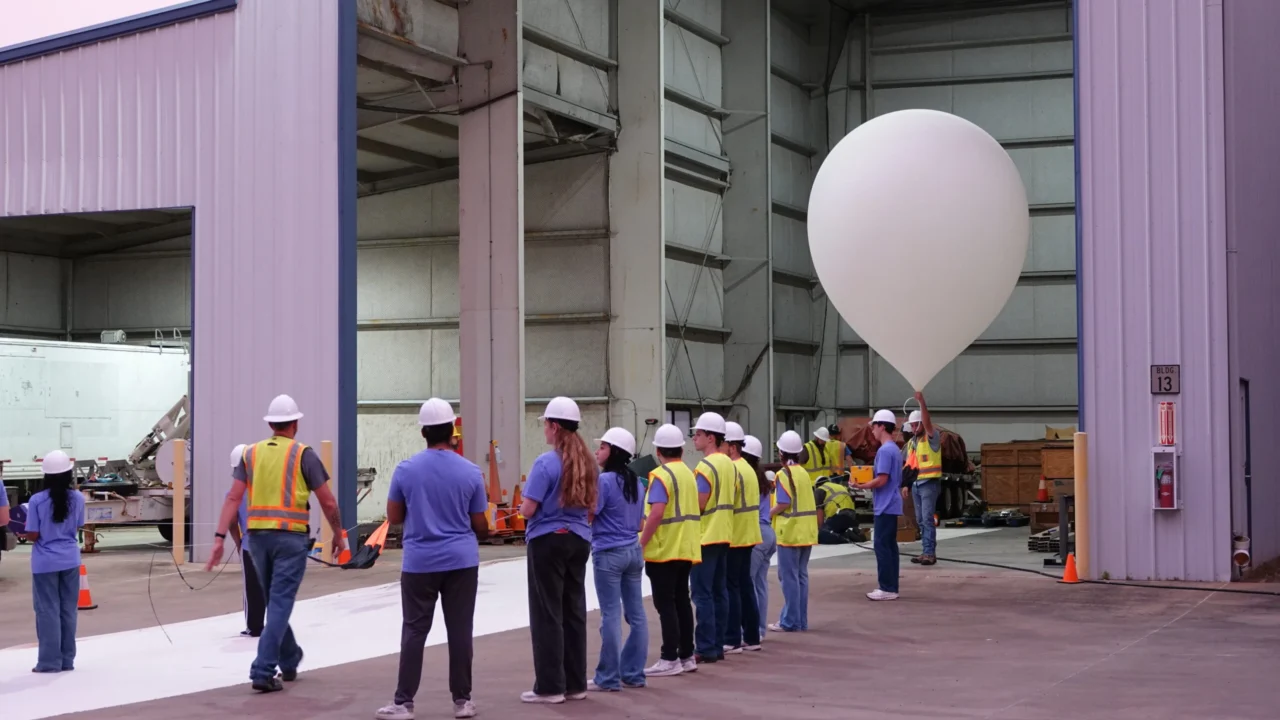
Teams of Louisiana students from multiple universities and a high school successfully launched 11 scientific payloads on NASA balloons from the Columbia Scientific Balloon Facility in Palestine, Texas. The May 19 flights, part of the 2026 Louisiana Aerospace Catalyst Experiences for Students (LaACES) campaign, sent student experiments to near-space altitudes for atmospheric and space science data collection.
What Happened
On May 19, the LaACES campaign conducted its 74th and 75th separate balloon launches, marking a long-standing collaboration between NASA’s Columbia Scientific Balloon Facility and the Louisiana Space Grant Consortium. Nine university teams — including Louisiana State University, Northwestern State, Southeastern Louisiana State, McNeese State, Loyola University, and Southern University — plus a high school team from St. Joseph’s Academy, deployed a total of 11 payloads.
Each payload was designed and built by students over months of preparation and underwent NASA-style technical reviews for flight readiness. The balloons, capable of carrying 7- to 9-pound payloads, lifted their instruments to the stratosphere, reaching near-space heights. Ground teams at the balloon facility provided helium fills, weather updates, launch support, and flight monitoring. Both balloons completed their flights successfully, with payloads recovered approximately 60 miles north of the launch site near Ben Wheeler, Texas.
Key Facts
The student experiments covered diverse scientific objectives, including atmospheric science, cosmic ray detection, thermal management, ultraviolet light characterization, stratospheric wind analysis, and solar cell performance. The flight operations were overseen by program directors Doug Granger and Aaron Ryan. After payload recovery, students analyzed retrieved data and presented findings to engineers, faculty mentors, and peers.
Since its inception, LaACES has facilitated over 60 balloon launches and approximately 135 unique student payloads, supporting more than 500 students from 13 Louisiana higher-education institutions. The program is funded by NASA’s National Space Grant College and Fellowship program and administered through the Louisiana Space Grant Consortium.
What This Means
The 2026 LaACES balloon flights offer students invaluable hands-on experience simulating real NASA scientific balloon missions, bridging academic study with authentic aerospace operations. These experiences not only cultivate practical skills in experiment design, engineering, and data analysis but also expose students to the complexities of mission planning and execution.
By engaging directly with near-space research activities, participants gain insights into atmospheric and space science that can inspire future careers in NASA, academia, or aerospace industries. The program’s ongoing success demonstrates how partnerships between NASA and educational institutions can effectively nurture the next generation of scientists and engineers while advancing scientific discovery.
Moreover, flights reaching the stratosphere yield critical data relevant to understanding Earth’s upper atmosphere and cosmic phenomena, contributing to broader scientific knowledge. This program’s model, integrating student-built payloads within professional NASA balloon operations, exemplifies how education and research can synergize effectively.
Background
NASA’s Columbia Scientific Balloon Facility supports large scientific balloon launches that carry advanced instruments for research in astrophysics, atmospheric science, planetary studies, and technology demonstrations. Unlike conventional weather balloons, these balloons reach altitudes near the edge of space, making measurements unattainable by aircraft or ground stations.
LaACES is a statewide initiative that has worked since its establishment to engage Louisiana students in scientific ballooning, providing a platform for applied learning and contributing to NASA’s broader Scientific Balloon Program.
What Comes Next
Following recovery and data analysis, student teams will continue refining their results and sharing outcomes with the NASA community and educators. LaACES remains active in preparing for future campaigns, aiming to sustain and expand student participation and continue its role in STEM workforce development.
Sources
This article is based on reporting and publicly available information from the following sources:
Read more Space & NASA stories on Goka World News.