
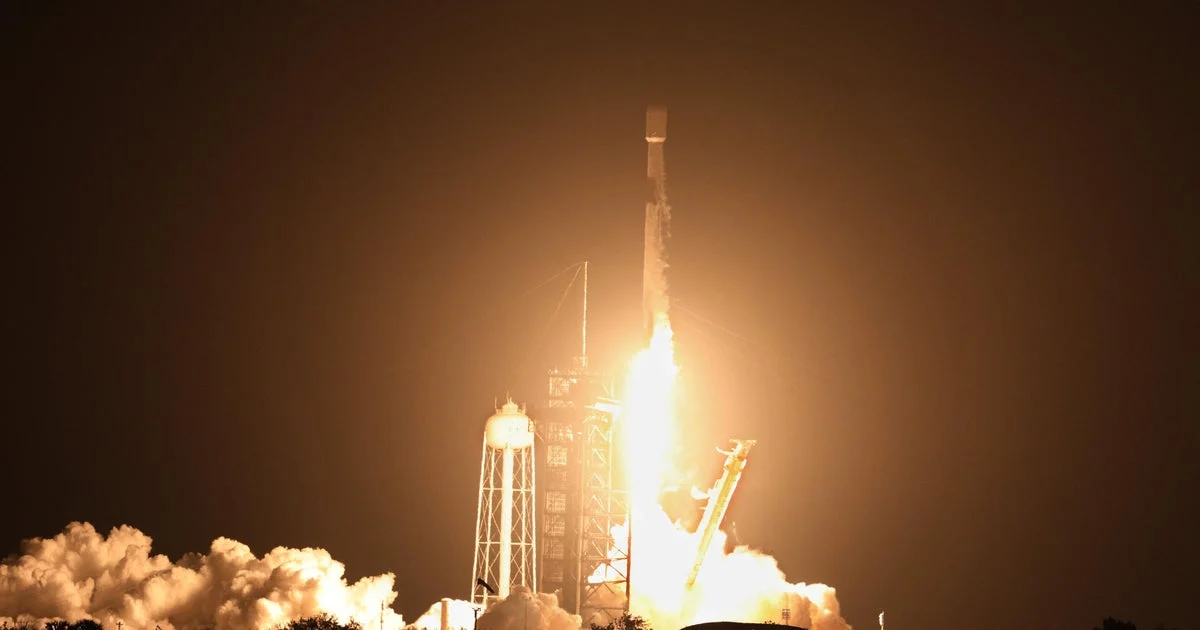
NASA confirmed that a discarded SpaceX Falcon 9 rocket booster is on a collision course with the moon and is expected to impact the lunar surface early Wednesday morning, creating a substantial crater. The event marks a rare case of a human-made object striking the moon.
What Happened
The abandoned second stage of a SpaceX Falcon 9 rocket, which launched two lunar landers in January 2025, has remained in orbit until this week. According to NASA and SpaceX officials, the 8,800-pound booster will collide with the moon at approximately 2:35 a.m. Eastern Time on August 5, 2026, near the Einstein and Bell craters. The impact velocity is projected to be about 5,400 miles per hour.
Originally, this rocket stage propelled Firefly Aerospace’s Blue Ghost-1 and Japan’s ispace Hakuto-R landers toward the lunar surface. While Blue Ghost-1 successfully landed, the Hakuto-R probe crash-landed. Following booster separation from the landers, solar activity and gravitational forces altered its trajectory, leading to its eventual lunar impact.
Key Facts
The Falcon 9 upper stage is roughly 45 feet long and 12 feet in diameter. NASA’s Jet Propulsion Laboratory’s Center for Near Earth Object Studies confirmed the booster has a 100% chance of impacting the moon.
The impact will release energy equivalent to about 2.8 tons of TNT and is expected to form a crater approximately 60 feet wide and 12 to 16 feet deep. It will eject lunar dust and rock outward from the site. Despite the size, the collision will be difficult or impossible to observe directly from Earth, even with powerful telescopes, because it will occur on the sunlit side of the moon.
The Lunar Reconnaissance Orbiter, a NASA satellite orbiting the moon, plans to capture before-and-after images of the impact site, though these will require one to two weeks to process and become publicly available.
What This Means
This incident provides a unique opportunity for lunar scientists to study impact processes on the moon’s surface in real time, especially how ejecta plumes behave in the lunar environment. Understanding such impact events helps refine geological models of the moon, which is critical for planning future exploration missions and potential lunar bases.
Though artificial impacts on the moon are rare compared to natural meteoroid strikes, they offer controlled data points to evaluate lunar geology and surface composition. For instance, analyzing the plume of dust and possibly vapor released could offer insights into the distribution of water ice or other volatiles beneath the moon’s surface, notably in regions not extensively studied before.
NASA’s continued observation and analysis of this event will also advance techniques for tracking orbital debris and understanding the complex dynamics between solar activity, gravity, and space objects—an important consideration as space traffic continues to increase.
Background
This is not the first human-made object to hit the moon. The Soviet Union conducted intentional lunar collisions in 1959, while NASA’s Apollo missions left behind hardware that impacted the surface between 1969 and 1972. A 2009 NASA mission deliberately crashed a rocket stage into a permanently shadowed crater at the lunar south pole, confirming the presence of water ice—one of the key incentives for nations planning moon bases.
The current SpaceX booster impact echoes past events by potentially lofting material that has been undisturbed for millions of years, thereby enhancing scientific understanding of the lunar environment.
What Comes Next
NASA scientists are preparing to collect and analyze data from the impact, including images from the Lunar Reconnaissance Orbiter. Follow-up observations by astronomers worldwide, including those using large telescopes, aim to monitor dust and vapor plumes. The findings are expected to contribute to ongoing lunar research and support future manned and unmanned missions.
Sources
This article is based on reporting and publicly available information from the following source:
Read more Space & NASA stories on Goka World News.