
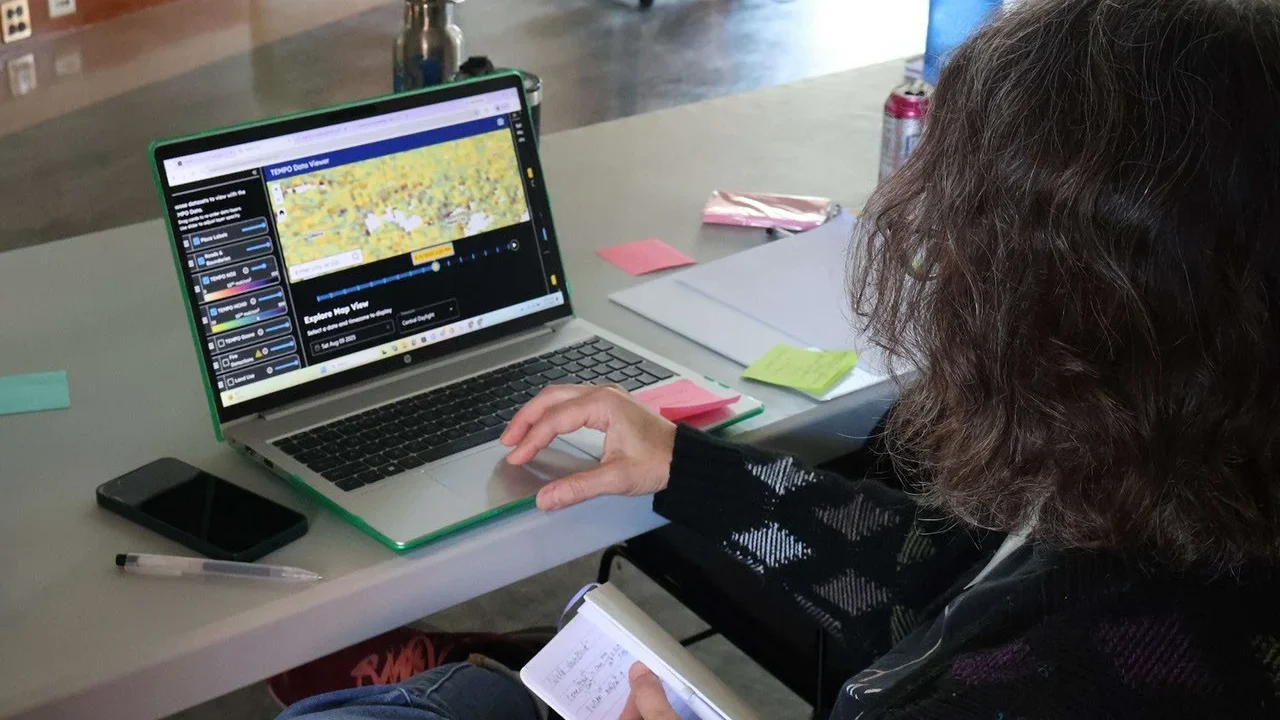
NASA’s TEMPO (Tropospheric Emissions: Monitoring of Pollution) mission data is now playing a pivotal role in education, as educators harness the satellite’s hourly pollution measurements to empower teens investigating local air quality. The NASA Science Activation Program’s Cosmic Storytelling with NASA Data (CosmicDS) project recently partnered with the Smithsonian Institution’s BEST AQI (Breathing Easier: Supporting Teen Air Quality Investigations) initiative, equipping educators with tools and curriculum to translate authentic NASA science into actionable community research.
What Happened
From July 27 to July 29, 2026, thirteen formal and informal educators gathered at the Center for Astrophysics | Harvard & Smithsonian (CfA) in Cambridge, Massachusetts, for the BEST AQI Leadership Institute. Led by Harvard’s CosmicDS team, the Institute introduced participants to TEMPO-Lab, an online platform designed to explore near-real-time air pollution data collected by NASA’s TEMPO satellite. The satellite captures hourly daytime measurements of air pollutants across North America from geostationary orbit, providing an unprecedented data stream for air quality monitoring.
Throughout the three-day workshop, educators used TEMPO-Lab to develop case studies involving scenarios like wildfire smoke, traffic emissions, power plant outputs, and agricultural pollutants. These would form the backbone of their curriculum to guide teens in examining and understanding air quality challenges in their communities. A highlight occurred when TEMPO scientist Heesung Chong announced a beta release of ground-level ozone data, which was integrated into the TEMPO-Lab tool overnight by software developer John Lewis, allowing educators immediate access to the latest scientific information.
Key Facts
NASA’s TEMPO mission monitors pollution with near-hourly temporal resolution during daylight hours from geostationary orbit, focusing on North America. TEMPO-Lab, funded by NASA’s Science Activation Program, provides free access to this data in an educational format. The BEST AQI Leadership Institute brought together 13 educators, who intend to share these resources with approximately 100 additional educators in South Dakota, Maryland, and New York, potentially impacting thousands of teen researchers. The integration of new ozone data into TEMPO-Lab within a day exemplifies the tool’s real-time adaptability to NASA’s evolving science.
What This Means
This initiative represents a significant step in linking advanced satellite science with grassroots community engagement and education. By providing teens with authentic NASA data to explore pollution in their own neighborhoods, the program fosters critical data literacy skills and empowers youth to make evidence-based decisions related to environmental health. This hands-on approach not only enhances STEM learning but also cultivates informed citizenship, encouraging young people to understand and address air quality issues that directly affect their wellbeing.
Moreover, the ability of TEMPO-Lab to rapidly incorporate the latest scientific data underscores a shifting paradigm where educational tools can keep pace with active NASA missions. This responsiveness ensures learners work with the most current observations, bridging the gap between complex space-based measurements and real-world application. Such engagement could inspire future careers in science and technology while supporting community-driven environmental health improvements.
Background
The TEMPO mission, launched to monitor atmospheric pollution across North America, offers hourly daytime measurements from a geostationary orbit, capturing pollutants such as ozone, nitrogen dioxide, and aerosols. The NASA Science Activation Program supports initiatives like CosmicDS to integrate NASA data into education, enabling learners to conduct meaningful investigations using real spacecraft data. BEST AQI is a Smithsonian-led effort guiding teens in air quality research aimed at fostering actionable insights in their own communities.
What Comes Next
The CosmicDS team will continue to support educators as they roll out the BEST AQI curriculum and TEMPO-Lab tool to a broader network of schools and informal learning sites. This expansion across multiple states will broaden hands-on air quality investigation opportunities for teens, deepening their engagement with NASA science while generating locally relevant air pollution insights. Continued development of TEMPO-Lab is expected to keep pace with new data products from the TEMPO mission, enriching future educational experiences.
Sources
This article is based on reporting and publicly available information from the following sources:
Read more Space & NASA stories on Goka World News.